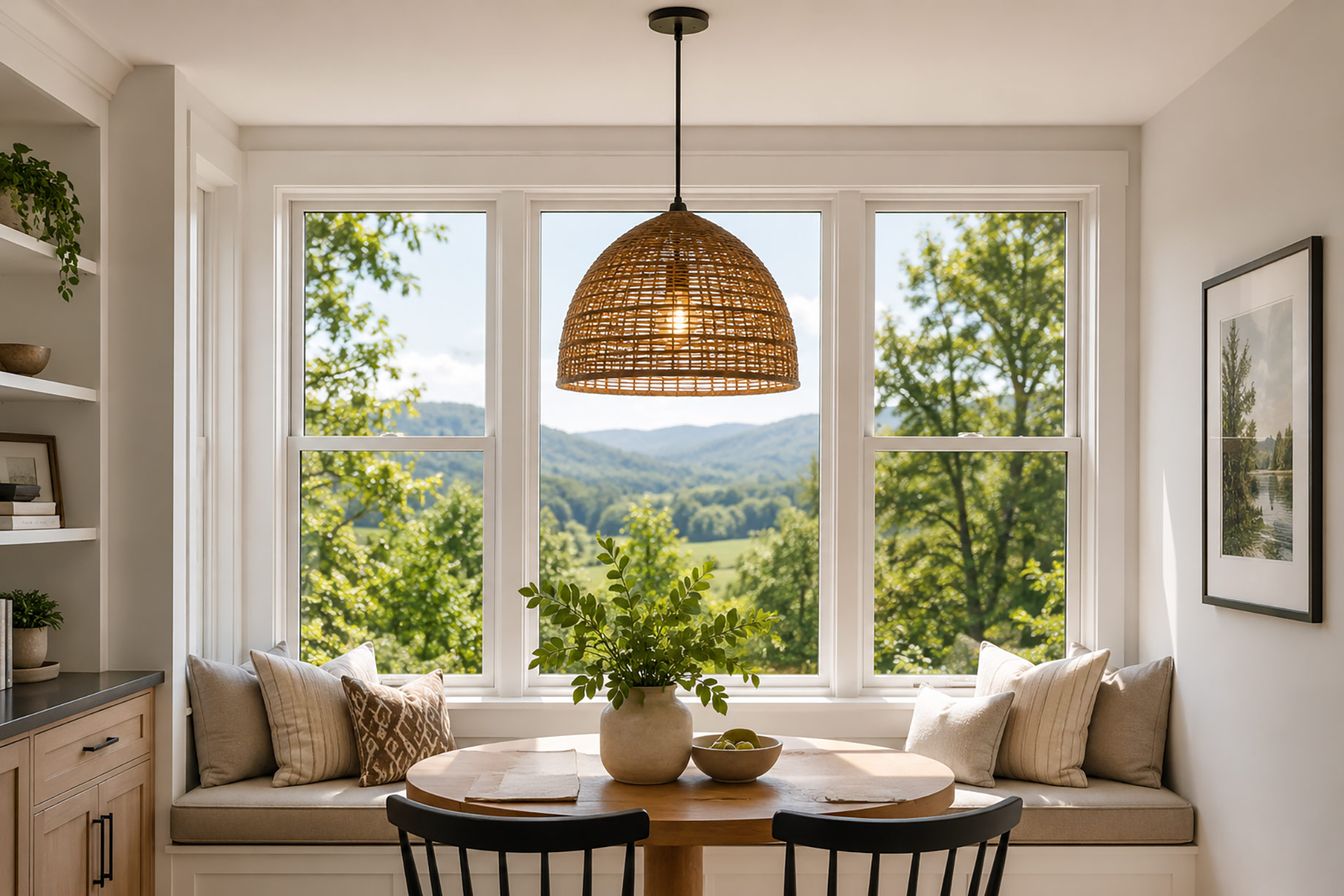
A pendant can look perfect on a product page and still feel completely wrong once it is installed in front of a window.
The problem is usually not the fixture itself. It is what the fixture interrupts.
Near a window, lighting has to balance four things at once: daylight, the view outside, task lighting, and fixture scale. A pendant that works beautifully over a kitchen island may feel intrusive over a sink window. A fixture that looks small in a showroom may suddenly block half the view from a window seat.
The window should still be the window.
That is why the best lighting choice near glass is sometimes a pendant, and sometimes it is not. If the ceiling is low, the window is narrow, or the view is the main feature, browsing a Rattan flush mount can help homeowners compare lower-profile options before committing to a hanging fixture. A close-to-ceiling light keeps the visual field cleaner while still adding a finished layer to the room.
The goal of this guide is to help you work out the right position, size, and hanging height before permanent installation. That way, you can make a better decision before the electrician arrives, whether the final answer is a pendant, a smaller fixture, or a flush mount that lets the view stay open.
Start With the Sightline, Not the Ceiling
One of the most common mistakes is to start with the junction box.
There is a ceiling box, so the assumption is that the pendant should simply hang from it. That works in some rooms. Near a window, it can be the wrong starting point.
Instead, ask a more useful question:
Where will the person using this space stand or sit, and what are they trying to see through the window?
That answer changes the lighting position more than the ceiling does.
At a kitchen sink
If the sink is centered under a window, the person using it will usually be standing directly in front of the glass. A pendant hanging through the middle of that sightline can become annoying very quickly, even if it looks perfectly centered from across the kitchen.
The fixture should provide useful light over the sink area without sitting directly in the most important part of the view.
At a window seat
A window seat changes the eye level because the user is seated rather than standing.
That gives you more flexibility to lower a pendant, but not unlimited freedom. The fixture still needs to stay out of the seated sightline and far enough away that someone can stand up comfortably.
At a dining table beside a window
Here, the fixture should relate primarily to the table rather than the window.
If the table is offset from the window, forcing the pendant to align with the window can make the whole composition feel slightly wrong. Let the table establish the lighting center, then adjust the hanging height so the fixture does not dominate the glass behind it.
Ceiling height tells you what is possible. Eye level tells you what will feel comfortable.
How High Should a Pendant Hang Near a Window?
There is no single height that works for every window because the activity below the fixture matters just as much as the ceiling height.
Use the following numbers as starting points, then adjust for shade size, sightlines, and the people using the room.
Over a kitchen sink with a window
A useful starting range is roughly 30 to 40 inches above the countertop.
But the number is secondary to the view.
If the bottom of the shade sits across the middle of the window when you stand at the sink, raise it. A slightly higher pendant that keeps the view open will usually feel better than a technically “correct” fixture sitting right in front of your face.
Also consider shade depth. A shallow 14-inch pendant may interrupt the view less than a deep dome of the same diameter.
Over a table next to a window
For dining tables, around 30 to 36 inches above the tabletop is a practical starting point.
Because people are seated and the table prevents anyone from walking directly below the fixture, the pendant can sit lower than it would in an open circulation area.
If the shade is broad and opaque, however, raise it enough to keep conversation sightlines comfortable.
In an open walking area near a window
If people can walk underneath the fixture, aim for roughly 7 feet of floor clearance.
This is especially important near patio doors, bay windows, or transitional areas where a pendant might otherwise drift into the walking path.
Over a window seat
This is the scenario where a fixed number is least useful.
Start with the finished seat, including the cushion. Sit down naturally. Look straight ahead. Then stand up from the bench.
The pendant should sit above the main seated sightline and far enough away that standing up does not feel awkward.
A simple mock-up works better here than a formula. Use string, painter’s tape, or a cardboard circle to mark the proposed diameter and lowest point before installation.
Match the Fixture to the Window Width, but Not Too Literally
Window width is useful context, but it should not be the only sizing reference.
Take a window around one meter wide, or roughly 39 inches.
If a pendant hangs directly in front of or close to that window, a fixture around 12 to 18 inches wide is often a reasonable place to begin. It has enough presence to look intentional without immediately covering a large amount of glass.
For a larger nook, vaulted ceiling, or wide built-in bench, a fixture in the 18- to 24-inch range may work better.
But there is a more important rule:
Do not size the pendant only from the window. Size it from the object or activity underneath it.
A 39-inch window above a 30-inch kitchen sink creates a very different scale problem from a 39-inch window behind a 72-inch window bench.
In the first case, the sink and task zone matter more. In the second, the bench and surrounding wall area may support a larger fixture.
This is why simple formulas such as “make the pendant one-third of the window width” can be misleading. They ignore the furniture, ceiling volume, and sightlines around the glass.
Remember That the Fixture Looks Different in Daylight
Lighting near windows has a strange double life.
During the day, the pendant is mostly an object.
You see its shape, material, and silhouette against daylight. If the fixture is dark, solid, or oversized, it can feel heavier than it did in the showroom because the bright window creates strong contrast behind it.
At night, the same fixture becomes a light source. Now you are dealing with glow, glare, shadows, and reflections in the glass.
This is why it is worth evaluating a pendant in both conditions.
Watch for reflections
Large windows can act almost like mirrors after dark.
An exposed bulb may reflect back into the room, creating a second bright point in the glass. If the pendant sits near eye level, this can become distracting.
A shaded bulb, diffuser, or dimmer can help.
Look at the silhouette during the day
If the window is an important architectural feature or looks onto a garden, the fixture should not become the dominant shape in front of it.
Open-frame and woven fixtures often feel visually lighter because the eye can still read some of the window through or around them.
This is one reason natural materials such as rattan can work well near windows. The texture is visible, but the fixture does not necessarily read as a heavy solid block.
Window-Seat Lighting Needs a Different Rule
A window seat is not a hallway, so applying the same clearance rule makes little sense.
No one is normally walking beneath the pendant. That means the fixture can often hang lower and feel more intimate.
But a lower pendant introduces a different set of questions:
- How tall is the finished cushion?
- Where is an adult’s head when seated?
- Will someone read or work there?
- Does the fixture project outward as well as downward?
- Can someone stand up without leaning away from the shade?
The best test is surprisingly low-tech.
Cut a cardboard circle roughly matching the pendant diameter, suspend it with string at the planned height, and sit down.
Then stand up.
Look through the window from the seat. Lean back against the cushion. Imagine reading there. If the cardboard constantly enters your field of view or feels too close when you stand, the real fixture will probably feel the same way.
A balloon also works if you need a quick three-dimensional mock-up.
This five-minute test is usually more useful than another online sizing chart.
Kitchen Sink Windows Need Task Light Without Visual Clutter
A sink window creates one of the trickiest lighting situations because the window and the work surface occupy almost the same visual zone.
You need enough light to wash dishes, prep food, or use the sink at night, but you probably do not want a large fixture floating in the center of the glass all day.
There are several ways to handle this.
- Choose a smaller pendant and hang it slightly higher.
- Use a shallow shade rather than a deep dome.
- Shift the task lighting to recessed or directional fixtures above.
- Use wall-mounted lighting beside the window if the architecture allows it.
- Consider a low-profile ceiling fixture when preserving the window view matters more than having a hanging pendant.
That last option is often overlooked. If the window is already the strongest feature in the space, there is no requirement that the light also become a focal point.
Sometimes a Flush Mount Is the Better Decision
There are rooms where the right pendant height still feels wrong.
Maybe the ceiling is low. Maybe the window is tall. Maybe the fixture keeps appearing in the sightline no matter where you hang it.
In those situations, changing fixture type can solve the problem more cleanly than trying to force a pendant to work.
A Flush mount collection can be useful to compare when you want decorative ceiling lighting but need to keep the area in front of the window visually open.
The trade-off is obvious: you lose the suspended shape of a pendant, but you gain clearance and a cleaner window view.
This can work especially well above a sink, beside a tall window, or in a small breakfast nook where a hanging fixture would make the ceiling feel crowded.
Woven Fixtures Can Add Texture Without Feeling Visually Heavy
When a pendant does make sense near a window, material matters almost as much as size.
A solid metal dome blocks more of the view than an open woven shade of the same diameter. Clear glass preserves visibility, but it can create more glare and reflection at night. Rattan and other woven materials sit somewhere in between.
They add texture and visible form while still allowing some visual movement through the weave.
This is where Rowabi’s approach to natural-material lighting can be relevant as an example rather than as a rule. The brand works with rattan and woven forms that can feel softer against windows and daylight than more visually dense fixtures.
That does not mean a woven pendant is always the correct choice. A dense weave can still block a significant amount of glass, especially if the fixture is oversized.
If you like the texture but do not want anything hanging into the view, a rattan flush mount can provide a similar natural-material layer closer to the ceiling.
The useful distinction is not simply pendant versus flush mount. It is how much visual space the fixture occupies between you and the window.
Check the View From More Than One Position
A lighting layout can look perfect from the middle of the room and awkward from the place where you actually spend time.
Before installation, check the proposed fixture from:
- the main room entrance;
- the kitchen sink;
- the nearest seated position;
- the adjacent room in an open-plan layout;
- outside looking back through the window, if the fixture will be visible from the exterior.
This last view is easy to forget.
At night, a pendant close to a large window may become part of the home’s exterior appearance because the illuminated fixture is visible through the glass.
That is not necessarily a problem. It simply means the fixture is doing more visual work than you may have expected.
Let the Window Stay the Main Event
Good lighting near a window should support the space without making you constantly notice where the fixture is hanging.
Start with the sightline. Then check the activity underneath, the fixture size, the window proportion, and the available clearance.
Use height guidelines as starting points, not rules. A pendant over a table can sit lower than one over a walkway. A window seat should be tested from the seated position. A kitchen sink fixture should move up if it blocks the middle of the view.
And if the pendant still feels like it is competing with the glass, change the fixture rather than forcing the placement.
The best result is usually the one where you notice the light when you need it, notice the texture when you look around the room, and still look straight through the window without thinking about either one.
