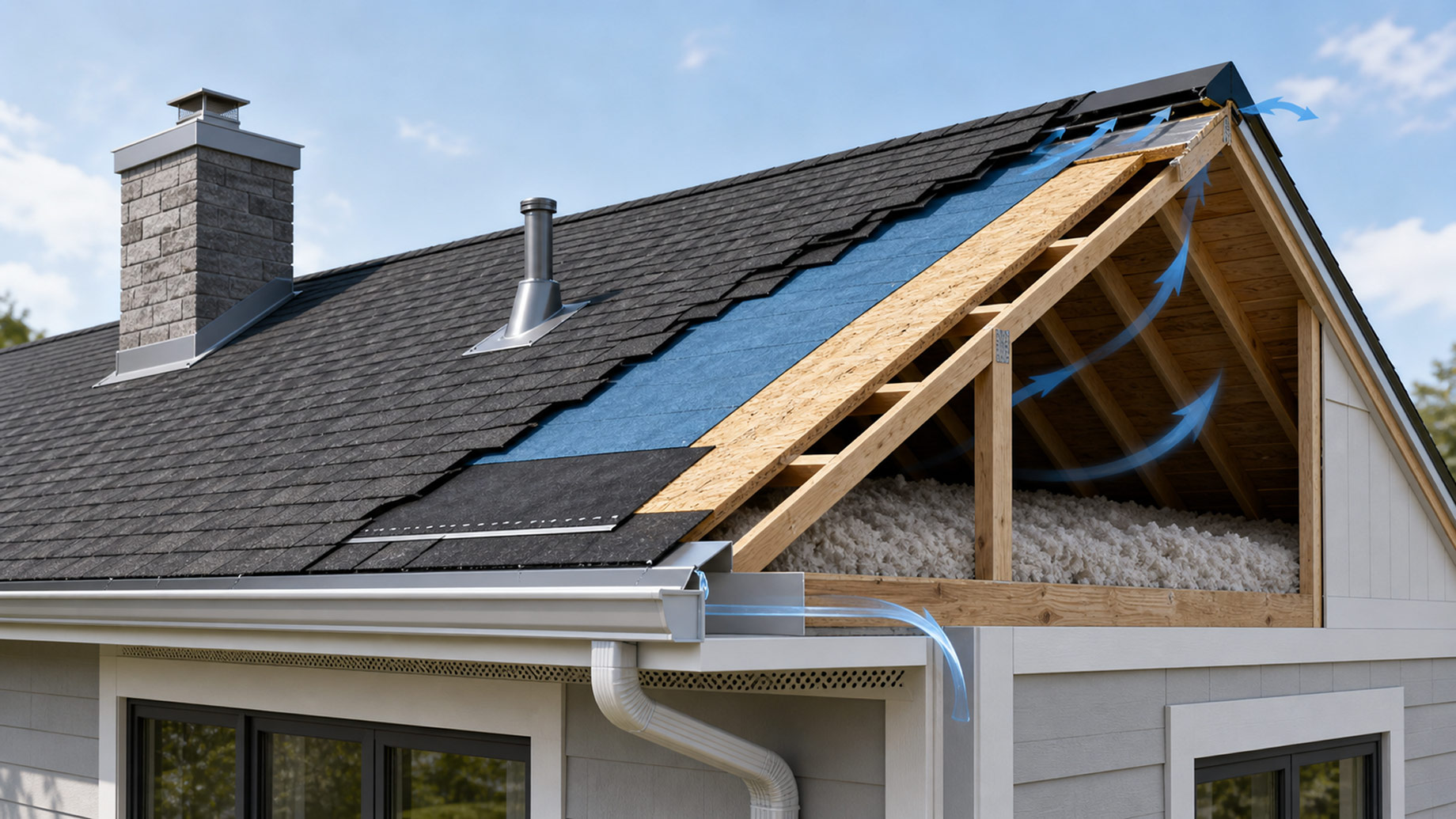
A roof is often described as a single feature of a home, but it is really a system made up of several distinct layers, each with its own job to do. When one of those layers fails, it rarely fails alone. Water finds its way through a gap in flashing, moisture builds up in a poorly ventilated attic, and a homeowner ends up dealing with a much larger problem than the one that started it.
Understanding how these components work together makes it easier to recognize early warning signs, have more informed conversations with a roofing contractor, and make smarter decisions about repair versus replacement when the time comes.
Why a Roof is More Than Just Shingles
Shingles get most of the attention because they are the only part of a roof most people ever see. But shingles are just the top layer of a system that includes structural decking, a waterproofing underlayment, flashing at every transition point, and a ventilation system that regulates temperature and moisture in the attic below.
Each of these components is designed to handle a specific type of stress, whether that is structural load, water infiltration, temperature swings, or wind uplift. A roof only performs as well as its weakest component, which is why understanding the full system matters more than focusing on shingle brand or colour alone.
Roof Decking: The Structural Foundation
Roof decking, sometimes called sheathing, is the layer of plywood or oriented strand board (OSB) fastened directly to the roof trusses or rafters. It forms the structural base that every other roofing component is built on top of.
Decking has to be strong enough to support the weight of the roofing materials, resist sagging under snow loads, and provide a stable surface for fasteners to grip securely. Decking that has been compromised by moisture, rot, or age is one of the more serious issues a roofing inspection can uncover, since it affects the structural integrity of the entire roof rather than a single surface layer.
Underlayment: The Hidden Water Barrier
Underlayment is installed directly on top of the decking and serves as a secondary water barrier beneath the shingles or roofing material. It is easy to overlook since it is completely hidden once the roof is finished, but it plays a critical role in protecting the decking if water ever makes it past the primary roofing surface.
Traditional felt underlayment has largely been replaced by synthetic underlayment in newer builds, offering better tear resistance and more consistent water protection. In colder climates, self-adhering ice and water shield membranes are also commonly installed along eaves and valleys, where ice damming and water backup are most likely to occur.
Shingles or Roofing Material: The First Line of Defense
Shingles, or other roofing material selected, form the visible outer layer of the roof and take on the direct impact of sun, wind, rain, and snow. This layer is what most homeowners think of when they picture a roof, and it is also where style, colour, and material choice come into play alongside performance.
Choosing the right roofing material involves balancing appearance with durability and local climate demands, which is not always a straightforward decision. JN Roofing is an experienced roofing company that will assist homeowners with shingle roofing choices, including styles, colours, textures, and durability considerations suited to their specific home and region. For new construction or larger renovation projects, they will also use a homeowner’s architectural drawings to create a detailed takeoff of the roofing project, helping ensure accurate material estimates before work begins.
Flashing: Protecting Roof Transitions
Flashing is the metal material installed at every point where the roof surface changes direction or meets another structure, around chimneys, skylights, vent pipes, and roof valleys. These transition points are the most common locations for leaks, since a flat, uninterrupted roof surface sheds water far more easily than one with joints and penetrations.
Properly installed flashing directs water away from these vulnerable areas rather than allowing it to pool or seep underneath roofing materials. Flashing failures are also one of the most common causes of leaks that appear to have no obvious source, since water can travel some distance from the point of entry before showing up as a stain on an interior ceiling.
Vents & Soffits: Why Ventilation Matters
Ventilation is one of the least visible but most important parts of a roofing system. Box vents and ventilator vents are the most common types installed on most homes, though ridge vents, installed along the peak of the roof, are another option that allows warm, moist air to escape the attic. Any of these work in partnership with soffit vents, located under the roof’s eaves, which allow cooler outside air to enter and replace it. Together, they create a continuous flow of air through the attic space.
Without proper ventilation, attics can trap heat in the summer and moisture in the winter, both of which shorten the lifespan of roofing materials and can contribute to problems like ice damming and mould growth. Ventilation guidance for Canadian homes, including how airflow interacts with attic insulation, is outlined by Natural Resources Canada, which covers how proper attic ventilation supports both energy efficiency and roof longevity.
Gutters & Eavestroughs: Managing Water Properly
Gutters and eavestroughs are the final component in a roof’s water management system, collecting runoff from the roof surface and directing it safely away from the home’s foundation. While technically separate from the roof structure itself, they work in direct partnership with roofing and flashing to control where water goes once it leaves the roof.
Clogged, damaged, or improperly sloped gutters can cause water to back up under roofing materials or pool near the foundation, leading to problems that have nothing to do with the roof’s actual condition but are often mistaken for roofing issues. Regular gutter maintenance is one of the simplest ways homeowners can protect the investment they’ve made in the rest of the roofing system.
Why Every Component Works Together
None of these components function in isolation. Decking provides the structural base, underlayment adds a secondary layer of protection, shingles handle direct weather exposure, flashing manages transition points, ventilation regulates temperature and moisture, and gutters direct water safely away from the home. A weakness in any one of these areas puts pressure on the others, which is why roofing problems often appear more complicated than they initially seem.
This interconnected nature is also why professional installation and inspection matter so much. Organizations such as the Canadian Roofing Contractors Association promote technical standards and best practices across the industry, helping ensure that roofing systems are installed with this full picture in mind rather than component by component.
When Individual Components Can Be Repaired vs. When Replacement Makes More Sense
Not every roofing issue requires a full replacement. A section of damaged flashing, a small area of deteriorated shingles, or a blocked ridge vent can often be repaired individually without disturbing the rest of the system. Localized repairs are usually the right call when the underlying decking is sound, and the damage is limited to a specific, identifiable area.
Full replacement becomes the more sensible option when multiple components are showing signs of age at the same time, when decking has been compromised by long-term moisture exposure, or when a roof is approaching the end of its expected lifespan and repairs would only address symptoms rather than the underlying cause.
An experienced roofing contractor can assess the condition of each component individually and help determine whether targeted repairs will hold up or whether replacement is the more cost-effective path forward.
Frequently Asked Questions
What is the most important component of a roofing system?
No single component is more important than the others, since each one protects against a different type of stress. A roof performs as a system, and a weakness in any single component can compromise the performance of the rest.
How do I know if my roof needs a repair or a full replacement?
This typically depends on how many components are affected and the condition of the underlying decking. Isolated issues in one area, such as flashing or a section of shingles, can often be repaired, while widespread age or moisture damage across multiple components usually points toward replacement.
Why is attic ventilation important to roof longevity?
Proper ventilation regulates temperature and moisture in the attic, which helps prevent problems like ice damming, mould growth, and premature deterioration of roofing materials from the underside.
Understanding Your Roof as a Complete System
A roof’s performance depends on far more than the shingles a homeowner sees from the street. Decking, underlayment, flashing, ventilation, and gutters all work together as a single system, and understanding how these components interact makes it easier to recognize problems early and make informed decisions about repair or replacement when the time comes.
