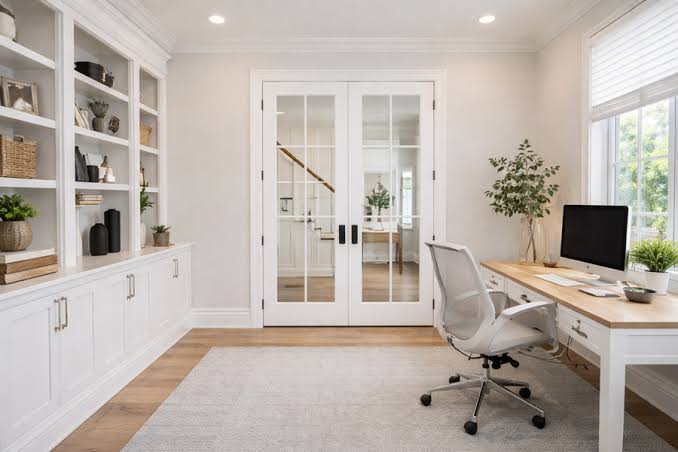
The home office has become one of the most design-conscious rooms in the house. It needs to function like a professional workspace – quiet enough for focused work and video calls, visually separate enough to signal “I’m working” to the rest of the household – while still feeling like part of the home rather than a sealed bunker.
French doors interior sit at the center of that tension better than any other door type. But getting the configuration right for a home office is more specific than most buyers realize. The wrong glass choice turns your office into a fishbowl. The wrong frame spec means sound bleeds through every call. The wrong configuration fights your floor plan instead of working with it.
This guide covers what actually matters when choosing interior french doors specifically for a home office.
Why the Home Office Is the Hardest Room to Door Correctly
Most rooms have a single dominant requirement. A bedroom needs privacy. A dining room needs atmosphere. A laundry room needs access.
A home office needs all of the following simultaneously:
- Visual separation from household activity without feeling isolated
- Sound control sufficient for calls, focused work, and confidential conversations
- Natural light to reduce eye fatigue and maintain connection to the rest of the house
- A clear signal to others in the home that the space is a workplace during working hours
- A door that opens fully when work is done, making the space usable as a secondary room
No solid door satisfies all five. No open archway satisfies the sound and privacy requirements. French doors – configured correctly – can satisfy all five at once. That’s why they’ve become the default recommendation for dedicated home offices in renovated and purpose-built homes alike.
The Glass Decision: The Most Important Call You’ll Make
In a home office, glass type determines whether the door works or whether you regret it within a week.
Clear Glass: The Transparency Problem
Clear glass maximizes light transfer, which sounds ideal until you’re on a video call and your spouse walks through the background in pajamas. Or until you realize that household members can see exactly what’s on your screen from the hallway. Or until the distracting movement of kitchen activity thirty feet away keeps pulling your attention off the work in front of you.
Clear glass is excellent for living room–dining room transitions where the goal is visual connection. In a home office, it creates more problems than it solves for most people – unless your office opens onto a quiet, low-traffic space and you have no privacy concerns about screen content or call backgrounds.
Frosted Glass: The Privacy Solution That Blocks Light
Full frosted or obscure glass solves the privacy problem completely but creates a different one: it blocks light almost as effectively as a solid door. The whole point of choosing a glazed french door over a solid door is the light transfer. If your glass is opaque, you’ve paid more for the aesthetic of a french door without the functional benefit.
Lightly Textured or Reeded Glass: The Home Office Sweet Spot
Lightly textured glass – reeded (vertical ribbing), rain, or a light acid etch – is where most home office installations land after careful consideration. It diffuses light effectively while obscuring direct sightlines. Someone walking past can see that the office light is on and that you’re at your desk, but they can’t see your screen, your expression, or your video call background clearly.
This is the functional middle ground: you get 70–80% of the light transfer of clear glass with meaningful privacy. It also photographs well, which matters if your office doubles as a video call background.
Laminated (Triplex) Frosted Glass: The Upgrade Worth Considering
Laminated glass with a frosted interlayer adds two benefits over standard single-pane textured glass: it dampens sound more effectively (the bonded layers resist vibration better than a single pane), and it’s impact-resistant – if the panel ever takes a hard knock, it holds together rather than shattering. For a home with children or pets, this is a meaningful safety upgrade on top of the acoustic benefit. If this spec appeals to you,this double door unit is a strong example of laminated frosted glass in a pre-hung white frame – a combination that works particularly well in home office openings.
Sound: What French Doors Can and Cannot Do
Let’s be honest about acoustic performance, because this is where buyer expectations most often diverge from reality.
A standard pre-hung french door with single-pane glass will reduce sound transmission – but not eliminate it. On a quiet video call in a quiet house, you’ll hear voices and activity from the other side, though at reduced volume. For most work-from-home scenarios, this is sufficient.
The factors that most affect sound performance in a french door for home offices:
Glass thickness and type. A single 1/4″ pane of clear glass is the lowest-performing option. Laminated glass – where two glass layers are bonded with a polyvinyl interlayer – performs meaningfully better because the interlayer absorbs vibration rather than transmitting it. The difference is audible on a quiet call.
Frame seal quality. Sound travels through gaps far more than through solid materials. A pre-hung door with integrated weatherstripping on all four sides – head, both jambs, and threshold – outperforms a slab installation where the seal depends entirely on how well the installer fitted the stops. If acoustic performance matters, specify pre-hung with weatherstripping, not slab.
Panel core material. A solid-core door (solid wood or composite core) absorbs more sound energy than a hollow-core door. The mass difference is real: a solid-core 80-pound panel dampens sound better than a 35-pound hollow panel at every frequency range relevant to speech.
Door undercut. Many interior doors are installed with a gap at the bottom for HVAC airflow. In a home office, that gap is an acoustic hole. A door sweep or adjustable threshold seal closes it without blocking air circulation entirely.
For serious acoustic requirements – a podcast studio, a therapy practice, or a space where highly confidential calls happen regularly – a french door with standard glass won’t achieve professional studio isolation. But for the vast majority of work-from-home environments, a solid-core pre-hung french door with laminated glass and a threshold seal delivers performance that’s more than adequate.
Configuration: Matching the Door to Your Office Layout
Single vs. Double
A double french door in a home office creates a formal, intentional look – it reads as an office entrance rather than a room door. The tradeoff is swing clearance on both sides and a center astragal that can feel slightly awkward as a daily-use passage when you’re carrying a coffee mug or a stack of papers.
For most home offices – particularly those converted from a bedroom or dining room – a single french door is the more practical choice. It’s easier to open and close one-handed, requires clearance on only one side, and still delivers all the light and visual separation benefits of a glazed panel.
Double doors make the most sense when the opening is architecturally wide (60 inches or more) or when the office is a dedicated, purpose-built space where the entrance is part of the room’s design statement.
Swing Direction
For a home office, outswing (swinging into the hallway or adjacent space) is often the better choice over inswing. It keeps the swing arc out of the office floor plan, where a desk, chair, and shelving are likely competing for space near the door. Confirm that the adjacent space has clearance and that the door won’t open against another door or a wall-mounted obstacle.
Pocket French Door: The Space-Efficient Alternative
If your office opening is narrow and clearance is tight on both sides, a pocket french door – a glazed panel that slides into the wall cavity – deserves serious consideration. When open, it disappears entirely, leaving a full unobstructed passage. When closed, it provides the visual separation and partial sound control of a standard french door.
The caveat: pocket doors don’t seal as tightly as hinged doors because the panel slides rather than compresses against a stop. For offices where acoustic performance is a priority, a hinged pre-hung unit with weatherstripping outperforms a pocket door at every price point.
Frame Finish and Color: The Visual Communication Layer
In a home office, the door’s appearance communicates something to the rest of the household – and to clients or colleagues who appear on your video calls.
White frames are the most versatile and the most common. They brighten the glass panel visually, blend with most interior trim, and photograph cleanly as a video call background element.
Black frames read as deliberate and contemporary. A black-framed french door against a light wall creates strong visual definition – it makes the office feel like a distinct, designed space rather than a converted room. It’s also increasingly popular as a background element in professional video calls precisely because it photographs with contrast and intentionality.
Natural wood or warm stained frames work well in home offices with a warmer, more traditional aesthetic – bookshelves, leather chairs, warm lighting. They’re less neutral than white but add character that suits the space.
Whatever finish you choose, the frame should match or complement your existing interior trim. A door that fights the baseboards and door casings in color or profile is a daily visual irritant that’s easily avoided by confirming trim specs before ordering.
Practical Details That Make the Difference
Handle height and type. A lever handle is easier to operate one-handed than a knob – relevant when you’re carrying items in and out of the office regularly. Specify the handle on the correct side for your dominant hand.
Privacy latch vs. passage latch. A passage latch (no lock) is standard for interior doors. For a home office, a privacy latch – which can be locked from the inside with a simple push-button or turn mechanism – adds a meaningful signal: when the privacy latch is engaged, it communicates “do not disturb” more effectively than a closed door alone. It also provides actual privacy for sensitive calls.
Glass visibility from desk position. Before finalizing glass type, sit in your desk chair and estimate the sightline from that position through the door. If your desk faces the door, clear glass means anyone in the hallway can make eye contact with you while you’re working – which some people find motivating and others find deeply distracting. If your desk is perpendicular to the door, the sightline issue is less pronounced.
Robe hooks or door stops. A door stop that prevents the open panel from damaging the wall behind it is a small detail that’s easy to forget and annoying to retrofit. Specify it at installation.
Who Should Choose French Doors for Their Home Office
French doors interior are the right call for a home office when:
- The office shares a wall or opening with a high-traffic household space (living room, kitchen, hallway)
- You take regular video calls where background and sound quality matter
- You want to signal working hours without physically isolating yourself from the house
- Natural light from adjacent spaces would genuinely improve the office environment
- The office doubles as a guest room, library, or secondary living space when not in use as a workspace
They’re less necessary when the office is already physically separated from main living areas, when sound isolation requirements exceed what any residential door can achieve, or when the office is used so infrequently that a standard solid door is entirely sufficient.
For the majority of people working from home in a converted room – a second bedroom, a formal dining room, a dedicated study – a well-specified set offrench doors interior solves the light, privacy, and separation problem more elegantly than any other single product decision in the room.
The investment is worth framing correctly: a solid-core pre-hung french door with laminated glass costs more than a hollow-core solid door, but it delivers better light, better acoustics, and a workspace that feels designed rather than improvised – which has a measurable effect on how seriously you and the rest of your household treat the space. For a room you’ll spend 40 or more hours a week in, that’s not a cosmetic upgrade. It’s a functional one.
One final note on sequencing: specify the door before you finalize the office layout. The swing direction, clearance arc, and glass visibility from your desk position all affect where the desk, shelving, and seating can go. Designing the room around a door that hasn’t been chosen yet is one of the most common and most avoidable home office renovation mistakes.
Quick Reference: Home Office French Door Spec
| Decision | Options | Recommendation | Notes |
| Glass type | Clear / Frosted / Reeded / Laminated | Lightly reeded or laminated frosted | Clear = fishbowl effect; full frosted blocks light; reeded hits the middle ground |
| Panel configuration | Single / Double | Single for most offices | Double suits openings 60″+ or design-forward spaces |
| Core material | Hollow-core / MDF solid / Engineered wood / Solid wood | Solid-core MDF or engineered wood | Hollow-core transmits too much sound; solid wood warps in humid rooms |
| Frame type | Slab / Pre-hung | Pre-hung with weatherstripping | Slab only if existing frame is confirmed plumb, square, and undamaged |
| Swing direction | Inswing / Outswing / Pocket | Outswing if adjacent space permits | Keeps arc out of office floor plan; pocket if clearance is impossible both sides |
| Handle type | Knob / Lever / Pull | Lever handle | One-handed operation when carrying items; more ergonomic for frequent use |
| Latch type | Passage / Privacy | Privacy latch (push-button or turn) | Provides “do not disturb” signal and actual lock for sensitive calls |
| Frame color | White / Black / Wood tone | White (versatile) or black (contemporary) | Black frames read strongly on video calls; white blends with most trim |
| Acoustic upgrades | Single-pane / Laminated glass / Door sweep / Threshold seal | Laminated glass + door sweep minimum | Each layer compounds; all four together achieve near-residential STC 32–35 |
| Handing | Left-hand / Right-hand inswing or outswing | Match to dominant hand and traffic flow | Confirm before ordering – cannot be changed post-manufacture on most units |
| Glass panel size | Divided lite (multi-pane) / Full panel | Full panel or 2–4 lite max | More lites = more frame = less light; in an office, maximize glass area |
| Frame profile width | Narrow (2–2.5″) / Standard (3–3.5″) / Wide (4″+) | Narrow to standard | Wide profiles reduce glass area and make small office openings feel heavier |
The Bigger Picture
A home office door is a decision most people make once and live with for years. The difference between a door that works and a door that merely exists in the opening is felt every single workday – in the quality of light on your desk, in whether you can take a call without lowering your voice, in whether the people you share the house with understand instinctively when you’re available and when you’re not.
French doors interior earn their place in a home office not because they look good in renovation photos – though they do – but because they solve a genuinely difficult spatial problem that no other single product resolves as completely. They borrow light without surrendering privacy. They separate a workspace from a living space without sealing one off from the other. They communicate occupancy without requiring a sign on the door.
The specification decisions outlined in this guide – glass type, core material, swing direction, acoustic upgrades – might seem like fine detail. But in a room where you’ll spend a substantial portion of your waking hours, fine detail is exactly what separates a workspace that supports focused, professional work from one that fights you every day in ways that are hard to articulate but impossible to ignore.
Get the door right first. Everything else in the office can be adjusted, replaced, or moved. The door, once installed, defines the room.