Seattle’s real estate market is full of charming older homes, craftsman bungalows in Ballard, Victorian-era properties in Capitol Hill, and mid-century homes throughout Wallingford and Queen Anne.
What that charm often comes bundled with is original sewer infrastructure that’s now 60, 80, or even over 100 years old, and a failing sewer line is exactly the kind of expensive surprise a standard home inspection doesn’t always catch.
Why Standard Home Inspections Often Miss This
A general home inspector examines what’s visible and accessible: the roof, foundation, electrical panel, plumbing fixtures.
The sewer lateral, the pipe connecting a home to the municipal sewer main, runs underground and out of sight, which means it’s typically outside the scope of a standard inspection unless a sewer scope is specifically ordered as a separate line item during the inspection contingency period.
What Materials You’re Actually Dealing With in Older Seattle Homes
Three legacy pipe materials show up consistently in Seattle’s older housing stock, and each carries different risk levels. Vitrified clay pipe was the standard residential sewer material from the early 1900s through the 1950s, common in pre-1960s homes throughout neighborhoods like Ballard, Wallingford, Queen Anne, and Capitol Hill.
Clay performs reasonably well under ideal conditions, but it’s installed in short sections joined by rigid couplings, and those joints become genuinely vulnerable to root intrusion and ground movement after 80 to 120 years of service.
Orangeburg pipe, used as a wartime material substitute in the late 1940s and 1950s, is made from wood pulp and coal tar, and it’s a much bigger concern. It degrades over time into a deformed, collapsed tube that simply can’t carry waste properly, regardless of how well it’s maintained.
Homes built after 1980 in Seattle generally have PVC or ABS plastic piping, which is far more durable and resistant to both root intrusion and general deterioration than either of the older materials.
Why Seattle’s Specific Conditions Make This Worse Than in a Drier Climate
Seattle’s frequent rainfall and consistently mild temperatures keep soil moist for much of the year, which is exactly the environment tree roots seek out aggressively in their search for water. Mature trees, and Seattle has plenty of them throughout its established neighborhoods, can send roots stretching up to seven times the tree’s height in that search. Once a root finds its way into even a small crack or joint gap in an aging clay pipe, it grows quickly, and toilet paper or debris catching on the root is often what triggers the first visible backup.
What a Sewer Scope Inspection Actually Reveals
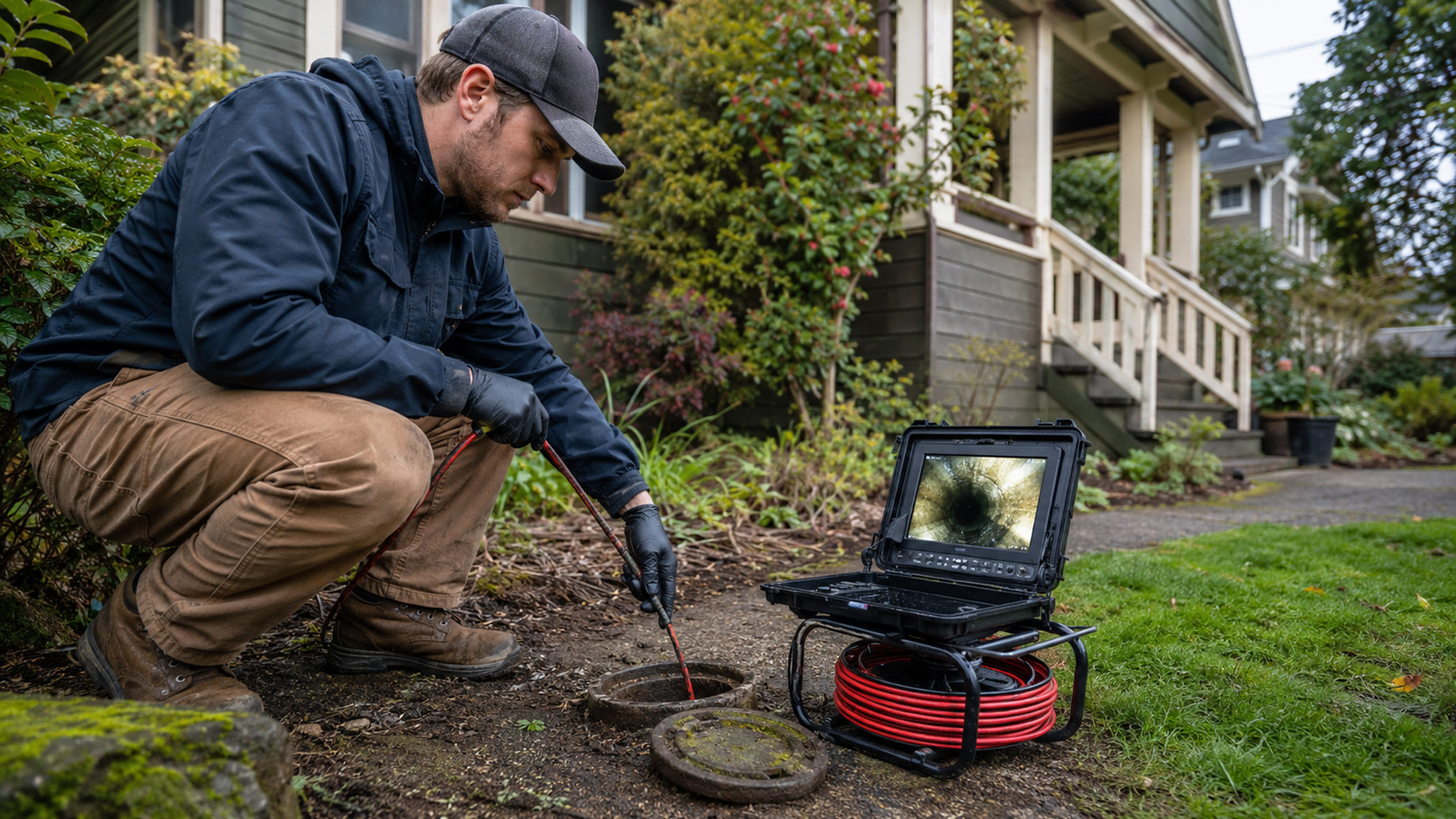
A sewer scope uses a waterproof video camera fed through the sewer line on a flexible rod, giving a direct visual look at the pipe’s actual condition, root intrusion, cracks, joint separation, bellies where the pipe sags and retains standing water, and general material degradation.
This is the only reliable way to know what’s actually happening underground, since none of these issues are visible or detectable from the surface until they’ve already caused a backup or, in a worst case, a collapsed section requiring emergency excavation.
Why This Matters So Much During a Home Purchase Specifically
Sewer line replacement is a genuinely expensive repair, and discovering the need for one after closing on a home is a far worse position than negotiating around it during the purchase process.
A sewer scope performed during the inspection contingency period gives you leverage: either the seller addresses the issue, the price reflects the needed repair, or you walk away from a property with a problem you’d otherwise inherit unknowingly.
What to Do With the Results
Minor root intrusion in an otherwise sound pipe can often be cleared with hydro jetting, a relatively affordable, non-invasive fix.
More severe root intrusion, particularly in clay pipe that’s already showing joint separation, often means replacement is the only durable solution rather than a repeated cycle of clearing roots that keep growing back.
Getting a Clear Picture Before You Close
If you’re purchasing an older Seattle home, ordering a sewer scope alongside your standard inspection is one of the more valuable, and often overlooked, steps in the process.
A sewer inspection in Seattle performed during your contingency window gives you the information you need to negotiate confidently or walk away informed, rather than discovering a costly sewer problem only after you already own the home.
