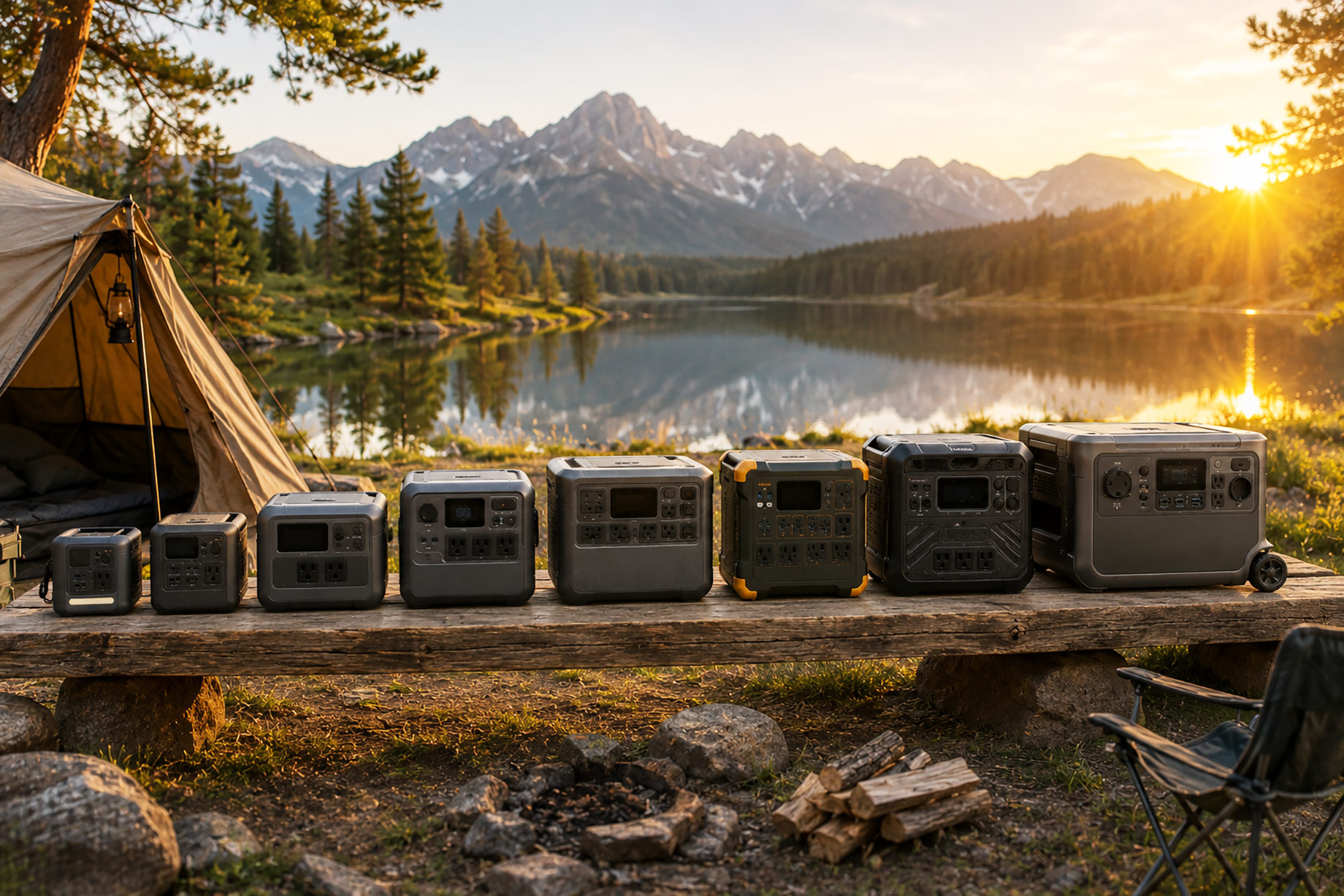
Portable power stations have come a long way in the last couple of years. Nearly every major brand has released new models, and a wave of newer companies has entered the space with genuinely competitive options. If you’ve been putting off buying one because the market felt overwhelming, now is actually a great time to jump in.
This roundup focuses on smaller and mid-sized units roughly 300Wh to 2,000+Wh, the kind of power stations that make sense for camping trips, remote work sessions, RV outings, or keeping the essentials running during a blackout. Rather than ranking them best to worst, they’re listed from smallest to largest, since the “best” one really depends on how much power you need and what you’re willing to spend.
1. Anker C300X
Capacity: 288Wh | Inverter: 300W
The smallest unit on this list earns its spot through sheer portability. It’s roughly shoebox-sized, comes with a detachable shoulder strap, and runs quietly enough to use indoors without noticing it. Despite the compact footprint, it still packs in three AC outlets, USB-A and USB-C ports, and a 12V car-style socket. A DC-only variant is also available for anyone who wants to save some money and doesn’t need AC outlets; it’s smaller, cheaper, and even throws in a built-in dome light.
2. DJI Power 500
Capacity: 512Wh | Inverter: 1,000W
DJI is best known for drones and camera gear, so it’s no surprise the Power 500 was built with content creators in mind. The standout feature is how quiet it runs even at full 1,000W output; noise is barely noticeable. That makes it a solid pick for anyone recording audio, editing on location, or just working at a desk without wanting to hear a fan spin up. It also includes an SDC port for fast-charging DJI drones and cameras, forward-facing ports for easy access, and a built-in carry handle.
3. DJI Power 1000
Capacity: 1,024Wh | Inverter: 2,200W
Think of this as the Power 500’s bigger sibling, with double the battery capacity and more than double the output, while keeping the same quiet operation and clean design. It has dual SDC ports for DJI gear, two grounded AC outlets, and USB-A/USB-C ports, all facing forward for convenience. An optional padded carrying bag with cable pockets makes it easy to bring along. This one sits in a real sweet spot: enough power to run something like a small fridge, but still compact enough for regular camping use.
4. EcoFlow DELTA 3 Plus
Capacity: 1,024Wh | Inverter: 1,800W
EcoFlow’s budget-friendly entry stands out for backward compatibility; it works with expansion batteries originally designed for older EcoFlow models like the DELTA Max, DELTA 2, and DELTA Pro, which is a nice way to save money if you’re already invested in the ecosystem. It also uses separate solar charging ports, so plugging into panels doesn’t tie up any of your other outlets. Port selection is generous, with six AC outlets (three grounded, three ungrounded) plus the usual USB-A, USB-C, and 12V DC options. Note that EcoFlow has since expanded this lineup further with the DELTA 3 Classic and DELTA 3 Max, so it’s worth comparing specs before buying.
5. Anker SOLIX C800X
Capacity: 768Wh | Inverter: 1,200W
What makes the C800X memorable is its built-in, removable LED lights that charge directly from the unit and extend on a telescopic handle, genuinely useful for campsites or blackouts where you need hands-free lighting. Beyond that party trick, it’s a well-rounded unit with five fully grounded AC outlets, a 12V port, app connectivity, and the ability to charge fully in under an hour.
6. Pecron E1500LFP
Capacity: 1,536Wh | Inverter: 2,200W
Pecron doesn’t have the brand recognition of Anker or EcoFlow, but the E1500LFP delivers a lot of capability for the price. It’s built tough, with rubberized corners, and includes a top-mounted wireless charging pad. The companion app is more polished than you’d expect from a lesser-known brand, and the unit supports expansion batteries if your power needs grow over time. For buyers prioritizing value over brand name, this is a strong contender.
7. OUPES Mega 2
Capacity: 2,048Wh | Inverter: 2,500W
The largest station on this list, the Mega 2 is aimed at people who need serious capacity without a premium price tag. It’s the first unit here with a built-in 30-amp plug, making it especially useful for RV owners, along with four AC outlets, a 12V port, and multiple USB ports. Its expansion batteries are also unusually capable; they can output power independently rather than just adding passive storage. OUPES customer support has also gotten positive marks for being genuinely responsive.
8. Anker F2000
Capacity: 2,048Wh | Inverter: 2,400W
Rounding out the list, the F2000 packs a lot of power into a relatively manageable size. It includes a 30-amp plug, four AC outlets, two DC plugs, and the usual USB ports, plus a suitcase-style handle and wheels for easy transport a nice touch given how heavy units in this capacity range tend to get. Anker’s larger F2600 has reportedly been overshadowing it in sales, which sometimes means good deals are available on the F2000 while stock lasts.
Choosing the Right One for You
There’s no single “best” portable power station here; the right pick depends on your use case:
- Ultra-portable and budget-conscious: Anker C300X
- Quiet operation for content creators: DJI Power 500 or Power 1000
- Expandable home backup on a budget: EcoFlow DELTA 3 Plus
- Built-in lighting for camping/blackouts: Anker SOLIX C800X
- Best value for the capacity: Pecron E1500LFP
- Maximum capacity, RV-ready: OUPES Mega 2 or Anker F2000
Whichever direction you go, all of these units represent genuinely competitive options in a market that’s improved dramatically in a short time. Match the capacity and port selection to what you actually plan to run, and you can’t go far wrong.
