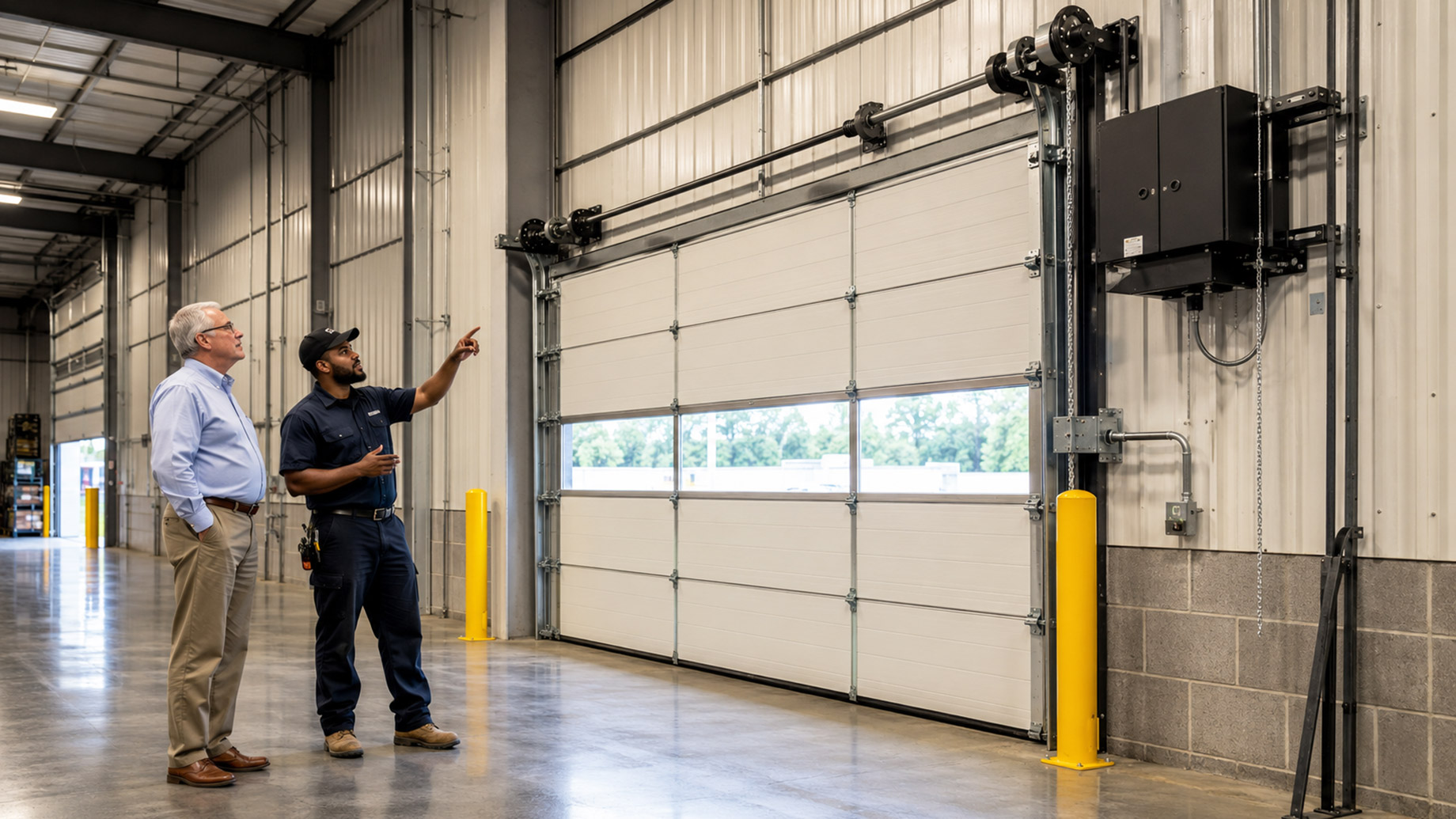
A commercial garage door is only as reliable as the opener driving it. Property owners often spend a lot of time choosing the door itself: material, insulation, security features. They spend far less time thinking about the operator that opens and closes it dozens of times a day. That’s a mistake, because an undersized or mismatched opener is one of the most common reasons commercial doors fail early.
Start With Duty Cycle, Not Just Door Weight
Residential openers are rated for a relatively small number of lifetime cycles because home garage doors typically open and close just a handful of times a day. Commercial facilities are an entirely different story. A warehouse or distribution center door might cycle 50, 100, or even 300 times in a single day.
Commercial-grade operators are generally categorized by duty cycle:
- Light-duty operators handle around 25 cycles a day and suit smaller, lighter doors with infrequent use
- Medium-duty operators are built for roughly 50 cycles a day, fitting moderate-traffic facilities
- Industrial-duty operators are designed for 300 cycles a day or more, intended for heavy doors and high-traffic environments like distribution hubs
Matching duty cycle to your actual usage pattern, not just a rough guess, is the single biggest factor in how long an opener lasts before it needs major service.
Match the Operator Type to Your Building Layout
Different operator configurations solve different space constraints.
Trolley operators mount overhead and use a horizontal track, similar to residential systems but built heavier. They work well for standard sectional doors in buildings with adequate ceiling clearance.
Jackshaft operators mount on the wall beside the door and connect directly to the door’s horizontal shaft, which frees up overhead space. This is a common choice for facilities that need the ceiling clear for cranes, conveyors, or storage.
Hoist operators are typically paired with rolling steel doors and other heavy-duty applications where a trolley-style mechanism isn’t practical.
If your facility has limited vertical clearance or heavy equipment near the ceiling, a jackshaft system is often worth prioritizing over a standard overhead trolley unit.
AC vs. DC Motors
Most modern commercial operators run on DC motors rather than the older AC style. DC motors tend to be quieter, more energy-efficient, and better suited to integrating with smart monitoring features like remote diagnostics. If your facility runs near office space, retail floors, or anywhere noise matters, this is worth specifying directly rather than assuming it’s standard.
Don’t Overlook Drive Type and Noise
Beyond motor type, the drive mechanism, chain, belt, or screw, affects both noise level and maintenance needs. Chain drives are durable and common but louder. Belt drives run quieter and are increasingly standard in facilities where noise matters, such as buildings with adjacent office or retail space.
Safety and Security Features Worth Prioritizing
A commercial opener isn’t just about lifting the door. Look for reliable obstruction sensors that meet current safety standards, since liability concerns are higher in commercial settings with frequent foot and vehicle traffic. Look for manual override capability for power outages or emergencies. Remote monitoring or smart connectivity lets facility managers check door status and diagnose issues without an on-site visit, and it’s increasingly standard on newer commercial models. Auto-close timers are also useful for facilities concerned about doors being left open unintentionally during shift changes.
Getting the Sizing Right
The most expensive mistake in commercial opener selection isn’t picking the wrong brand. It’s undersizing for actual usage. An opener that’s constantly running near its capacity wears out far faster than one matched correctly to the door’s weight, size, and daily cycle count. A short conversation with an experienced commercial door provider, who can walk your facility and assess door weight, traffic patterns, and layout constraints, is the most reliable way to land on the right specification. Choosing the right commercial garage door opener for your facility is worth getting right the first time, since replacing an undersized unit a year or two in costs far more than specifying correctly up front.
