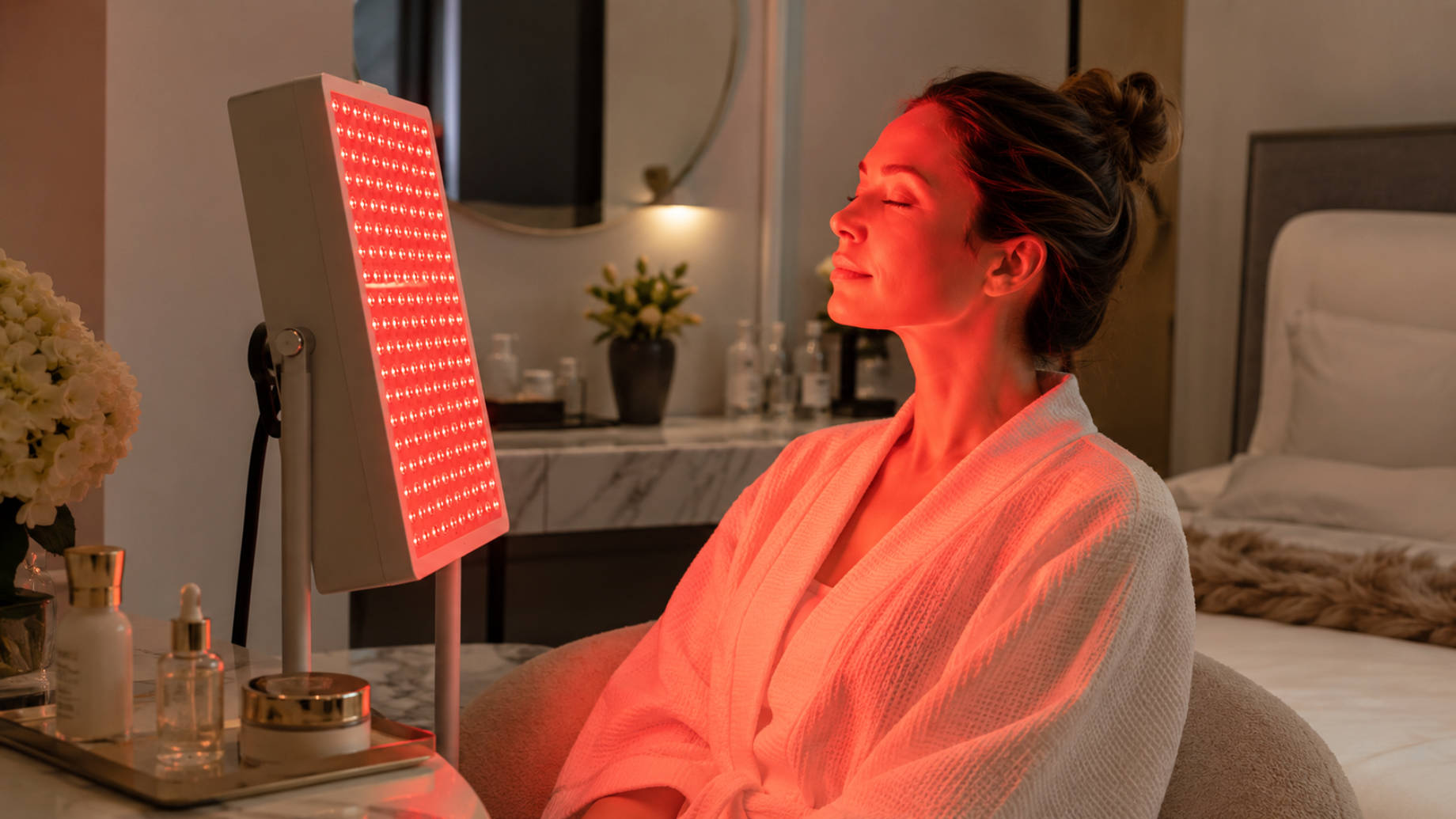
Among the wellness investments that have moved from spa to home over the past few years, the at-home red light therapy panel has been one of the quieter shifts. The premise is straightforward. Specific wavelengths of red and near-infrared light, delivered consistently to the skin, stimulate the fibroblasts that produce collagen and elastin. Over weeks of regular use, the result is what skin clinics have been charging four-figure sums for since the early 2000s, without the appointment, the travel, or the wait list. A growing number of people exploring red light therapy for anti-aging are finding that a well-built home panel delivers the same wavelengths the clinical studies measured, at a price that compares favorably with a single in-office laser treatment. Here is a closer look at the panels worth considering, with the picks listed first and the supporting research that informs them just below.
The Three Panels Worth Considering
1. RLT Home Total Spectrum MINI
The MINI is the right form factor for collagen and skin work specifically because most of the action happens at the face, neck, and decolletage rather than across larger body areas. It delivers seven wavelengths in a portable, premium-build panel: 480, 630, 660, 810, 830, 850, and 1064nm. The two wavelengths the collagen research has converged on most strongly, 633nm and 830nm in combination, are both included, with independent channel control letting you weight them according to your specific aging concerns. For someone whose primary interest is fine lines, wrinkles, and overall skin texture, the 630/660nm red channels do the heaviest lifting; for skin laxity and deeper-layer support, the 810/830/850nm near-infrared channels are where the work happens.
Three features stand out for daily, long-term facial use. The panel tests at near-zero EMF at six inches, which matters when you are using a device daily within close range of the face. The build includes free eye protection (reading and blackout goggles), which is important for any facial protocol. And the panel ships with a free personalized therapy plan delivered by a clinician, which is the kind of touch most luxury beauty brands charge extra for. At $595 with a 60-day trial, a 3-year warranty, free insured shipping, and HSA/FSA eligibility via Truemed, it sits at the entry-level price point of the series but is purpose-built for the use case. Fortune named the Compact model in the same series the top anti-aging panel pick in January 2026, which speaks to the engineering across the line.
2. Heliocure Helio Spark
The Helio Spark is Heliocure’s smaller targeted panel, delivering six wavelengths (630, 660, 810, 830, 850, and 1064nm) without blue light. The no-blue-light positioning is a deliberate choice the brand makes for skin work, since blue wavelengths are not part of the published collagen-stimulation evidence and can affect circadian rhythm in evening use. The panel offers 72 LEDs in an 11.8 by 11.4 inch footprint, with touch and remote controls, and supports five precision modes alongside a full-spectrum option. The brand publishes independent irradiance measurements by LightLab and lists wavelength density allocations on every product page. The 60-day trial, 3-year warranty, and free US shipping match the protections offered by RLT Home. For someone who wants the simplest, most clinically grounded dual-wavelength setup at a similar size to the MINI, the Helio Spark is a strong fit. The trade-off is that the wavelength count is slightly lower and the configuration is less granular.
3. TheraFace PRO by Therabody
TheraFace PRO takes a different approach. Rather than a panel, it is a handheld device combining percussive massage, microcurrent, and a red and infrared LED ring around the treatment head. It is built for short, daily sessions that integrate into an existing skincare routine, and the build quality and engineering reflect Therabody’s recovery-tool pedigree. For someone who wants something more hands-on and ritualized than a panel, or who values the percussion and microcurrent functions alongside LED, it is a premium option that fits the bathroom counter rather than the wall. The trade-off compared to a panel is that the LED coverage per session is smaller and the wavelength count is more limited. For pure collagen stimulation evidence-matching, a multi-wavelength panel does more. For a multi-modality device that combines several at-home treatments in one, TheraFace PRO is the strongest option in this group.
How Collagen Loss Actually Works
Collagen is the structural protein that gives skin its firmness, smoothness, and resilience. Skin contains predominantly type I and type III collagen, produced by specialized cells called fibroblasts that live in the dermis. Beginning in the mid-twenties, fibroblast activity slows, and total collagen production drops by roughly 1 percent per year. By the time most people reach their forties, the cumulative loss has begun to register visibly: fine lines around the eyes and mouth, looser texture along the jawline, the loss of the natural “bounce” that younger skin has.
The acceleration of this process is driven by oxidative stress and inflammation, both of which are amplified by sun exposure, late nights, alcohol, environmental pollution, and the cumulative effects of stress on cellular metabolism. The pharmaceutical and aesthetic industries have built an enormous business around addressing the visible results: retinoids stimulate cellular turnover, peptides signal fibroblasts to produce more collagen, laser resurfacing creates controlled micro-injuries to trigger a healing response, and microneedling does the same with mechanical perforation. All of these work to varying degrees. All have downsides, costs, or recovery time.
Red light therapy operates on a different principle. The wavelengths are absorbed by mitochondria in the fibroblasts themselves, increasing ATP production, reducing oxidative stress, and creating the metabolic conditions for fibroblasts to behave more like they did a decade earlier. The result is not a controlled injury healing response. It is a sustained low-grade increase in the fibroblast’s own collagen-producing activity.
The Clinical Evidence
The published research on red light therapy for collagen and skin rejuvenation is now deep enough to give clear guidance on which wavelengths and what protocols produce measurable results.
A 2023 review and clinical analysis published in Lasers in Medical Science, Reverse skin aging signs by red light photobiomodulation, pooled results from multiple controlled trials and confirmed that red and near-infrared photobiomodulation produces statistically significant reductions in wrinkle depth, improvements in skin elasticity, and increases in dermal collagen density. The analysis found the strongest effects at wavelengths in the 630-660nm red band combined with 810-850nm near-infrared, delivered three to five times per week for 8 to 12 weeks.
A widely cited controlled trial published in Photomedicine and Laser Surgery used a combined 633nm and 830nm LED protocol and reported up to 36 percent reductions in wrinkle volume, 19 percent improvements in elasticity, and measurable increases in intradermal collagen density on biopsy. The trial design was rigorous, with split-face placebo control, and the results have been replicated across several follow-up studies.
A 2007 randomized split-face study (one of the early gold-standard trials in the field) demonstrated that twice-weekly LED sessions at 633nm produced measurable improvements in skin texture, fine line density, and patient satisfaction over 12 weeks. Histologic biopsy confirmed an increase in collagen and elastin protein synthesis in the treated skin compared to the control side.
The convergence across these studies is the dual-wavelength protocol: 633nm (or 630-660nm in the LED equivalent) combined with 830nm near-infrared, delivered consistently over weeks. The fibroblast response is not instant. It is cumulative, building across 6 to 12 weeks before the visible changes become obvious.
What to Look For in a Panel
For collagen-focused use, four specifications separate panels that will deliver the research-backed effects from panels that will produce only marketing claims.
Wavelength coverage. At minimum, a panel should include 630-660nm and 810-850nm. The published trials have used these bands almost exclusively. Panels that include 1064nm extend the therapeutic window for deeper-layer support, which becomes more relevant for skin laxity and structural firming.
Irradiance at distance. Raw LED output figures are largely marketing. What matters is the irradiance reaching the skin at typical treatment distance (6 to 12 inches). Quality manufacturers publish measured irradiance at standardized distances. If a panel does not, it is a flag.
EMF and flicker. For daily facial use over months, lower EMF emissions and zero LED flicker matter. The published EMF readings should sit near zero microtesla at six inches. Driver quality on cheaper panels is often where these specifications quietly degrade.
Warranty, LED lifespan, and return policy. Cliched specifications, but they matter on a multi-month protocol. A 3-year minimum warranty, a 100,000-hour LED lifespan, and a 60-day return window are the markers of a serious manufacturer.
Practical Protocol
The protocols used in the clinical trials cluster around the same parameters. Three to five sessions per week, 10 to 20 minutes per session per treatment area, with the panel positioned 6 to 12 inches from the skin. Most users see the first changes around week four (improved skin texture, slight improvement in fine line definition), with the more meaningful structural changes (elasticity, collagen density) emerging around weeks 8 to 12. Maintenance after the initial protocol typically runs at two to three sessions per week indefinitely.
Eye protection during facial sessions is essential. The included goggles in higher-quality panels are not a marketing accessory; they protect against the photoreceptive cells in the retina from extended exposure. Skincare products that contain photosensitizing ingredients (certain retinoids, hydroquinone, some essential oils) should be applied either well before or well after sessions, not immediately before. The treatment itself feels mildly warm, similar to a sunny window. There is no sting, no recovery time, and no required downtime afterward.
Final Word
For someone making a multi-decade investment in skin quality, the case for a quality home panel has quietly become very strong. The clinical evidence is consistent and well-replicated, the safety profile is excellent, and the price of a serious panel now compares with a single in-office laser treatment rather than a year’s worth.
The RLT Home Total Spectrum MINI is the most complete pick for someone whose primary interest is collagen and skin work, because the wavelength coverage, the independent channel control, the published EMF and irradiance numbers, and the included accessories deliver everything the published trials suggest matters. The Heliocure Helio Spark is the strongest no-blue-light alternative at a similar size, for someone who prefers simpler configuration. TheraFace PRO is the right choice for someone who values a multi-modality device that combines LED with percussion and microcurrent rather than a single-function panel.
Whichever you choose, treat it like the long-cycle aesthetic investment it is. Eight to twelve weeks of consistent use to begin seeing meaningful changes, and ongoing maintenance after that. The hardest part is the patience. The easier part is that the device sits on a counter or against a wall in your home, available the moment you want to use it, for as many years as the LEDs last.
