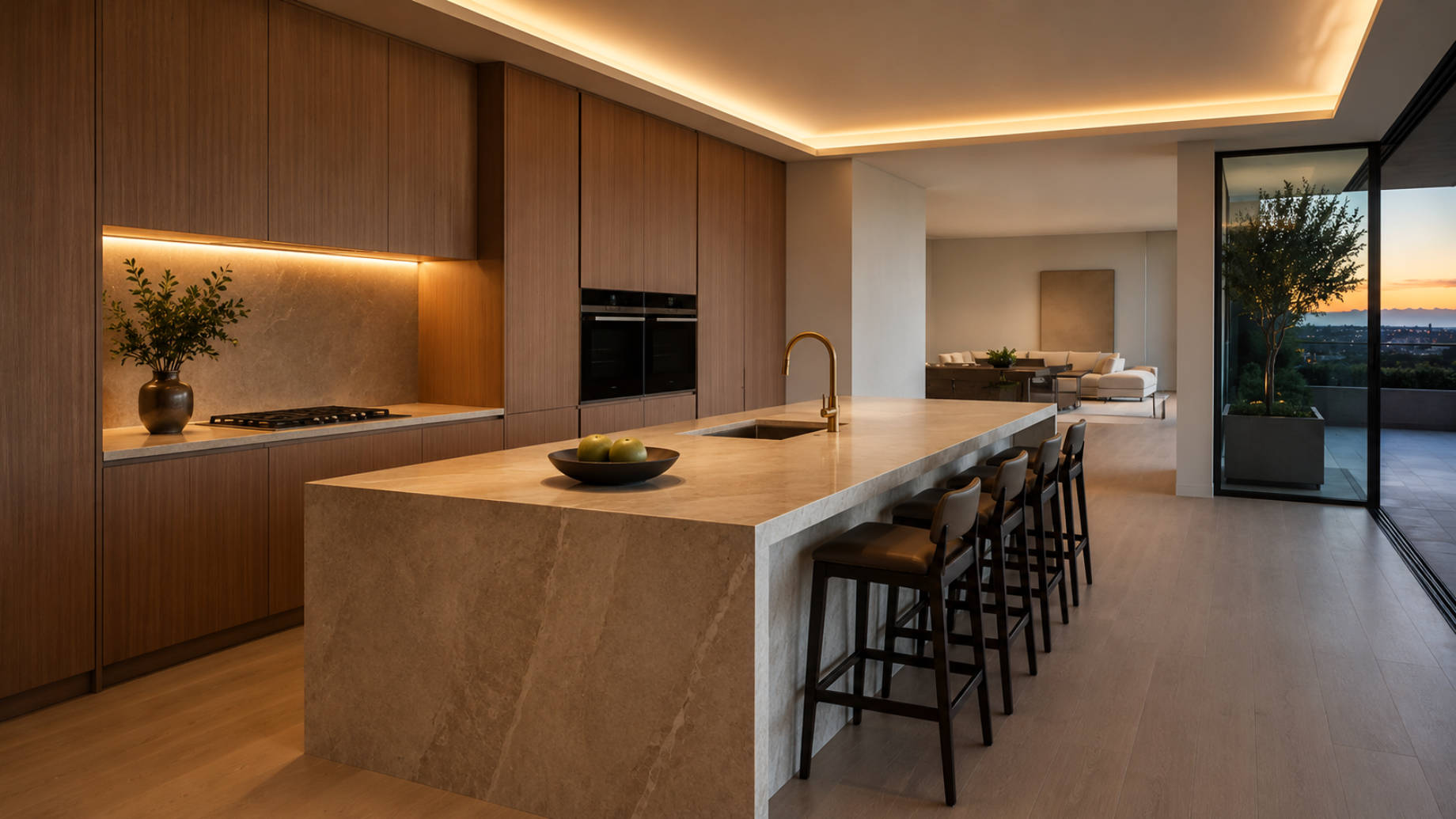
A kitchen can be expensive without ever feeling luxurious. It can have new cabinets, freshly cut stone, a respectable lighting plan, and a six-figure appliance package, and still fall short of the quality people expect in a genuinely elevated space. That’s because luxury in a kitchen isn’t a function of cost. It’s the product of a deeper level of planning, restraint, and intent.
A standard renovation tends to replace what’s old with something newer. A luxurious kitchen does considerably more. It improves how the room actually works, sharpens the relationship between function and design, and produces a space that feels calm, tailored, and effortless to use.
The difference isn’t always dramatic at first glance. More often, it’s felt before it’s noticed. The room flows. The materials look considered. Storage disappears into the cabinetry. Light lands where it should. The whole kitchen sits in itself in a way that ordinary updates rarely achieve.
Layout is treated as the foundation, not an afterthought
The biggest difference usually starts with the layout. In a standard renovation, the floor plan often survives the project intact while everything around it gets replaced. That can sharpen the look of the room without doing much for daily life inside it.
A luxurious kitchen takes the opposite view. The layout is the starting point, because it shapes every later decision. Circulation, prep space, storage, seating, sightlines, and the relationship between the kitchen and the rooms around it are all considered before anyone opens a finish library.
That attention changes the experience of being in the room. Cooking gets easier. Hosting gets easier. Moving through the kitchen on the way to somewhere else stops being a negotiation. A kitchen that feels effortless almost always begins with decisions you don’t notice at first — and feel constantly once the room is in use.
The design responds to the house, not just the room
One reason certain kitchens feel expensive but not truly refined is that they read as separate from the house around them. The finishes are handsome on their own, but the room feels like its own project rather than a chapter of a larger one.
A luxurious kitchen is more integrated. It responds to the architecture, the light, the scale of the adjoining rooms, and the overall character of the home. The materials look like they belong. The proportions agree with the spaces on either side. Transitions into the dining room, the living area, or the terrace feel composed rather than abrupt.
That’s one reason a well-planned custom kitchen remodel tends to carry more presence than a renovation built around product selection. The room reads as designed, not assembled.
Materials are chosen for depth, not for impact
Luxury is often misread as visual drama. In practice, the most successful kitchens feel refined precisely because their materials have depth rather than volume.
Stone with quiet natural movement instead of an attention-grabbing pattern. Wood with real character and warmth rather than a uniform finish. Hardware that has weight in the hand and a restrained finish. Cabinetry built to the room, not adapted from a catalogue. These choices age into a kitchen instead of dating it. The goal isn’t to impress from every angle. It’s to make a room that stays balanced as you live with it.
Standard renovations tend to reach for trend-forward details because they read as change. Luxurious kitchens are more disciplined. They rely on fewer, better decisions that hold together over a decade.
Storage is built into the experience of the room
A beautiful kitchen loses most of its power if everyday life turns it into visual chaos within a week. This is where storage becomes one of the clearest markers of real quality.
In a standard renovation, storage usually grows but follows a fairly generic formula. In a more luxurious kitchen, storage is shaped around the way the room is actually used. Deep drawers for stacks of pans. A dedicated home for the toaster and the espresso machine so they’re not living on the counter. A pantry planned around the things you actually buy. Integrated waste and recycling. Clear zoning so the spices live near the stove and the glasses live near the sink.
That kind of planning is what gives a kitchen its polished feel. It quietly removes friction from the day. The luxury isn’t only in how the cabinetry looks — it’s in how naturally the room absorbs ordinary life.
Lighting is layered with more precision
Lighting matters enormously to how luxurious a kitchen feels, and not because someone hung a striking pendant over the island. In a thoughtful kitchen, lighting is built in layers that carry the room through every part of the day.
Task lighting handles the counters and the cooktop, so the work actually gets done well. Ambient lighting softens the room in the evening. Accent lighting brings out the depth in materials that would otherwise read flat after dark. Natural light is treated as part of the plan from the start, not as a happy accident that the architecture occasionally provides.
A standard renovation may include attractive fixtures. A luxurious kitchen uses light intentionally enough that the room looks composed at 7 a.m., at 1 p.m., and at 9 p.m. — three completely different rooms, all by design.
Craft and detail are easier to sense
Luxury shows up most clearly in the details no one points at. Cabinet proportions look right rather than arbitrary. Joinery is crisper. Door and drawer panels line up with each other and with the floor reveal. Hardware feels solid when you pull it. Edges, reveals, and transitions are resolved instead of merely closed.
This level of finish is genuinely hard to fake. It comes from careful planning and careful execution, and there’s no shortcut to it. It’s the difference between a kitchen that photographs well and one that holds up when you’re standing in it.
None of this requires ornament. Often the opposite is true. The simpler the design, the more nakedly the quality of the detail has to carry the room — which is part of why minimal kitchens are so unforgiving to build well.
The room supports a lifestyle, not just an aesthetic
A standard renovation tends to focus on what’s visible. A luxurious kitchen asks a broader question — how should this room actually feel to live in?
That shift changes the design priorities. It may lead to better circulation between the prep zone and the dining area, quieter storage solutions for the appliances people use daily, a more natural gathering spot for evenings with friends, or a stronger connection to whatever’s outside the back wall. It often leads to choices that reduce visual noise rather than adding to it.
In other words, a luxurious kitchen isn’t simply a prettier version of the old one. It’s a more honest expression of how the home is meant to function.
Restraint does more than people expect
One of the most underrated qualities in luxury design is restraint. Standard renovations often try to prove their value by piling on — more contrast, more finishes, more decorative moments, more trend signals.
A truly luxurious kitchen feels more controlled. The palette is tighter. The details are more selective. The design is secure enough not to oversell itself.
That restraint is a big part of why these rooms age well. Rather than feeling pinned to a specific moment, they feel grounded in quality and proportion — qualities that don’t go out of fashion.
Final thought
What separates a truly luxurious kitchen from a standard renovation isn’t a single feature you can point to. It’s how every meaningful part of the room works in concert. Layout, materials, light, storage, proportion, and detail are all pulling in the same direction.
A standard renovation can make a kitchen look new. A luxurious kitchen goes further. It makes the room feel resolved, natural to use, and seamlessly tied to the home around it.
That’s what stays with people. Not that the finishes were costly, but that the space felt thoughtful, effortless, and complete.
