Most furniture in a well-designed home recedes. It does its work quietly — a side table, a bookshelf, a console — without demanding to be noticed. Two pieces never do: the sofa and the dining table. They are the social anchors of a home, the first things a guest reads when they walk into a room, and the ones that linger longest in the impression they leave. How they are chosen, and what they say about the people who chose them, shapes how a home feels to everyone who enters it.
Getting these two decisions right is not about following trends. It is about understanding what you want your home to say.
The Sofa: Where Character Begins
The living room sofa is the most read piece of furniture in any home. Before a guest has sat down, before they have taken in the art on the walls or noticed the quality of the light, they have already formed an impression — from the sofa’s scale, its silhouette, its material. That impression is rarely conscious. It is simply felt.
Scale comes first, and it is less forgiving than most people expect. A sofa that is too large for a room makes the space feel consumed; one that is too small makes it feel unresolved. The rule of thumb most designers return to is that a sofa should occupy roughly two thirds of the wall it sits against — enough to anchor the room without overwhelming it. Getting this right requires a tape measure and some honesty about the room’s actual proportions, not its aspirational ones.
Silhouette is where personality enters. A low, linear profile reads as contemporary and assured — it assumes the room around it is worth looking at. A deep, cushioned sofa reads as relaxed and deliberate — it tells guests the room is for inhabiting, not presenting. A structured silhouette with tapered legs reads as design-literate and considered — it references a specific tradition without being enslaved to it. None of these is objectively better. All of them communicate something, and the choice should be intentional.
Material is a long-term commitment that most buyers underestimate. Bouclé and velvet are beautiful but unforgiving in households with children, pets, or heavy daily use. Performance fabrics have come a long way and now handle real life without the visual compromise they once demanded. Leather ages well when it is genuine and properly maintained; it ages badly when it is not. The honest question is not what you want the sofa to look like on the day it arrives — it is what you want it to look like, and feel like, three years from now.
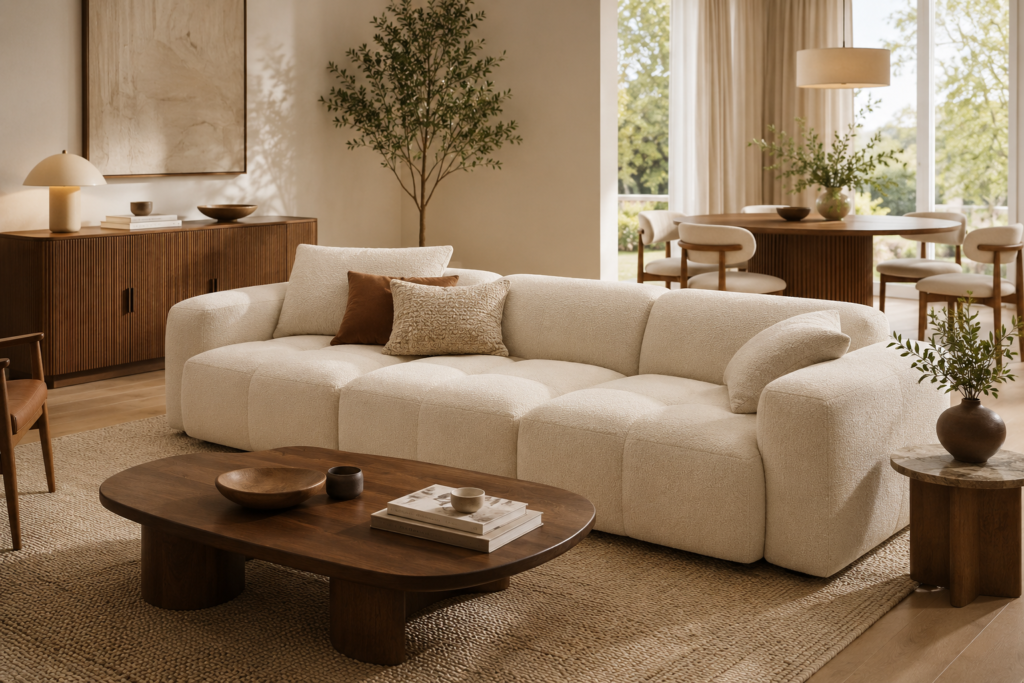
For those working through the options — from modular configurations to deep-seated sectionals to more structured forms — reviewing a broad range of modern sofas across styles, upholstery materials, and configurations is a useful way to sharpen instincts about which direction actually suits the room.
The one principle that overrides all others: choose the sofa for the life that happens in the room, not the life you imagine happening there.
The Dining Table: The Most Underestimated Decision
The dining table is where a home is most alive. Meals, conversations, celebrations, the long late evenings that quietly become memories — they all happen here. And yet it is the piece that most buyers choose least carefully, defaulting to size and price point rather than to the experience the table will create every time people gather around it.
Shape is the first decision, and it carries more weight than most people expect. A round table creates intimacy — everyone can see everyone else, no one sits at the head, conversation moves freely around the surface. It is the right choice for a household that values warmth and ease over formality, and it works particularly well in rooms that are not elongated. A rectangular table suits longer rooms and larger gatherings; it has a natural hierarchy that can feel either grand or practical depending on how it is used. An oval table is often the most underrated option: it softens the rectangle, removes the bluntness of sharp corners, and preserves seating capacity while adding a note of considered elegance.
Material defines the experience of the table in ways that are felt daily. A warm walnut surface creates a different atmosphere from a cool sintered stone top — not better or worse, but categorically different in mood. Stone and sintered surfaces read as formal and contemporary; they are durable and low-maintenance, which matters when a table is used for actual meals rather than occasional entertaining. Solid wood brings warmth and a sense of history; it develops character over time but requires more care. Glass creates lightness and visual openness — it is particularly effective in smaller rooms or against dark walls, though it demands visual restraint in everything around it.
The base is often treated as a secondary consideration. It deserves more than that. A pedestal base opens up legroom and gives the table a sense of weightlessness that four legs cannot match — and it makes seating more flexible when the number of guests varies. Four-leg bases feel grounded and traditional, which suits certain rooms and certain aesthetics perfectly well. Architectural bases — X-frames, trestle structures, sculptural single-column designs — make the table itself a design statement, which can be exactly right or exactly wrong depending on the room’s overall character.
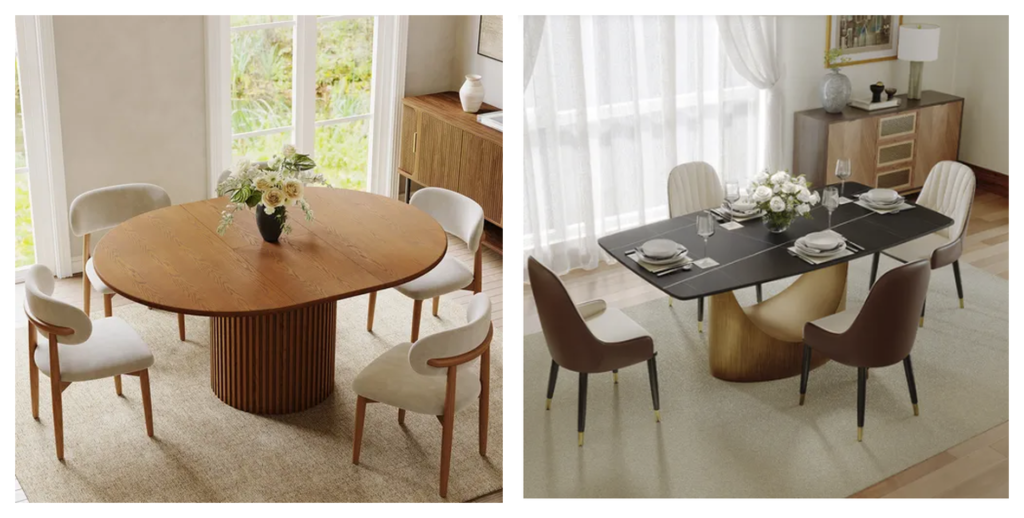
Working through the full range of modern dining tables — across shapes, materials, and base configurations — makes the trade-offs between options more tangible and the final decision more grounded.
How the Two Pieces Work Together
The most considered homes treat the sofa and the dining table as part of a visual conversation — not as independent purchases made at different times with different references in mind. They do not need to match. Matching, in fact, tends to produce rooms that feel like showrooms rather than homes. But they do need to share a design language: a common material reference, similar wood tones, or a consistent level of visual weight that lets the eye move between them naturally.
Scale relationship matters even across rooms. A very large sectional sofa and a very small dining table create a compositional imbalance that is difficult to resolve with other pieces. The two should feel proportionally coherent — generous in a similar way, or restrained in a similar way — even when separated by an open-plan layout.
Material continuity is often the simplest path to coherence. Walnut legs on the sofa and a walnut dining table. A sintered stone dining table surface echoed in a stone-topped coffee table nearby. These are not rules — they are the kind of repeated material references that train the eye to read a home as intentional rather than assembled over time. Brands like Povison work within this principle, maintaining consistent wood finishes, material palettes, and design details across their sofa and dining ranges. The practical effect is that it becomes easier to build a room where the key pieces feel genuinely related without being identical.
The Decision Behind the Decisions
The sofa and the dining table are not necessarily the most expensive purchases in a home. But they are the most visible, the most social, and the most revealing of how a space actually feels to live in. Choosing them with the same care that goes into flooring, architecture, or lighting — rather than as afterthoughts once the structural decisions have been made — is the difference between a home that looks furnished and one that feels genuinely composed.
That distinction, in the end, is what separates a house full of furniture from a home with a point of view.