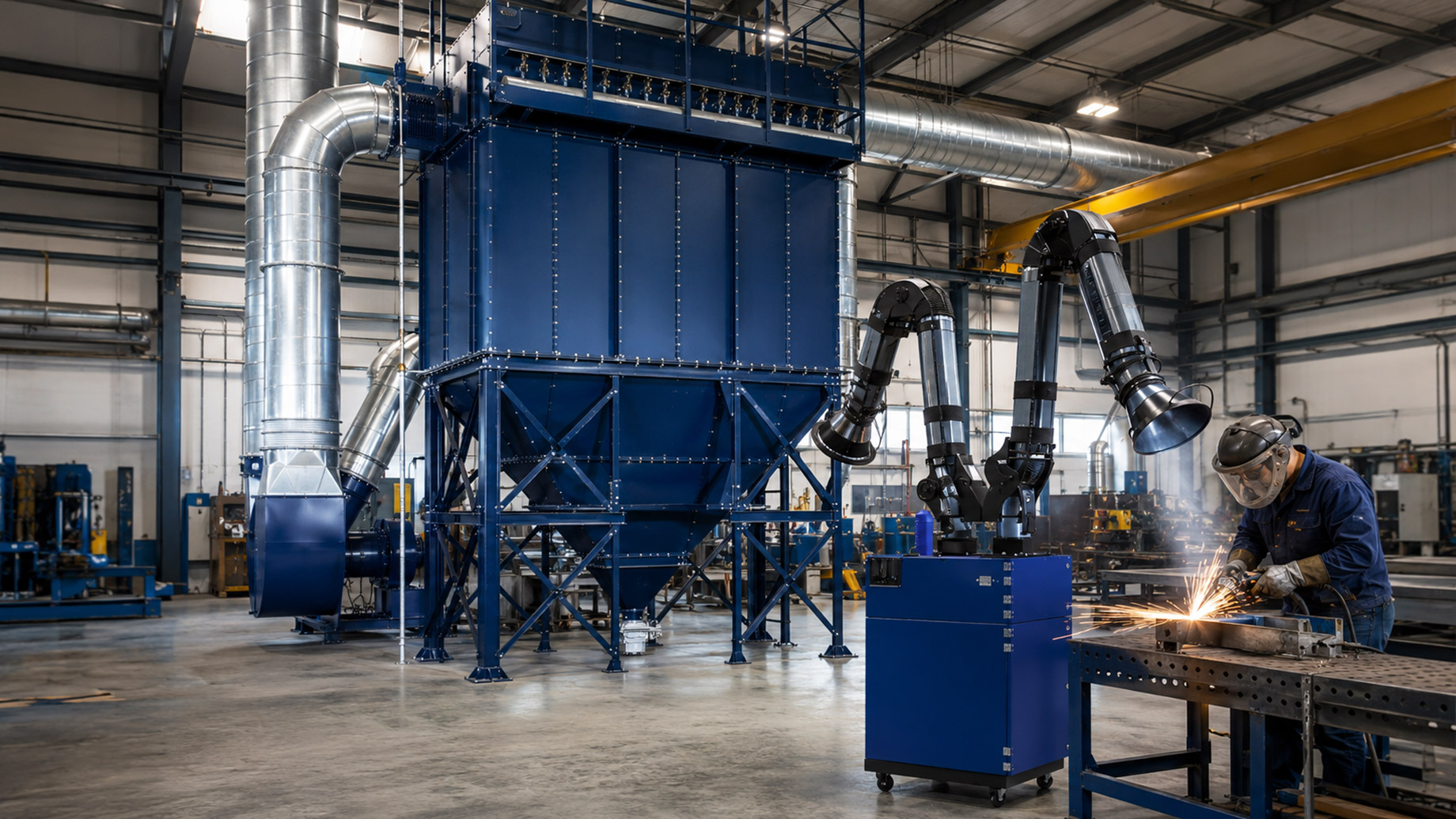
Industrial properties are complex environments. Manufacturing floors, fabrication shops, material processing plants, warehouses, cutting stations, polishing areas, and production lines all depend on clean, controlled air to support safety, productivity, equipment performance, and long-term operational reliability.
Dust, fumes, particulate matter, and process emissions can create more than a housekeeping problem. When airborne contaminants are not captured properly, they can affect machinery, visibility, worker comfort, production efficiency, and the overall condition of the facility. In more demanding operations, they can also increase fire, explosion, corrosion, and maintenance risks.
This is why properly engineered dust collection units are an important part of modern industrial infrastructure. The right system helps capture contaminants close to the source, filter the air effectively, and keep production areas cleaner and more controlled.
What Industrial Dust Collection Systems Do
An industrial dust collection system is designed to move contaminated air away from work areas, separate particles from the airstream, collect the captured material, and discharge or recirculate cleaner air depending on the facility’s requirements.
Unlike small-scale air-cleaning devices, industrial systems are built around process conditions. They must be selected according to the type of dust, the volume of air that must be moved, the layout of the building, the number of workstations, the temperature of the air, the pressure resistance of the ductwork, and the type of filtration required.
Common industrial applications include:
- Metal cutting and grinding
- Polishing and sanding stations
- Welding and fabrication areas
- Mineral, cement, and powder processing
- Woodworking and composite material production
- Bulk material handling
- Industrial coating, finishing, and surface treatment
- Chemical and manufacturing processes that produce fumes, mist, or particulate emissions
When designed correctly, industrial dust collecting units help keep contaminants from spreading through the facility.
Main Components of an Industrial Dust Collection System
Although designs vary depending on the application, most systems include several core components that work together.
These may include:
- Air inlet: The point where contaminated air enters the system.
- Housing: The main body of the collector, designed to contain airflow, filters, and collected material.
- Filter section: The area where bags, cartridges, or other filter elements separate dust from the airstream.
- Cleaning or regeneration system: A mechanism that removes accumulated dust from the filter surface, often through compressed-air pulses or mechanical shaking.
- Dust collection bin or hopper: The lower section where captured particles are stored for removal.
- Fan or blower: The component that generates suction and moves air through the system.
- Outlet pipe or discharge section: The final air path after filtration.
- Spark arrestor or safety device: A protective feature used in certain systems to reduce ignition risks before particles reach the filter area.
The performance of the system depends on how these components are matched. A powerful fan alone is not enough if the ductwork, filters, capture points, and dust discharge system are not properly designed.
Baghouse and Cartridge Systems
Baghouse and cartridge collectors are two common filtration approaches in industrial environments.
A baghouse dust collector uses fabric filter bags to capture dust from the airstream. These systems are commonly used for heavy dust loads, continuous production, and facilities that require durable filtration over long operating cycles. Baghouse systems are often selected when a facility needs a robust central collection solution for multiple production points.
A cartridge dust collector uses cylindrical filter cartridges with a large filtration surface area in a compact footprint. Cartridge systems can be especially useful when a facility needs efficient filtration in a smaller space or where modular design is preferred. They are often used in applications involving fine dust, metalworking, surface finishing, and other industrial processes that benefit from high filtration area in a compact collector.
Both types must be sized according to the actual process, not simply by building size. Dust type, particle size, air volume, filter loading, cleaning method, and maintenance access all matter.
Wet Scrubbers for Industrial Air Cleaning
Not every air pollution control challenge is best handled by dry filtration. In some industrial environments, wet scrubbers are used to remove certain dust particles, fumes, gases, sprays, vapors, acid mixtures, or other process emissions.
A wet scrubber brings contaminated air into contact with liquid, allowing pollutants to be captured through physical and chemical interaction. This can make wet scrubbers useful for applications where the contaminant profile is more complex than dry dust alone.
Wet scrubbers are often considered when facilities deal with:
- Sticky or humid particulate matter
- Acidic or chemically reactive emissions
- Process vapors and sprays
- Operations where dry filtration may not be the ideal method
- Industrial air streams requiring a compact but purpose-built cleaning system
The correct choice depends on the material being captured, the process temperature, the chemical composition of the emissions, and the facility’s environmental requirements.
Portable Dust Collection Units
Portable dust collection units are useful when contamination is concentrated at a specific workstation or when production layouts change frequently. These systems can be placed near the source of dust generation, allowing facilities to capture particles before they spread through the workspace.
A portable dust collection unit may be appropriate for:
- Polishing stations
- Abrasive cutting areas
- Metalworking workstations
- Temporary production zones
- Isolated machinery
- Small workshops
- Testing or experimental manufacturing areas
- Facilities where different workstations are used at different times
Portable dust collection units are especially practical when a full central duct network is unnecessary or when a facility needs flexibility. They can also be useful when contaminants from one operation should not be mixed with dust from other production areas.
Key advantages include:
- Flexible placement near the source of contamination
- Faster installation compared with a full ducted system
- Easier relocation when work areas change
- Practical use for temporary or remote workstations
- Direct access for filter inspection and maintenance
For facilities with changing production demands, a portable dust collection unit can be a practical way to improve localized air quality without redesigning the entire building.
Central Unit Dust Collection for Larger Facilities
Central unit dust collection is usually more appropriate when multiple machines, workstations, or production lines must be connected to one larger system. Instead of placing separate collectors throughout the facility, a central system uses ductwork to capture contaminated air from several points and route it to a main collector.
This approach is often used in:
- Large manufacturing plants
- Continuous production environments
- Facilities with many operating machines
- Operations with heavy dust loads
- Production lines requiring 24/7 air handling
- Sites where hot air or process emissions must be extracted directly from equipment
- Facilities where filtered air may need to be returned to the building
Central systems require careful engineering. The duct network must maintain sufficient transport velocity so dust does not settle inside the ducts. The fan must be selected to overcome system resistance, and the filtration area must be appropriate for the dust load and airflow volume.
When properly designed, central unit dust collection can provide consistent performance across a large industrial site.
Important Design Parameters
Selecting the right system requires more than choosing between portable and central equipment. The design must reflect the operating realities of the facility.
Important parameters include:
- Airflow volume: The system must move enough air to capture dust at each generation point.
- Capture velocity: Air must move fast enough at the source to prevent particles from escaping into the workspace.
- Duct transport velocity: Dust must remain suspended in the ductwork until it reaches the collector.
- Static pressure: The fan must overcome resistance from ducts, filters, fittings, and equipment.
- Filter media: Bags or cartridges must match the dust type, temperature, moisture, and chemical conditions.
- Temperature: The system must account for operating temperature, dew point, corrosion risk, and filter material limits.
- Air-to-cloth ratio: The filtration area must be appropriate for the airflow and dust characteristics.
- Dust characteristics: Fine, abrasive, sticky, combustible, toxic, or fibrous dust may each require different design choices.
- Maintenance access: Filters, bins, hoppers, and service doors should be accessible for inspection and cleaning.
- Safety controls: Spark arrestors, explosion protection, and other safeguards may be necessary depending on the process.
Ignoring these factors can lead to poor capture performance, clogged filters, excessive pressure drop, duct accumulation, premature equipment wear, and higher operating costs.
Why System Selection Matters for Industrial Property Performance
For owners, operators, developers, and managers of industrial properties, air control systems are part of the building’s operational value. A facility with poorly controlled dust can face higher maintenance costs, more frequent cleaning, production interruptions, and greater wear on equipment.
A properly selected system can support:
- Cleaner production areas
- Better working conditions
- Reduced dust accumulation on machinery and surfaces
- More reliable equipment performance
- Improved process control
- Easier maintenance planning
- Better suitability for manufacturing tenants
- Longer-term property functionality
In industrial real estate, these factors can affect how well a building supports modern production. A clean, well-managed facility is easier to operate, easier to lease, and more adaptable to demanding tenants.
Choosing Between Portable and Central Systems
The decision between portable dust collection units and central systems should be based on the facility layout, production process, and contaminant profile.
A portable system is usually the better choice when:
- Dust is generated at one workstation
- Operations move or change often
- The process is temporary or experimental
- A small number of machines need localized capture
- Contaminants should remain isolated from other areas
- Fast deployment is important
A central system is usually the better choice when:
- Multiple workstations operate at the same time
- Dust loads are high or continuous
- The facility needs one integrated air-handling solution
- Ducted capture from several machines is required
- The building supports large-scale manufacturing
- Long-term production efficiency is the priority
Some facilities may use both. A central system can handle the main production floor, while portable units support remote stations, temporary work, or specialized processes.
Final Thoughts
Industrial air management is not a secondary detail. It is part of how a modern manufacturing or processing facility functions. Whether a site requires baghouse filtration, cartridge collectors, wet scrubbers, portable systems, or a fully engineered central installation, the goal is the same: capture contaminants effectively, protect the production environment, and support reliable operations.
The best system is not simply the largest or most powerful option. It is the one designed around the facility’s actual dust sources, airflow needs, process conditions, maintenance requirements, and long-term production goals.
