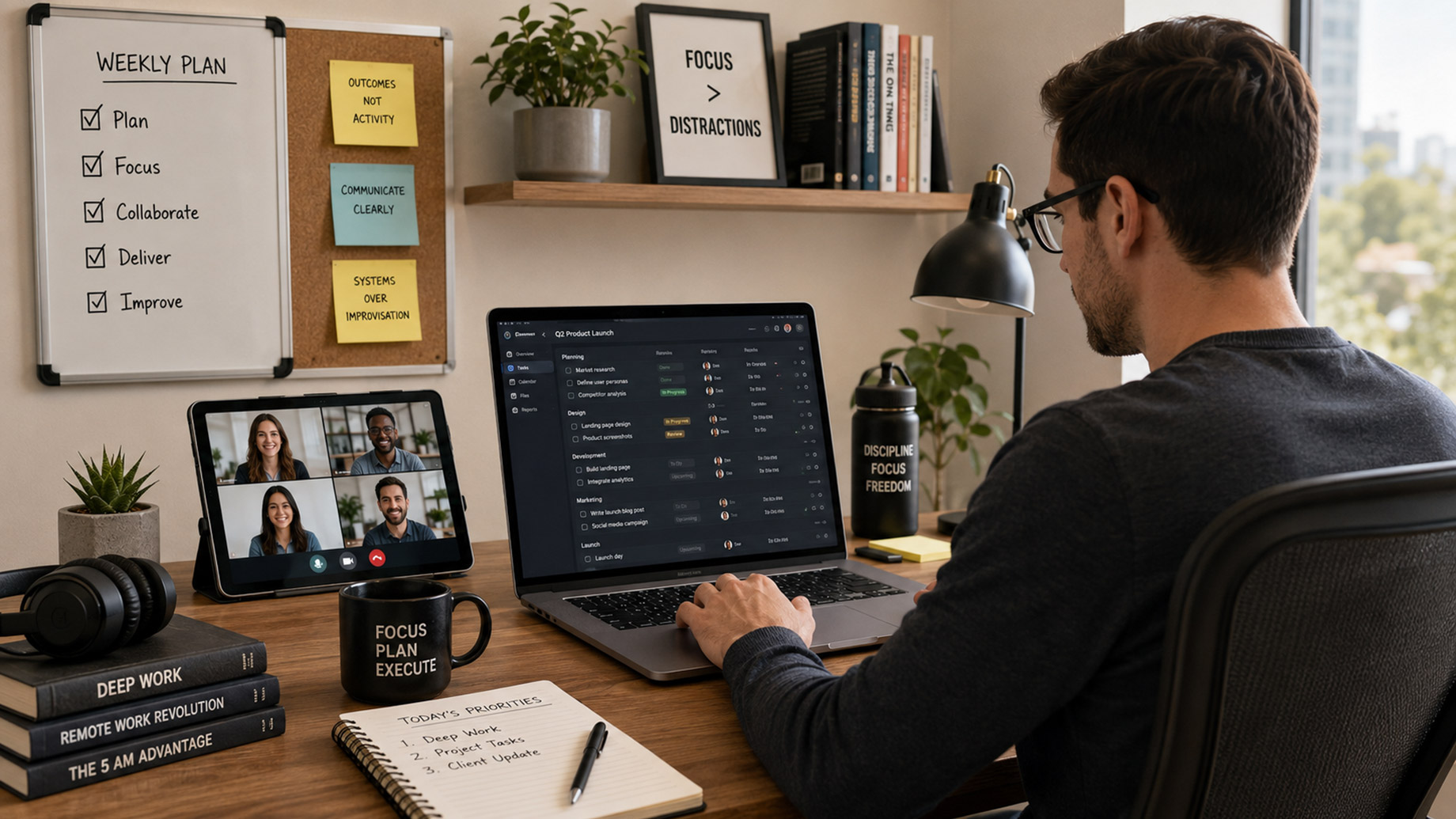
Remote work has evolved into a high-performance discipline. It’s no longer about simply logging in from home—it’s about executing reliably in distributed systems, communicating with precision, and maintaining output without burning out. The professionals who succeed treat remote work like an operating model: they design workflows, standardize communication, and use technology intentionally.
This guide breaks down the tools, tips, and tactics that actually work in 2026. Done right—and supported by the right remote work tools—these practices will help you produce consistent results, regardless of where you work.
What “Mastery” Looks Like in Remote Work
Before diving into tactics, define the target state. Remote work mastery means:
- Delivering outcomes consistently, not just activity
- Maintaining focus without supervision
- Communicating clearly across time zones
- Operating with systems instead of improvisation
- Sustaining performance without burnout
If your workflow meets these criteria, you’re not just working remotely—you’re mastering it.
The Tool Stack That Powers Remote Work
Technology is the backbone of distributed work—but only when used strategically. A fragmented tool stack creates confusion; a well-designed one creates flow.
Core Categories You Need
- Communication Layer: Messaging and video platforms for real-time and async updates.
- Work Management System: Task tracking, project timelines, and accountability.
- Knowledge Base: Centralized documentation for processes, decisions, and resources.
- File & Collaboration System: Shared storage with version control and easy access.
- Automation & AI Layer: Handles repetitive work like scheduling, summaries, and data organization.
This ecosystem of remote work tools should be simple, integrated, and consistently used across your team.
Tips That Improve Daily Execution
Mastery comes from small, repeatable behaviors.
Tip #1: Start with Outcomes, Not Tasks
Define what “done” looks like before you begin. This sharpens focus and prevents wasted effort.
Tip #2: Limit Your Daily Priorities
Focus on 3–5 high-impact tasks. Overloading your list reduces completion rates.
Tip #3: Protect Your Peak Hours
Schedule deep work during your highest energy periods and guard that time aggressively.
Tip #4: Use Structured Communication
Every update should include:
- Context
- Current status
- Next steps
- Deadline
This eliminates back-and-forth confusion.
Tip #5: Review Your Day
A quick end-of-day review improves planning and reduces stress.
Tactics for High-Performance Remote Work
1. Time Blocking with Intent
Instead of reacting to tasks, design your day in advance.
Example Structure:
- Deep work (morning)
- Meetings (midday)
- Admin tasks (afternoon)
- Review and planning (end of day)
This reduces decision fatigue and increases efficiency.
2. Async-First Collaboration
Real-time meetings are useful but often overused.
Tactical shift:
- Use written updates for progress
- Record explanations instead of scheduling calls
- Reserve meetings for decisions or complex discussions
This keeps work moving across time zones.
3. Single Source of Truth
Information scattered across platforms leads to errors.
Solution: Centralize all project data, tasks, and documentation in one system supported by your remote work tools.
This ensures:
- Everyone works from the same information
- Less duplication of effort
- Faster decision-making
4. Deep Work as a Default Mode
Shallow work dominates remote environments if not controlled.
Execution tactics:
- Block 60–90 minute focus sessions
- Turn off notifications
- Avoid multitasking
High-value work requires uninterrupted attention.
5. Weekly Optimization Loop
Continuous improvement is essential.
Weekly process:
- Review completed work
- Identify bottlenecks
- Adjust workflows
This keeps your system efficient over time.
Avoiding the Most Common Remote Work Failures
Even experienced professionals fall into these traps:
Tool Overload
Using too many platforms creates friction.
Fix: Consolidate and standardize.
Meeting Overload
Too many meetings reduce productive time.
Fix: Adopt async-first communication.
Lack of Visibility
Work goes unnoticed without updates.
Fix: Share structured progress reports.
Burnout
Overworking reduces long-term performance.
Fix: Set boundaries and schedule recovery time.
Building a Sustainable Work System
Remote work is a long-term model. Sustainability matters more than short bursts of productivity.
Create a Repeatable Workflow
Your day should follow a predictable pattern that reduces decision-making.
Automate Where Possible
Use remote work tools to handle repetitive tasks and free up cognitive bandwidth.
Set Clear Boundaries
Define work hours and stick to them to avoid burnout.
The Role of Mindset in Mastery
Tools and tactics are only effective when paired with the right mindset.
Ownership
You are responsible for your output, schedule, and communication.
Discipline
Consistency beats motivation. Build habits that support performance.
Adaptability
Remote work evolves quickly—be ready to adjust your approach.
Measuring Success in Remote Work
Traditional metrics don’t always apply. Focus on:
- Output quality
- Task completion rate
- Meeting deadlines
- Impact of your work
Tracking these indicators provides a clearer picture of performance.
Future-Proofing Your Remote Work Strategy
The remote landscape will continue to evolve. To stay ahead:
- Embrace automation and AI
- Improve digital communication skills
- Continuously refine your workflow
- Stay updated with emerging remote work tools
Those who adapt quickly will maintain a competitive edge.
A Simple Daily Framework for Mastery
If you want a practical starting point, follow this:
Morning
- Plan your top priorities
- Complete one deep work session
Midday
- Handle meetings and collaboration
Afternoon
- Complete remaining tasks
- Process emails and admin work
Evening
- Review progress
- Plan the next day
This structure creates consistency and clarity.
Final Thoughts
Remote work mastery isn’t about working more—it’s about working with precision, clarity, and intention. The combination of structured systems, disciplined execution, and the right remote work tools creates a workflow that is both efficient and sustainable.
When you focus on outcomes, streamline your processes, and continuously refine your approach, remote work becomes more than a convenience—it becomes a strategic advantage.
Master the system, and you’ll master the work—no matter where you are.