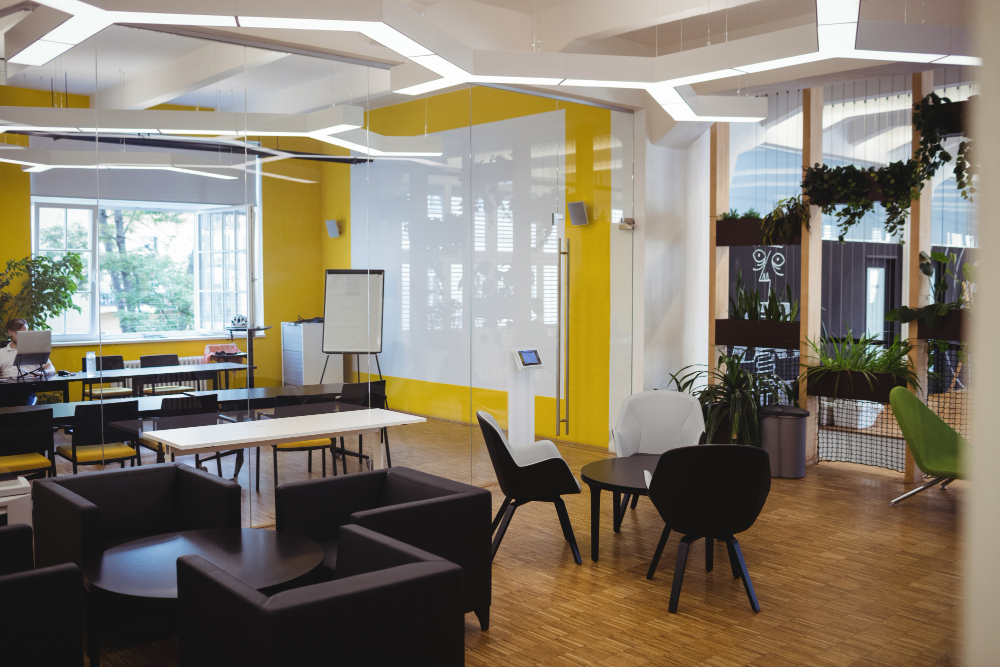
In today’s evolving workplace, the question is no longer just how much office space do you need per employee but what that space represents. Beyond simple metrics, spatial planning has become a reflection of organisational culture, design intent, and the way people interact within the built environment. As businesses adapt to new ways of working, the modern office is being redefined through a more considered approach to layout, experience, and flexibility.
The Shift from Quantity to Quality
For decades, office planning followed predictable formulas, often guided by the standard office room size in meters and a fixed allocation per desk. While these benchmarks still provide a useful reference, they no longer dictate design outcomes in the same way.
Today, leading workplaces prioritise quality of space over quantity. This means considering not just how much room each employee occupies, but how effectively that space supports productivity, comfort, and collaboration. In premium office environments across global cities, spatial efficiency is carefully balanced with a sense of openness, light, and material sophistication.
Understanding Space Per Employee in Contemporary Offices
Traditional allocations typically ranged between 8 to 15 square metres per person. However, the rise of hybrid work and agile environments has reshaped these expectations.
The concept of open plan office space per person has reduced individual footprints in many cases, but it has also introduced new design challenges. Density alone is no longer the goal. Experience and usability now define success.
Modern benchmarks often include:
- Open plan environments: 8–10 sqm per person
- Activity-based workplaces: 6–8 sqm per person
- Private offices: 12–20 sqm per person
Yet these figures are only part of the story. The most effective workplaces are those that adapt these guidelines to suit the rhythm and character of the organisation.
Read more: How to Design an Office for a Gen Z Workforce
The Influence of Design on Spatial Perception
One of the most significant shifts in commercial interior design is the understanding that space is not purely physical. It is also perceptual.
Elements such as:
- Natural light and glazing
- Ceiling height
- Material palette
- Spatial flow and circulation
can dramatically influence how large or comfortable a workplace feels, regardless of its actual footprint.
In this context, a well-executed office renovation can transform a compact floorplate into a highly functional and visually expansive environment. The goal is not simply to maximise space, but to enhance how it is experienced.
Beyond the Desk: A More Holistic Allocation of Space
The modern office is no longer centred around rows of workstations. Instead, it is composed of a variety of settings designed to support different modes of work.
Rather than focusing solely on individual desk size, organisations are allocating space across:
- Collaborative zones for team interaction
- Quiet areas for focused tasks
- Informal breakout spaces
- Meeting rooms of varying scale
This layered approach reflects a broader evolution in workplace thinking, where flexibility and choice are prioritised over uniformity.
Open Plan, Reconsidered
While open plan layouts remain prevalent, their success depends on thoughtful execution. Simply reducing the open plan office space per person without addressing acoustics, privacy, and zoning can undermine both comfort and productivity.
Contemporary open offices are more nuanced. They incorporate:
- Acoustic treatments to manage noise
- Visual screening for privacy
- Defined zones to support different activities
In high-performing workplaces, openness is not about removing structure. It is about creating a balanced and adaptable environment.
Designing for Flexibility and Longevity
As organisations continue to evolve, so too must the spaces they occupy. Flexibility has become a defining characteristic of effective workplace design.
Through strategic office renovation and forward-thinking commercial interior design, businesses are creating environments that can adapt over time. This includes:
- Modular layouts that can be reconfigured
- Multi-functional spaces that serve different purposes
- Technology integration that supports mobility
Rather than designing for a fixed headcount, the focus is on creating a workplace that remains relevant as needs change.
A New Definition of Workplace Value
Ultimately, the question of space per employee is no longer just a calculation. It is a strategic decision. The modern office must balance efficiency with experience, ensuring that every square metre contributes to both performance and wellbeing.
In this sense, the workplace becomes more than a functional setting. It is an environment that shapes how people think, collaborate, and engage. As expectations continue to evolve, the most successful offices will be those that move beyond rigid standards to embrace a more holistic, design-driven approach.