For the better part of two decades, the ritual of finding a home service professional followed a predictable, often frustrating script. It began with a specific need—a leaking pipe, a flicker in the hallway lights, or a desire for a kitchen refresh—and was followed by a tedious digital hunt. In the pre-digital era, homeowners relied on the static Yellow Pages or word-of-mouth recommendations from neighbours. Then came the era of the search engine, a period defined by typing fragmented keywords like “plumber near me” or “best roofer [City Name]” and sifting through pages of blue links, sponsored ads, and often contradictory star ratings.
However, we are currently witnessing a fundamental shift in consumer behaviour that is arguably the most significant since the invention of the search engine itself: the rise of Artificial Intelligence as the primary concierge for home management.
Homeowners are increasingly bypassing traditional search methods in favour of AI assistants, such as ChatGPT, Claude, and Google’s AI Overviews. This transition is not merely a change in the technology we use; it represents a profound change in consumer psychology. The modern homeowner is no longer looking for a list of options to investigate; they are looking for a specific, synthesized answer to a complex problem.
The Evolution: From Keywords to Conversation
The traditional search model was built entirely on keywords. It required the user to translate their problem into “Google-speak.” A homeowner needing a bathroom renovation might type “bathroom remodel contractors” and then spend hours opening multiple tabs, comparing websites, cross-referencing Yelp reviews with Google Business Profiles, and trying to decipher which companies were still in business or available.
AI has disrupted this dynamic by enabling—and encouraging—conversational search. Homeowners are now asking complex, nuanced questions that mirror how they would speak to a knowledgeable property manager or a trusted neighbor. Instead of distinct, robotic keywords, queries are becoming long-form and context-heavy.
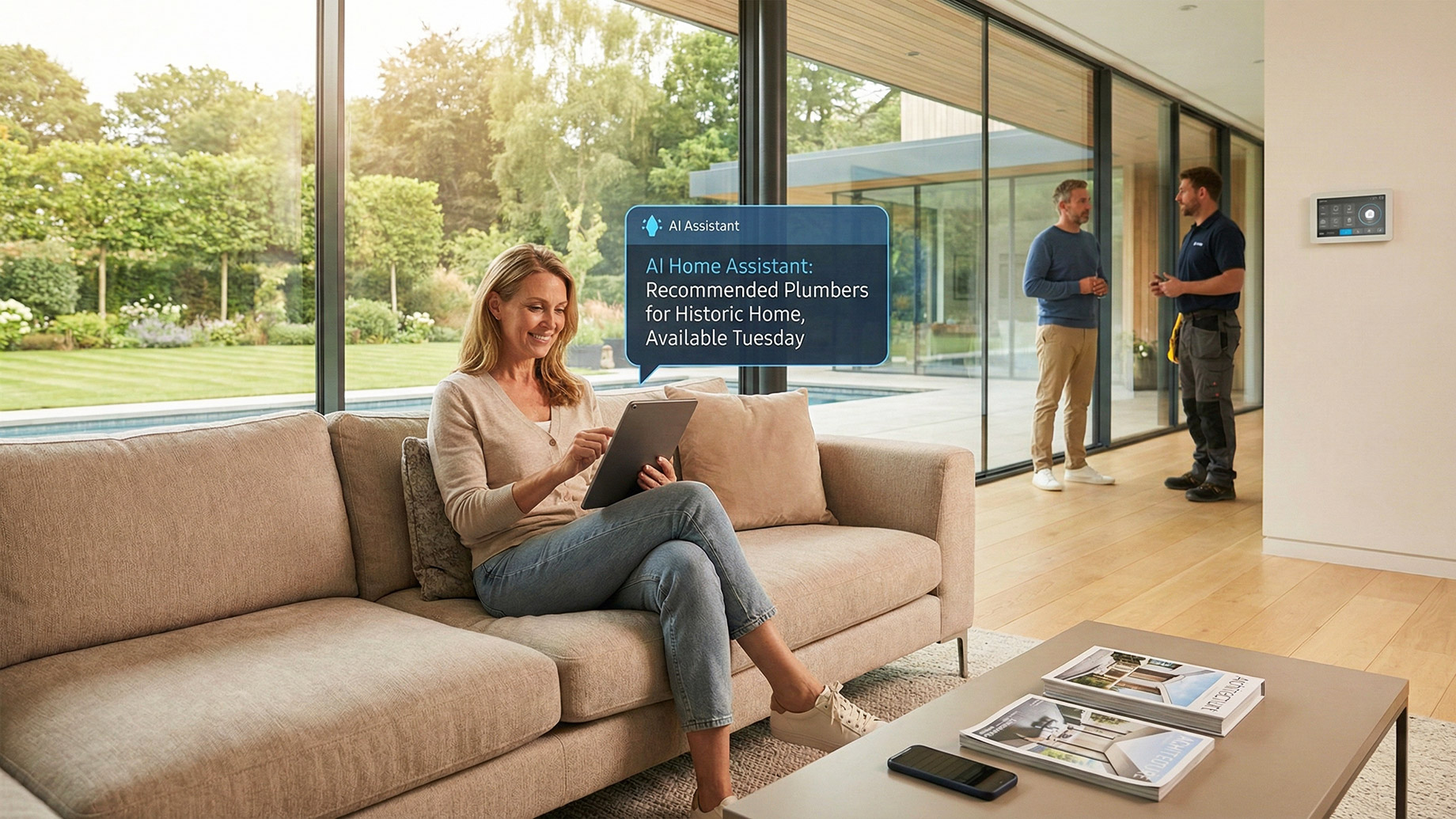
A homeowner today is far more likely to open an AI assistant and ask, “Who is the most reliable roofer near me who specializes in slate tiles and has experience with historic homes?” or “Who do you recommend for a bathroom remodel in my area that fits a mid-century modern aesthetic and has availability next month?”
This shift from “search” to “ask” changes the discovery landscape entirely. The AI aggregates data from across the web—reviews, forum discussions, business profiles, social media mentions, and articles—to synthesize a direct recommendation. For the homeowner, this significantly reduces the cognitive load of decision-making. They don’t want ten tabs open with ten different phone numbers; they want a summarized shortlist of who is the best for their specific situation and why.
The End of “Link Hunting” and Analysis Paralysis
One of the primary drivers of this shift is the concept of “analysis paralysis.” In the traditional model, a search for “HVAC repair” yields millions of results. The burden is entirely on the homeowner to filter the noise. They must differentiate between the company with the best SEO (Search Engine Optimization) and the company with the best actual service.
AI assistants strip away this noise. When a user engages with an AI model, the “blue links” that defined the internet for twenty years become secondary. Google’s introduction of AI Overviews places a generated summary at the very top of the results page, often pushing traditional organic links below the fold.
If a homeowner asks about “emergency HVAC repair for a carrier unit,” the AI can provide a summary of the top three providers, highlighting their specific strengths (e.g., “Company A offers 24/7 service,” “Company B specializes in Carrier units,” “Company C has the highest customer satisfaction for pricing”). This evolution signifies that discovery is now driven by AI-generated answers rather than manual user research. The AI acts as a curator, interpreting the user’s intent—such as urgency, specific material requirements, or budget constraints—and matching it with the semantic data available on various service providers.
The Role of Digital Accuracy and Visibility
For home service professionals, this presents a daunting new challenge: how to be “recommended” by a machine rather than just “found” by a search engine. The algorithms powering these assistants prioritize authority, consistency, and contextual relevance over simple keyword density.
In the past, a business could rank high simply by having a lot of backlinks or a keyword-stuffed description. Today, AI models are “reading” the internet to understand the entities behind the websites. They are looking for consistency across the web. If an AI cannot verify a business’s expertise, service area, or current hours through available data, it is less likely to recommend it in a conversational response. The risk of “hallucination”—where an AI invents information—means these models are programmed to be cautious.
Within this context, the backend data of a business becomes its most valuable asset. Some home service businesses use tools like Pantora to improve their online visibility and ensure they are accurately represented when homeowners rely on AI-driven discovery. By ensuring that the data feeding these AI models is structured, accurate, and comprehensive, professionals can increase the likelihood of appearing in those crucial, conversational answers. If a business’s digital footprint is messy or contradictory, the AI may simply skip over them in favor of a competitor with a clearer data profile.
Trust, Sentiment, and the “Human” Element
Perhaps the most sophisticated aspect of this AI revolution is how it handles trust and reputation. In the old model, a business with a 4.8-star rating was generally assumed to be “good.” However, star ratings can be misleading. A 4.8 rating could be the result of five reviews or five hundred.
AI assistants dig deeper. They analyze the sentiment of the reviews, not just the score. A homeowner might ask, “Find me a landscaper who is known for cleaning up thoroughly after the job.” The AI can scan thousands of review text bodies to find mentions of “clean up,” “mess,” or “tidy,” and recommend a professional based on that specific qualitative trait, regardless of whether those keywords appear on the business’s actual website.
This forces home service professionals to focus on the holistic customer experience. In an AI-driven world, your “digital reputation” is a composite of every interaction, comment, and review across the web, synthesized into a single narrative by the algorithm.
Ongoing Interactions: The AI Project Manager
Another profound change AI brings to the home service industry is the concept of “ongoing interaction.” A traditional search engine interaction is usually transactional and fleeting: search, click, call, leave. An AI interaction is continuous and contextual.
Homeowners are beginning to treat these assistants as long-term project managers. The conversation may start with, “How much does a kitchen remodel cost in my zip code?” and evolve into, “What permits do I need for this?” and finally, “Based on my budget of $50k, which local contractor has the best reviews for custom cabinetry?”
The AI builds a context window, remembering previous details about the homeowner’s house and preferences. This allows for a level of personalization that traditional search engines simply cannot match. If an AI knows a user has a historic Victorian home based on previous questions about window restoration, it will filter its future recommendations for contractors who have experience with preservation, effectively filtering out generalists who might otherwise rank highly for generic keywords.
The Future: Multimodal Discovery
Looking ahead, the friction of finding a professional will decrease even further as these tools become “multimodal”—capable of processing images, video, and voice simultaneously. We are rapidly approaching a reality where a homeowner will be able to snap a photo of a leaking pipe, a cracked piece of drywall, or a dying patch of lawn, upload it to an AI assistant, and ask, “What is wrong with this, how much will it cost to fix, and who can be here by Tuesday?”
The AI will analyze the image to diagnose the issue (e.g., identifying a specific type of fungal infection on the lawn), estimate the repair complexity, and cross-reference this with the schedules and capabilities of local pros. This is the future of home maintenance: a seamless integration of visual diagnosis and algorithmic recommendation.
For the modern homeowner, the era of “Googling it” is slowly fading. We are entering the era of the intelligent concierge—a digital intermediary that doesn’t just find information, but understands the home, anticipates needs, and vets professionals in seconds. In this new paradigm, visibility for the service professional isn’t about having the loudest billboard or the most keywords; it’s about being the most trusted, accurate answer in the machine.