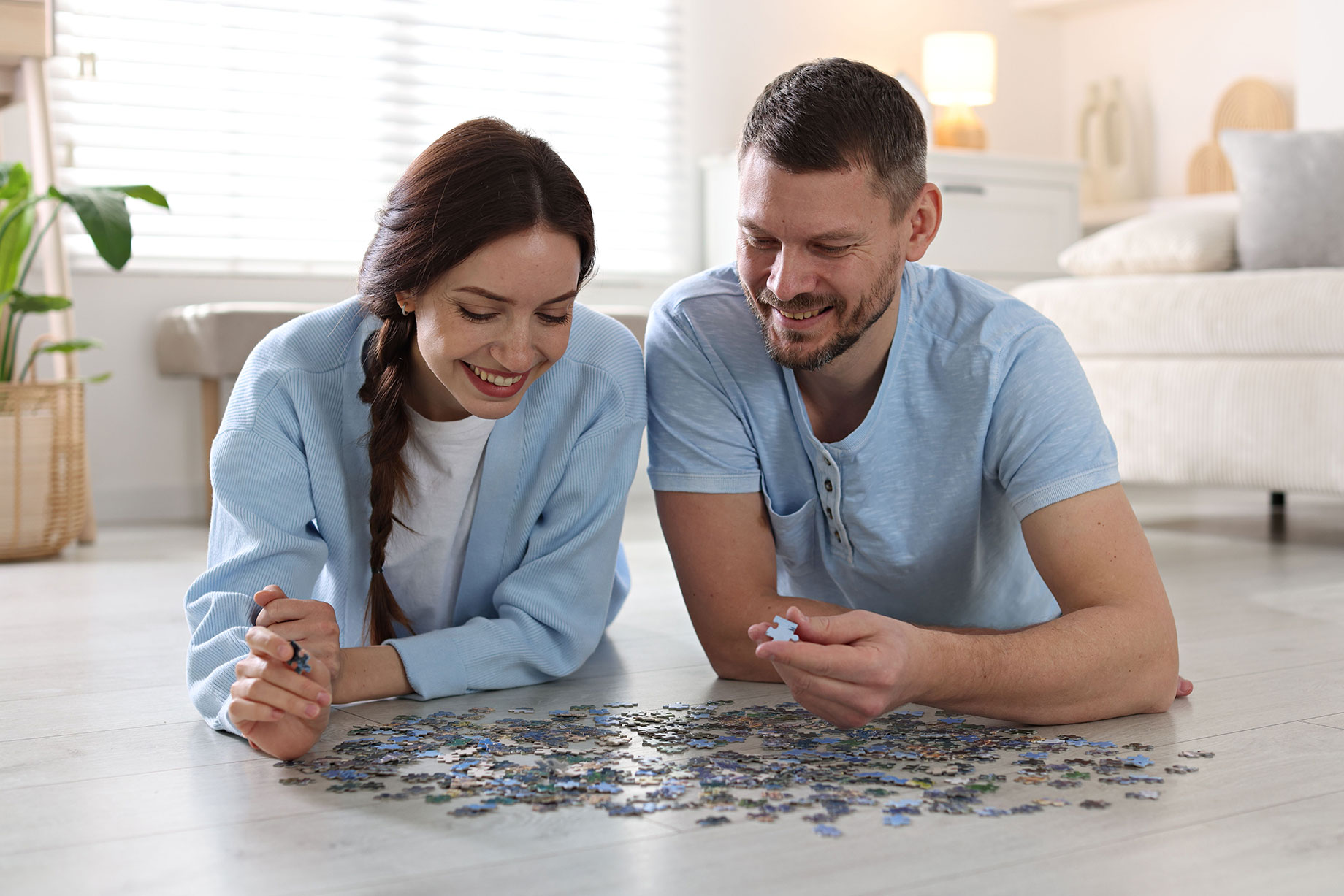
In an era defined by rapid notifications, infinite scrolling, and the constant demand for multitasking, the ability to truly focus has become a rare skill. We live in a digital landscape that fractures our attention span, pulling us in a dozen directions simultaneously. It is perhaps this very fragmentation that has led to a quiet but powerful resurgence of a centuries-old pastime: the jigsaw puzzle.
Once relegated to rainy afternoons and quiet retirement homes, the puzzle has undergone a cultural renaissance. It is no longer just a way to pass the time; it is being embraced by busy professionals, creatives, and wellness advocates as a vital tool for mental clarity. Whether played on a tablet during a commute or spread out on a coffee table on a Sunday morning, the humble puzzle offers a unique antidote to the chaos of modern life.
Engineering a State of “Flow”
Why do we find satisfaction in fitting jagged pieces of cardboard or pixels together? The answer lies in psychology. The activity requires a specific type of engagement that neuroscientists refer to as “flow.” This is a state of complete immersion in an activity, where the ego falls away, and time seems to fly.
When you are working on a puzzle, you are engaging both sides of your brain. The left hemisphere, responsible for logic and sequence, analyzes the shape of the pieces. The right hemisphere, the seat of creativity, manages the intuitive matching of colors and the visualization of the bigger picture. This simultaneous activation creates a mental workout that is surprisingly relaxing. It forces the brain to shift gears from the frantic “beta” wave state of daily stress to a calmer “alpha” wave state, similar to what is achieved during dreaming or meditation.
The Dopamine Loop
Every time you successfully place a piece, your brain releases a small hit of dopamine, the neurotransmitter associated with reward and pleasure. In a work environment where projects can take months to complete, these immediate, tangible micro-victories provide a sense of agency and accomplishment that is deeply satisfying.
The Digital Evolution: Puzzling Without Boundaries
While the romantic image of a 1,000-piece puzzle spread across a dining table persists, the modern lifestyle often demands more flexibility. Not everyone has the space to dedicate to a sprawling project for weeks on end, nor the desire to manage the risk of losing a crucial corner piece.
The digitization of the hobby has opened the doors to a new generation of enthusiasts. High-definition screens and touch interfaces have made the experience tactile and immersive without the physical clutter. This is particularly valuable for those who travel frequently or have compact living spaces.
Digital platforms have also democratized access to high-quality imagery. You can now access vast libraries of art, landscapes, and abstract designs instantly. For those looking to decompress without a subscription fee or a trip to the store, free jigsaw puzzles are readily available online. These digital iterations allow you to customize the difficulty level, from a breezy 50-piece break to a grueling 500-piece challenge, ensuring that you can fit a mental workout into a 15-minute gap in your schedule.
Comparing the Experience
| Feature | Traditional Physical Puzzles | Modern Digital Puzzles |
| Sensory Input | High; involves texture, smell, and physical handling. | Visual and auditory; relies on screen resolution and interface. |
| Convenience | Low; requires dedicated surface area and setup time. | High; instant start/stop capability anywhere. |
| Variety | Limited to the boxes you own. | Unlimited; access to thousands of images instantly. |
| Social Aspect | collaborative; friends can gather around a table. | Competitive or solo; often includes leaderboards or sharing features. |
| Cost | Recurring cost per puzzle box. | Often free or low-cost subscription models. |
The Aesthetic Eye: From Landscapes to Micro-Worlds
One of the primary draws of puzzling is the visual journey. It forces you to look—really look—at an image. You begin to notice the brushstrokes in a Van Gogh reproduction, the architectural symmetry of a city skyline, or the subtle gradients in a sunset. This deep looking trains the eye to appreciate detail and nuance, a skill that translates well into photography, design, and general observation.
There is a growing trend within the community toward specific, highly detailed genres. While sweeping vistas are classic, many enthusiasts are pivoting toward “micro” subjects. These puzzles focus on dense, intricate environments that require a sharp eye for perspective and storytelling.
If you enjoy discovering hidden details and appreciate the charm of scaled-down reality, Miniature World Puzzles provide a captivating challenge. These puzzles often depict diorama-style scenes—a cluttered artist’s studio, a tiny greenhouse, or a cross-section of a fantasy home. The joy here is not just in completing the border, but in “building” these tiny rooms piece by piece, revealing small narratives and hidden objects as you go.
A Social Anchor in a Disconnected World
Interestingly, puzzles are also reclaiming their role as a social anchor. In a time where family members often sit in the same room staring at different screens, a physical puzzle serves as a communal hearth. It is a low-stakes collaborative goal that invites conversation. There is no competition, no winner or loser—only the shared objective of bringing order to chaos.
This social aspect extends to the digital realm as well. Many apps now allow friends to compete against the clock or collaborate on the same board remotely, bridging the gap between solitary gaming and social interaction.
Conclusion: Prioritizing Mental Maintenance
Adopting puzzles as a regular hobby is an investment in your cognitive health. Studies suggest that keeping the brain active with puzzles can improve visual-spatial reasoning and short-term memory, potentially delaying the onset of cognitive decline in later years.
But beyond the medical benefits, the true value lies in the stillness it offers. In a loud world, the quiet concentration of finding that one elusive blue piece is a form of sanctuary. It is a reminder that big pictures are built one small step at a time—a philosophy that applies as much to life as it does to the game.
So, the next time you feel the weight of burnout approaching, consider stepping away from the email inbox and turning toward a puzzle. Whether you choose the tactile snap of cardboard or the convenient tap of a screen, the result is a sharper, calmer, and more focused you.
