Luxury renovations tend to invite careful questions. How will the stone age? Can the cabinetry be repaired? Will the hardware finish still look credible after years of daily use?
Then the primary suite is furnished in a weekend.
That mismatch is easy to miss because bedroom furniture can look convincing when it is new. A fashionable finish, a generously padded headboard, and crisp hotel-style bedding create an immediate impression. The harder question is what remains once the finish has been rubbed, the fabric has absorbed several years of use, and the room has been restyled around a different palette.
A bed should not become the reason an otherwise composed suite needs to be redesigned.
That is where restrained mid-century furniture earns its place. The strongest examples depend on proportion, visible wood, and construction rather than exaggerated volume or a short-lived decorative treatment. Brands such as AURA Modern Home reflect that broader shift toward furnishings that feel warm and substantial without becoming visually loud.
The investment case is not that one style will remain fashionable forever. No style can make that promise. The better argument is that honest materials and disciplined forms are easier to live with after the trend cycle moves on.
Read more: Stylish One-Bedroom Living With Comfort and Efficiency
The real cost appears after the first impression
Furniture prices tell only part of the story.
A less expensive bed may work perfectly well for a guest room or a temporary home. In a primary suite, however, the frame is used every day and is difficult to ignore. Loose joints, worn upholstery, damaged corners, and unstable center supports become part of the room’s daily experience.
Replacement has its own costs. The old frame must be disassembled and removed. A new piece has to be selected, delivered, assembled, and styled into a room that may have been designed around different dimensions. Damage to floors and walls is possible during each change.
None of those inconveniences appears on the original price tag.
This is why the cheapest acceptable option is not always the economical one. A better question is whether the piece can remain useful through several versions of the room. Could it work after the wall color changes? Would it still make sense with new nightstands? Can worn areas be touched up rather than hidden?
A bed that survives those changes reduces replacement fatigue. That may not sound glamorous, but it is one of the clearest differences between a suite that matures and one that constantly needs correction.
Real materials tend to reveal age more gracefully
Wood does not remain untouched. It changes color, reacts to light, collects small marks, and responds to variations in humidity. Those changes are not automatically defects.
On a well-made walnut or oak frame, gradual variation can deepen the character of the surface. Grain remains visible beneath the finish. A minor scratch may be repairable, and a softened edge may look used rather than ruined.
Synthetic finishes often age differently. Once a printed surface chips or a thin decorative layer is damaged, the material underneath may become visible. Repair can be difficult because the color and pattern exist primarily at the surface.
That does not mean every veneer is inferior.
A carefully selected wood veneer over a stable, well-constructed core can produce beautiful furniture. Veneer has been used in fine cabinetry and furniture for centuries, often because it allows makers to arrange distinctive grain patterns or use valuable timber efficiently. The problem is not veneer itself. It is weak construction disguised by a convincing outer layer.
Solid wood can be poorly dried, carelessly joined, or badly finished. It can move with seasonal humidity. It can also be heavy and expensive. Material labels alone do not settle the quality question.
The more useful distinction is between furniture designed to be maintained and furniture designed to be replaced.
The USDA Forest Service’s Forest Products Laboratory studies wood as an engineering material and researches ways to extend its service life. Its work reinforces a principle that applies at furniture scale as well: species, moisture conditions, design, and construction all affect durability. Wood is not durable simply because a product description says “solid.” It has to be used intelligently.
Construction details matter more than dramatic styling
A headboard gets the attention. The quieter parts determine whether the bed remains pleasant to own.
Start at the corners. Look for connections that fit cleanly and can be tightened if movement develops. Examine how the side rails meet the headboard and footboard. A decorative exterior can conceal a very ordinary fastening system, so product photographs should not be the only evidence considered.
The center support deserves equal scrutiny, particularly on queen and king frames. Long spans carry repeated loads. A strong central rail, secure attachment points, and properly placed support legs help distribute that load instead of asking the outer rails to handle everything.
Slat spacing matters too. Mattress manufacturers often specify the support system required to preserve comfort and warranty coverage. A beautiful frame with widely spaced or flexible slats may need an additional foundation, which changes both the finished height and the visual result.
None of this is as memorable as a sculpted headboard. It is far more relevant on an ordinary Tuesday night.
In my honest assessment, luxury furniture should become less noticeable in use. It should not squeak, shift, loosen, or require the owner to develop workarounds. The piece succeeds when its construction disappears behind the experience of the room.
Restrained forms give future changes somewhere to go
Trend-driven furniture often arrives with a complete personality. It may have a dramatic boucle surface, deeply channeled upholstery, an oversized winged headboard, or a finish closely associated with a particular design moment.
That can be appealing. It can also narrow the future of the room.
When the bed carries several strong ideas at once, every later update has to negotiate with them. New art may compete with the headboard. Different bedding may expose an awkward color relationship. A revised wall treatment may make the original shape feel heavier than it did before.
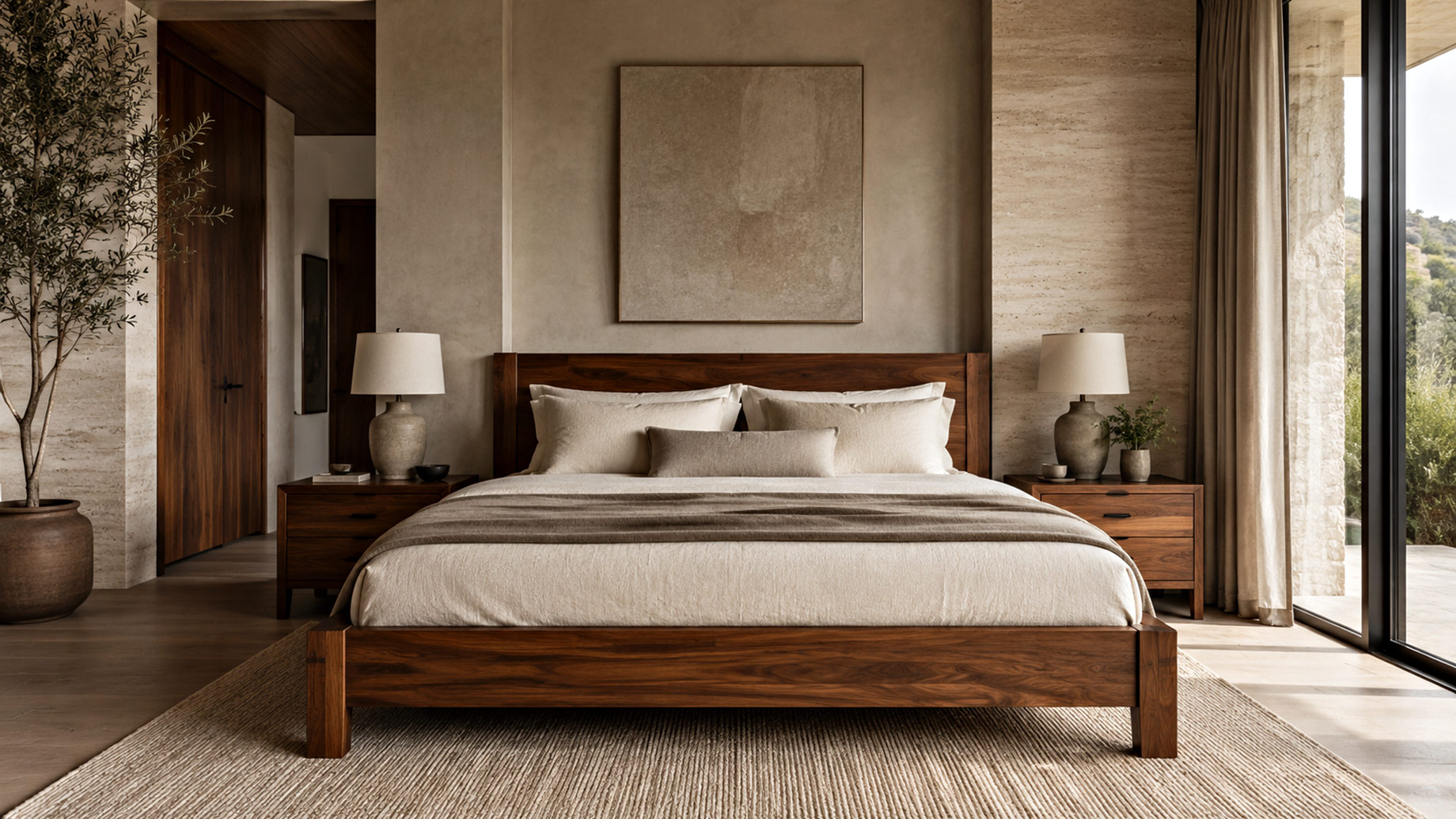
A restrained wood frame behaves more like a stable background. The grain adds variation, but the silhouette does not dictate every supporting choice. Linen can replace velvet. Plaster can replace wallpaper. Dark nightstands can give way to lighter ones without forcing the bed out of the room.
This only works when restraint is genuine. A generic brown frame is not automatically timeless. Poor proportions remain poor proportions, and a badly scaled headboard will not improve merely because it is made from wood.
Look for a clear silhouette, controlled thickness, and enough visual character to prevent the piece from feeling anonymous. The most adaptable furniture is not bland. It is specific without being demanding.
Listing presentation rewards clarity, not furniture theatrics
The primary bedroom carries real weight when a home is prepared for sale. In the National Association of REALTORS’ 2025 staging report, 83 percent of buyers’ agents said staging made it easier for buyers to visualize a property as a future home. The primary bedroom was considered the second most important room to stage, behind the living room.
That does not prove that a particular bed will increase a property’s sale price. It does show that buyers use the room to imagine ownership.
Listing photographs compress that experience. They flatten depth and give viewers only a few seconds to understand the space. Furniture with a clear outline and moderate visual weight can help preserve sightlines, reveal more of the wall, and reduce congestion in the image.
The bed does not need to perform for the camera. It needs to let the room perform.
Warm wood can help because it provides contrast against pale walls and soft textiles without introducing another pattern. Still, no frame can compensate for an undersized rug, crowded nightstands, tangled cords, or bedding piled high enough to conceal its proportions.
There is a useful discipline here. Before a listing photograph is taken, remove one decorative layer and look again. Luxury rooms often improve when the furniture is allowed to breathe.
Smaller footprints make replacement mistakes more visible
Homes do not need to be tiny for furniture scale to matter.
The National Association of Home Builders reported that the average size of a new home declined from 2,479 square feet in 2022 to 2,411 square feet in 2023. Its buyer-preference research found that buyers were looking for homes of roughly 2,070 square feet.
A primary suite within that footprint has little patience for unnecessary bulk.
Thick upholstered rails can reduce usable clearance beside the bed. A deep headboard may push the mattress farther into the room. Wide wings or projecting shelves can interfere with nightstands and switches. Those inches are easy to dismiss on a product page and difficult to ignore after delivery.
This is one reason solid wood mid-century modern bed frames can make sense in a considered suite. Their appeal is not limited to appearance. A clean frame can provide material presence without relying on excessive padding or ornamental depth.
The dimensions still need to be checked carefully. “Low profile” does not mean compact, and platform frames can extend beyond the mattress on every side. Measure the complete exterior footprint, not just the mattress size listed in the product name.
Painter’s tape is useful here. Mark the frame on the floor, including any ledges or projecting legs, then walk the room as it will actually be used. Open the closet. Pull out the dresser drawers. Move from the doorway to each side of the bed.
A measurement becomes meaningful when it is connected to movement.
Common buying habits create avoidable problems
The most common mistake is choosing from a front-facing photograph. That image reveals the headboard and almost nothing about the structure.
Side views show rail thickness, mattress recess, and the true distance between the frame and the floor. Rear views may reveal how the headboard is supported. Detail photographs can expose whether corners are joined cleanly or covered with decorative caps.
Another problem begins with the mattress being treated as an afterthought. A thick mattress can overwhelm a low headboard and erase the proportions that made the frame attractive. A thinner mattress may expose gaps or sit below the intended rail height. The frame and mattress need to be evaluated as one composition.
Finish samples also deserve more skepticism. Walnut-colored furniture is not necessarily walnut. Oak can be stained until its natural character is nearly unrecognizable. Ask whether the description refers to species, veneer, or finish color.
The matching-set habit causes a different kind of damage. Buying the bed, nightstands, dresser, and bench in the same wood and identical design language may feel safe, but it can leave the suite looking packaged. Repetition is useful. Total uniformity is not.
Let the bed establish the dominant material. Supporting pieces can relate through color, line, or scale without copying it exactly.
A practical test for long-term value
Before committing to a frame, consider six questions.
Can its structure be maintained?
Connections should be accessible enough to inspect or tighten. Replacement hardware should not require dismantling decorative upholstery or breaking glued panels.
Does the finish tolerate ordinary life?
Ask how the surface should be cleaned and whether minor scratches can be repaired. A finish that demands perfect conditions may be a poor fit for a frequently used room.
Will the mattress and support system work together?
Confirm slat spacing, center support, mattress depth, and whether a foundation is required.
Does the complete footprint preserve circulation?
Use the exterior dimensions. Include projecting legs, shelves, ledges, and any bench planned for the foot of the bed.
Can the design survive a different room scheme?
Imagine it with another rug, new wall color, simpler bedding, and changed lighting. If the bed only works within one tightly coordinated look, its useful life may be shorter than its structural life.
Is the material description precise?
“Wood,” “wood finish,” and “solid wood” do not mean the same thing. Neither do species names and color names. Clear specifications are a basic sign that the maker expects the construction to be examined.
No single answer guarantees quality. Together, they reveal whether the piece was designed beyond the showroom moment.
The smartest luxury purchase may be the one that delays the next purchase
A primary suite does not become more luxurious each time its furniture is replaced. Constant updating can produce the opposite effect, a room that always looks recently assembled and never fully settled.
The stronger investment is often a piece that gives future decisions more freedom. It accepts new textiles. It tolerates a revised palette. Its structure can be maintained, and its surface has enough depth to remain credible after ordinary use.
That is the quieter promise of a well-chosen wood bed. It does not preserve the room in one design era. It gives the room permission to change without starting over.