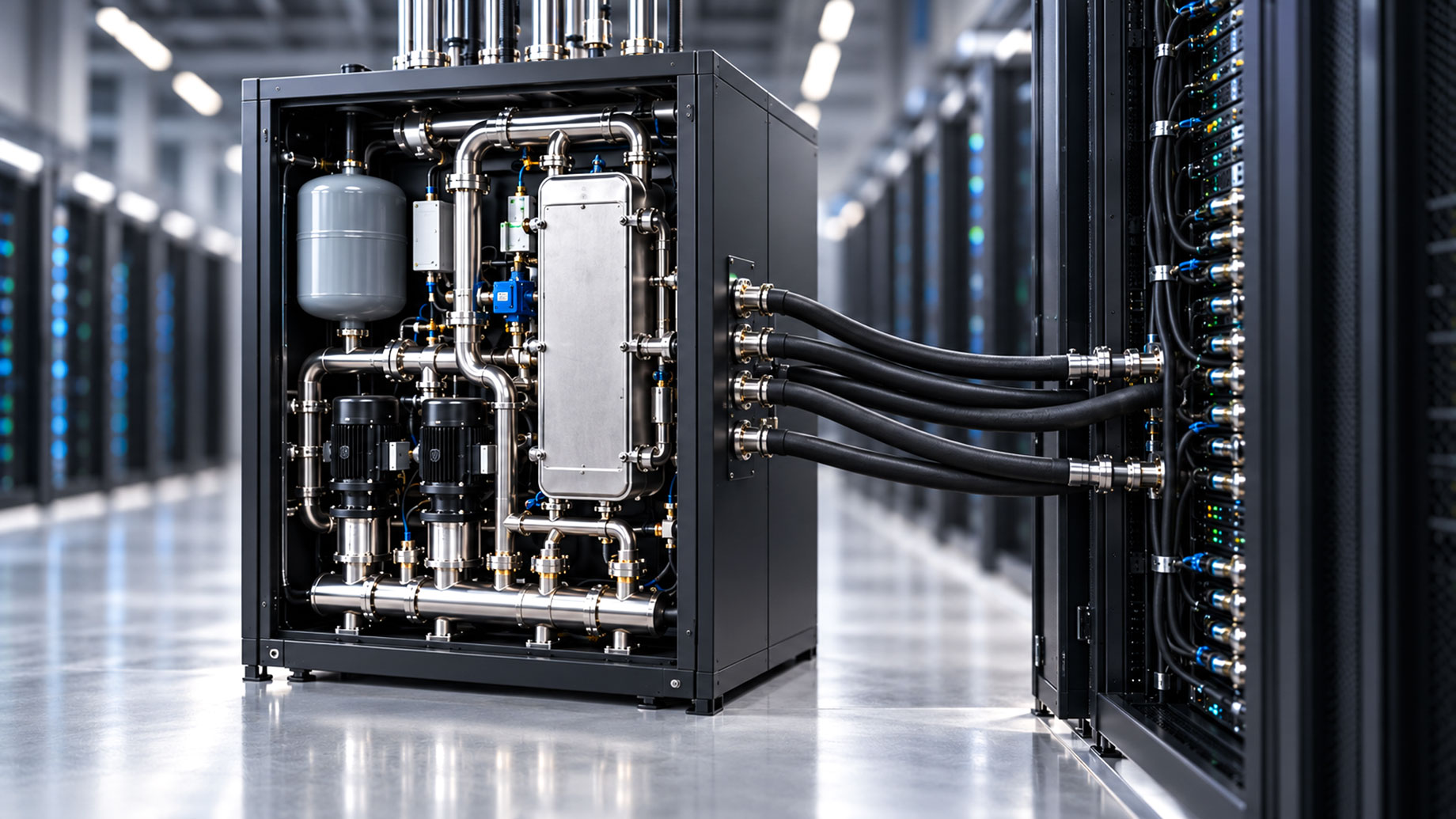
As rack densities rise to support artificial intelligence, high-performance computing, and other demanding workloads, data center cooling strategies are changing. Liquid cooling can move heat away from high-density IT equipment more effectively than traditional air cooling in applications where heat loads have become difficult to manage with air alone.
A key component in many direct-to-chip liquid cooling systems is the coolant distribution unit, or CDU.
What Does a CDU Do?
A CDU provides an interface between the facility cooling infrastructure and the technology cooling system serving IT equipment.
Rather than simply circulating coolant, a CDU may incorporate heat exchangers, pumps, valves, sensors, controls, and other components needed to manage heat transfer and coolant conditions. This allows the secondary cooling loop serving servers or racks to operate under conditions appropriate for the IT equipment while exchanging heat with the facility-side system.
This separation can also help protect sensitive IT cooling components from differences in pressure, water chemistry, or operating conditions on the facility side.
Why CDU Selection Requires a System-Level Approach
CDUs should not be selected solely according to a published cooling-capacity number. Their performance depends on how they interact with the larger cooling system.
Engineers should evaluate expected heat loads, coolant temperatures, available facility water conditions, flow requirements, allowable pressure drop, redundancy strategy, controls, and anticipated future capacity.
The location of the CDU matters as well. Depending on the architecture, equipment may be installed at the rack, row, room, or facility level. Each configuration affects piping distances, available space, service access, redundancy, and the amount of infrastructure supported by an individual unit.
Plan for Changing Cooling Loads
Today’s cooling requirement may not represent tomorrow’s.
AI and HPC deployments can significantly increase rack-level heat loads, making scalability an important consideration when planning liquid-cooling infrastructure. A design that operates comfortably during an initial deployment may become constrained as additional liquid-cooled equipment is installed.
When comparing CDU manufacturers, data center operators should therefore consider more than immediate capacity. Available configurations, integration capabilities, serviceability, controls, redundancy options, and the manufacturer’s ability to support future expansion can all affect the long-term usefulness of the equipment.
Look Beyond the CDU Itself
The CDU is only one part of the liquid-cooling system.
Pumps, heat exchangers, manifolds, valves, hoses, tubing, quick disconnects, sensors, controls, and facility piping all influence system performance. Poor coordination among these components can create flow restrictions, control problems, inadequate cooling, or unnecessary pumping requirements.
That makes early coordination among IT equipment suppliers, mechanical engineers, facility operators, and cooling-equipment providers particularly valuable.
Design for Operations, Not Just Startup
Commissioning a liquid-cooling system successfully is important, but the system must also remain manageable over years of operation.
Service access, component replacement, monitoring, leak detection, isolation capabilities, redundancy, and maintenance procedures should be considered during design rather than after equipment has been installed.
As liquid cooling becomes a larger part of data center infrastructure, choosing a CDU increasingly becomes a lifecycle decision. The strongest solution is not simply the unit capable of meeting today’s thermal load. It is one that fits the complete cooling architecture and can continue supporting the facility as computing demands change.
