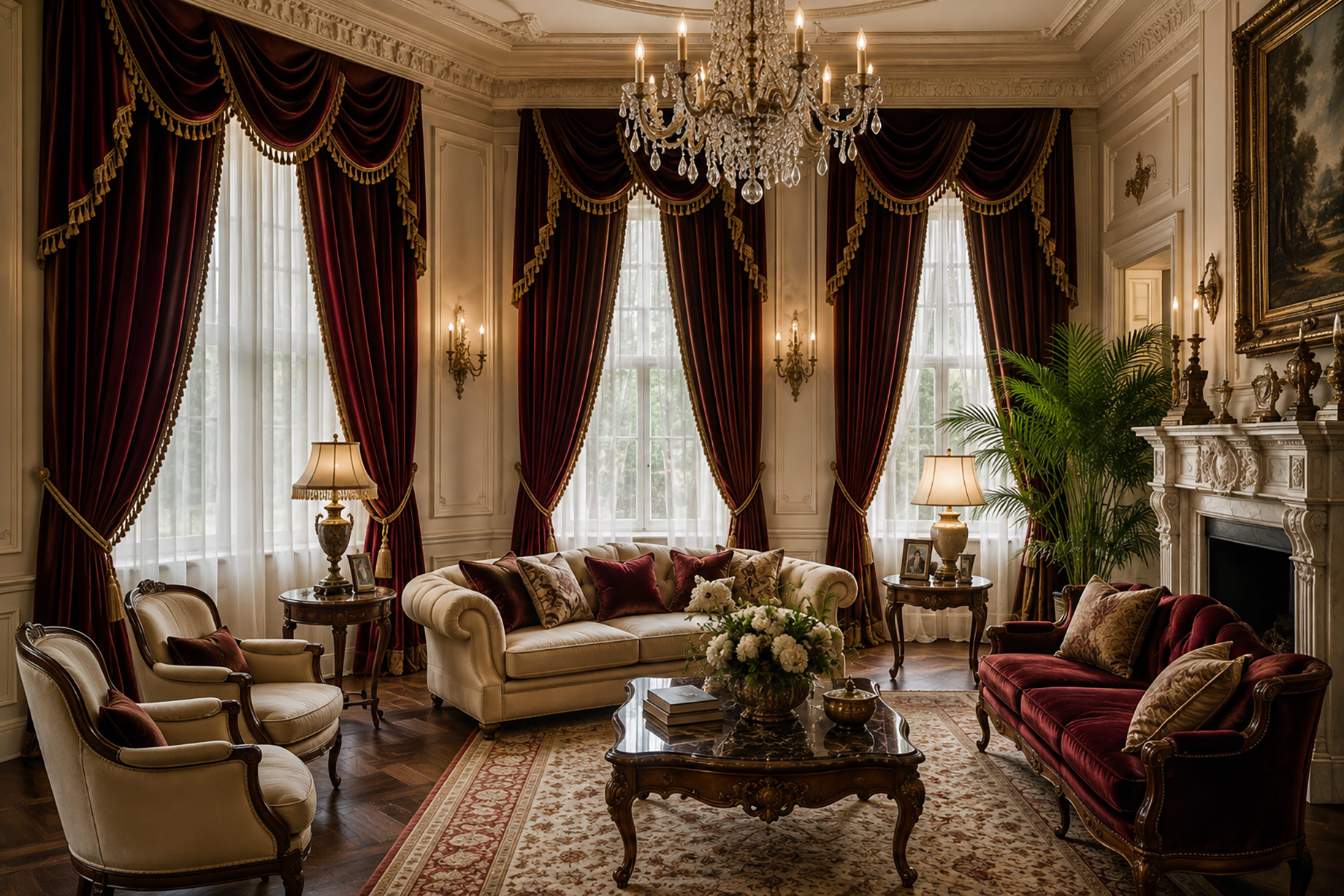
Walk into a formal living room that genuinely works, and the window treatment is usually doing more of the job than the furniture gets credit for. Marble mantels and antique rugs matter, but it is the fabric framing the windows that decides whether a room reads as staged or lived-in at a serious level.
Velvet is the material most estate designers reach for first, and not for decorative reasons alone. It absorbs light instead of reflecting it, softens hard architectural lines, and adds weight to a room that thinner fabrics simply cannot fake.
Key Takeaways
- Velvet’s dense pile absorbs and scatters light, which is why it reads as “formal” in ways flatter fabrics do not.
- Weight and lining matter more than color when it comes to how a drape performs in a large room.
- Formal drapery has a documented design history, including custom commissions for hotels, embassies, and modernist landmark homes.
- Sourcing and construction standards affect how a velvet drape hangs, fades, and holds up over a decade of use, not just how it looks on day one.
- Pairing velvet with the right hardware and lining prevents the two most common formal-drapery mistakes: a flat, lifeless hang and premature fading near sun-facing windows.
Why Velvet Reads as Formal in the First Place
Every fabric handles light differently, and that is really the whole story with velvet. A woven cut pile stands up from the base cloth and catches light from multiple angles at once, which is why a velvet drape looks deep and almost three-dimensional compared to a flat linen or cotton panel hung in the same window.
That optical depth is also why velvet drapery for a formal living room tends to look intentional rather than decorative. In a large room with high ceilings, thin or sheer fabric can feel like an afterthought once the eye moves past it. Velvet holds the eye at the window the way a piece of furniture holds it at a seating group, which is part of why it remains the default choice in rooms built for entertaining rather than everyday use.
The Design History Behind Formal Drapery Fabrics Is Longer Than Most People Assume
Formal drapery is not simply “expensive curtains.” It has its own design lineage, and one of the clearest examples of that lineage comes from the work of American textile designer Dorothy Liebes, whose handwoven fabrics shaped how mid-century architects and hoteliers dressed their most important rooms. Liebes designed the drapery for the Persian Room at New York’s Plaza Hotel and contributed drapery and upholstery fabrics to a Frank Lloyd Wright residential commission, work that the design history behind formal drapery fabrics traces in detail through her five-decade career.
What is worth noticing in that history is how deliberately drapery was treated as an architectural element rather than a finishing touch. Liebes worked directly from blueprints, treating a formal room’s fabric choices as part of the same design conversation as its floor plan. The Cooper Hewitt, Smithsonian Design Museum devoted a dedicated exhibition to her textile work, including a drapery panel produced for that same Persian Room commission, which underscores how significant a single formal drapery commission could be to a design career at that level.
That same idea, that textiles carry structural and cultural weight rather than sitting purely in the decorative category, runs through the history of woven fabric more broadly. A recent Metropolitan Museum of Art exhibition on textile artists working across centuries of weaving traditions makes a related point: the discipline of weaving has always doubled as a serious design language, not a secondary craft.
Choosing Weight, Pile, and Lining for a Formal Room
Velvet is not one fabric; it is a family of fabrics, and the differences matter more in a formal living room than almost anywhere else in the house. A lightweight cotton velvet suits a smaller room or a secondary sitting area, while a heavier cotton-linen or mohair-blend velvet is what most designers specify for larger formal spaces, since the added weight helps the fabric fall in cleaner, heavier folds rather than clinging or curling at the hem.
Lining is the detail that separates a genuinely formal drape from a nice-looking curtain. A proper blackout or sateen lining adds body, protects the fabric from sun fading, and improves how the panel falls at both the header and the floor. Unlined velvet drapery will still look attractive from across the room, but it will not hold its shape the way a lined panel does after a year of daily opening and closing.
Color and pile direction deserve equal attention. Velvet’s nap catches light differently depending on which way it is hung, which is why designers typically hang all panels in a room with the pile running in the same direction; mixing directions creates a visible mismatch in how the panels reflect light, even when the fabric is identical.
What Premier Table Linens Brings to a Formal Drapery Project
Sourcing is where a lot of formal drapery projects quietly go wrong. A velvet that looks correct in a swatch book can behave very differently at full-panel scale, particularly around color consistency across large yardage runs and how the fabric performs once it is lined and hung at height.
Premier Table Linens has built its 2026 velvet drapery collection specifically around that problem, offering full-bolt yardage runs so an entire room’s panels come from the same dye lot rather than being pieced together from smaller cuts. That consistency matters more than it sounds: a formal living room with four or six window panels needs every panel to read as identical fabric, not four close approximations of the same color.
The practical upside for anyone planning a formal room is being able to source drapery-weight velvet and have it match panel to panel without guessing at dye variance between orders. That is a small technical detail, but it is exactly the kind of detail that separates a room that reads as professionally finished from one that almost gets there.
Living With Velvet Drapery Day to Day
Velvet rewards a bit of ongoing care rather than none at all. Vacuuming with a soft brush attachment on a low setting keeps dust from settling into the pile, and rotating panels occasionally, where the design allows it, evens out any fading from direct sun exposure over time.
Humidity is worth watching too. Velvet can crush in persistently damp rooms, so a formal living room that also functions as a sunroom or gets heavy seasonal humidity benefits from occasional steaming to restore the pile, rather than waiting until the crush becomes visible from across the room.
None of these changes the basic appeal of the fabric. Formal rooms are, by definition, spaces meant to hold up to scrutiny, and a well-sourced, properly lined velvet drape is one of the more reliable ways to make sure a room still looks considered five or ten years after it was first dressed. That durability, paired with the fabric’s long design pedigree, is exactly why velvet keeps showing up in the estate homes and formal interiors that are built to be lived in rather than simply photographed once and left alone.
Frequently Asked Questions
What makes velvet different from other formal drapery fabrics?
Velvet’s cut pile stands away from the base weave, which lets it absorb and scatter light rather than reflect it flatly. That is what gives velvet drapery its characteristic depth compared to linen, silk, or cotton panels of the same color.
Does velvet drapery need a special lining?
A blackout or sateen lining is strongly recommended for formal rooms. Lining protects the face fabric from sun fading, adds body that helps the panel hang in cleaner folds, and extends the usable life of the fabric significantly.
How do I keep velvet draperies from crushing or matting?
Regular light vacuuming with a soft brush attachment, occasional steaming to restore the pile, and hanging all panels with the nap running in the same direction all help maintain the fabric’s finish over time.
Is velvet drapery practical for a room that gets a lot of natural light?
Yes, provided the panels are properly lined. Unlined velvet in a sun-facing formal room will fade unevenly within a few years, while a lined panel holds its color considerably longer.
Why do formal drapery panels need to come from the same fabric run?
Velvet’s dye lots can vary subtly between production runs, and that variance becomes visible once multiple panels hang side by side in the same room. Sourcing full-panel yardage from a single run avoids this mismatch entirely.
