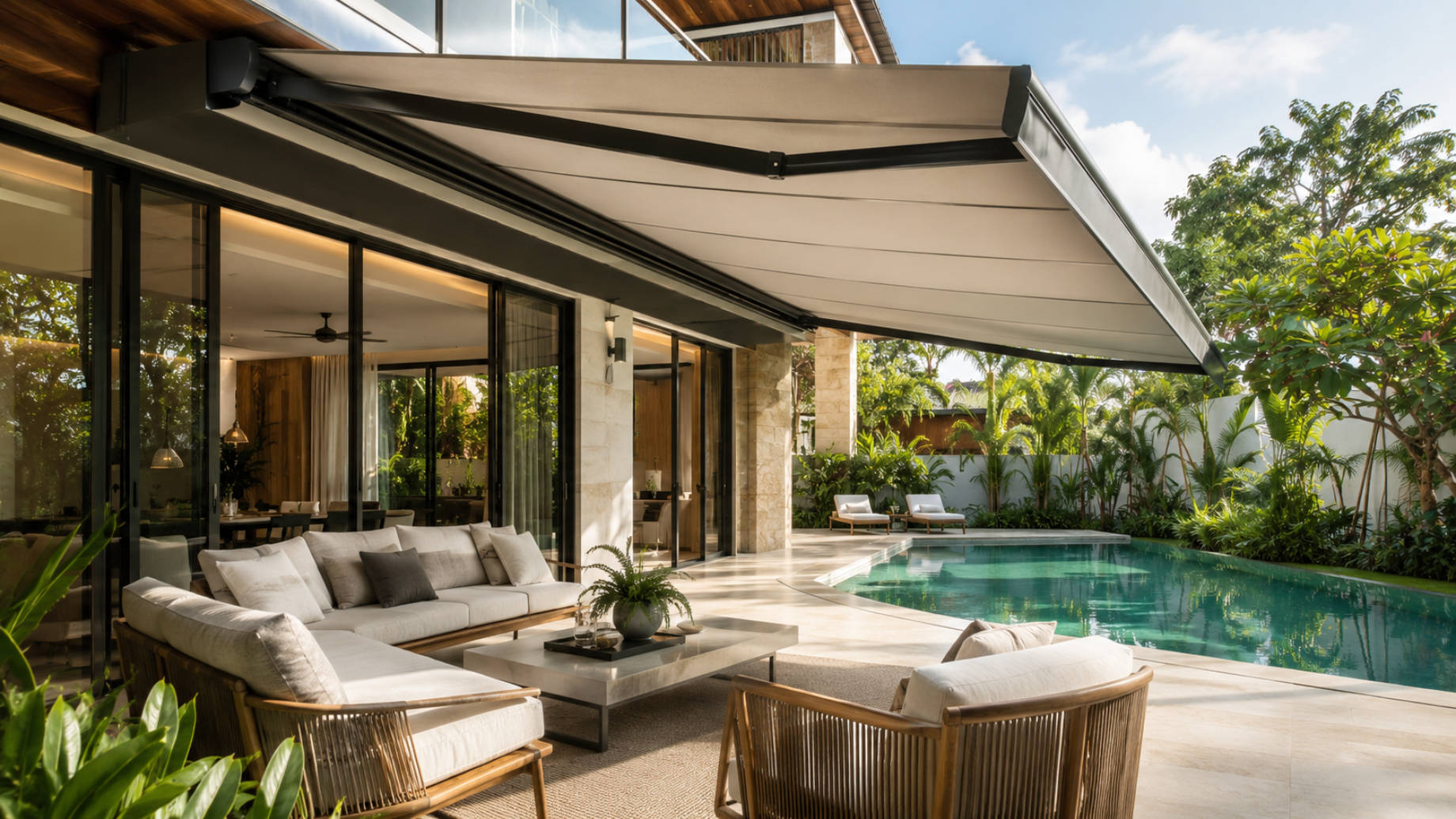
In the choreography of a great tropical home, the most luxurious moments rarely happen indoors. They unfold on the shaded terrace at noon, beneath a canopy by the pool, on a balcony kept cool by a retractable awning while the afternoon sun blazes a metre away. For all the attention lavished on marble interiors and infinity edges, it is shade considered, engineered, beautifully resolved that makes outdoor living in the tropics not merely bearable but sublime. And the instrument that delivers it, long dismissed as an afterthought, is enjoying a quiet renaissance: the awning. Nowhere is that reinvention more visible than in Singapore, where architect-designed villas and sky-terrace penthouses have turned outdoor shading into a discipline in its own right.
From Utility to Architecture
The awning has travelled a long way from the striped canvas flap that once shaded a shopfront. In essence it remains what it has always been an awning, a secondary covering fixed to a building’s exterior but its execution has been transformed. Where there was once only fixed canvas, today’s palette runs to motorised retractable systems, frameless glass canopies, louvred aluminium pergolas and sculptural fixed overhangs engineered to read as a deliberate part of the architecture. The modern awning is no longer bolted on as an apology for the sun; it is drawn into the design from the very first sketch.
That change is as much cultural as technical. Architects who once concealed shading devices now celebrate them, treating a run of louvres or the clean line of a cantilevered canopy as part of a building’s elevation rather than a blemish on it. On Singapore’s landed houses and penthouses, the awning has become a compositional tool a way to add rhythm to a façade, to frame a view, and to cast the deep, articulate shadows that give tropical modernism its distinctive character.
Engineering for the Equator
Few climates demand shade as insistently as Singapore’s. Sitting barely a degree north of the equator, the city endures relentless ultraviolet exposure, afternoon temperatures around 31°C, and monsoon downpours that arrive without ceremony. A well-placed awning does far more than create a pleasant spot to sit: by intercepting direct sun before it strikes glass and walls, it cuts solar heat gain at the source, easing the load on air-conditioning and trimming running costs month after month. That thermal logic sits squarely within the Building and Construction Authority’s Green Mark push for cooler, more energy-efficient buildings shading remains among the simplest passive strategies a home can deploy.
Sun is only half the brief. An awning in this part of the world must also stand up to sudden, drenching rain and the gusts that accompany it, shedding water cleanly while staying anchored against wind uplift. The engineering that makes this look effortless the pitch of the fabric, the strength of the arms, the way water is directed away from doorways rather than onto them is invisible when done well and painfully obvious when it is not. It is the difference between a terrace that stays usable through a squall and one abandoned at the first cloud.
The Retractable Revolution
The single biggest shift in high-end shading has been the move from fixed to flexible. Motorised retractable awnings let a homeowner summon shade at the touch of a button and withdraw it just as easily full sun over breakfast, deep shade by mid-afternoon, the fabric tucked safely away before a storm. Paired with rain and wind sensors, the best systems all but manage themselves, retracting automatically when the weather turns. Folded into a home’s smart-home ecosystem, an awning becomes one more surface the house tunes on its occupants’ behalf, as routine as drawing the blinds.
Materials have kept pace with the mechanisms. Today’s shading fabrics are solution-dyed acrylics and technical weaves engineered to resist fading, mildew and the punishing tropical sun, offered in tailored palettes that read as considered design rather than utility. Slim cassette housings conceal the folded fabric in an aluminium profile when it is not in use, so that a retracted awning all but disappears into the line of the building present when wanted, absent when not.
Glass, Aluminium and the Architectural Canopy
For permanence and architectural presence, the conversation turns to glass and aluminium. Frameless glass awnings shelter an entrance or walkway from rain without casting a shadow or interrupting a sightline ideal where the view is the whole point. Aluminium-framed canopies and pergolas, by contrast, offer structure and longevity, shrugging off the corrosion and relentless humidity that would defeat timber or steel. Specifying these well the fall for drainage, the concealed fixings, the way a canopy meets the façade is exacting work, and increasingly the preserve of dedicated specialists such as Roofers Singapore, whose remit spans awnings, outdoor canopies and the roofing and ceiling systems that frame a tropical home’s exterior.
Longevity is the quiet argument for these materials. In a climate that corrodes, warps and fades with unusual speed, powder-coated aluminium and tempered glass hold their finish and their geometry for years with minimal fuss no small thing on homes where every exterior detail is on permanent display. The maintenance saved across a decade often justifies the higher specification several times over.
Extending the Living Footprint
The deeper appeal of good shading is spatial. A covered terrace is not merely a shadier patch of garden; it is an additional room, one that simply happens to have no walls. Awnings and canopies turn balconies, poolside decks and alfresco dining areas into spaces usable at any hour, dissolving the threshold between inside and out that defines contemporary tropical design. It is no coincidence that this has arrived alongside a broader appetite for biophilic living for interiors that stay connected to nature, air and light. A home that flows effortlessly onto a sequence of shaded outdoor rooms lives a great deal larger than its floor plan suggests.
The scenarios multiply once the principle is grasped. A retractable awning lets a rooftop become a dining room under the stars by night and a sheltered lounge by day; a fixed canopy turns a poolside into a cabana; a glass awning keeps an entrance court or koi pond dry without dimming the light. Each is a small act of climate editing, and together they expand the genuinely livable area of a home far beyond its walls.
The Quiet Economics of Shade
There is, as ever, a financial dimension. Quality awning systems aluminium frames, marine-grade fabrics, engineered glass are built to last, and their running-cost savings compound quietly across years of lower cooling bills. In a property market as discerning as Singapore’s, a home that demonstrably handles sun and rain with sophistication reads as well-conceived, and buyers notice. Shade, done properly, is less an expense than an investment in comfort, efficiency and resale appeal.
Increasingly, this is also how premium homes are presented to the market. Listings now lead with the shaded roof terrace, the louvred pergola over the dining deck, the awninged balcony framing its view outdoor rooms photographed as lovingly as the kitchen, because buyers have learned to price the lifestyle they make possible.
A Considered Kind of Comfort
The luxury of a tropical home is measured less in square footage than in how gracefully it lets its owners live with the climate rather than against it. The awning retractable or fixed, glass or aluminium, whisper-quiet or boldly architectural is the unassuming hero of that ambition. As Singapore’s finest residences continue to blur the line between indoors and out, the art of shade has earned its place not at the margins of the design, but at its very heart.
