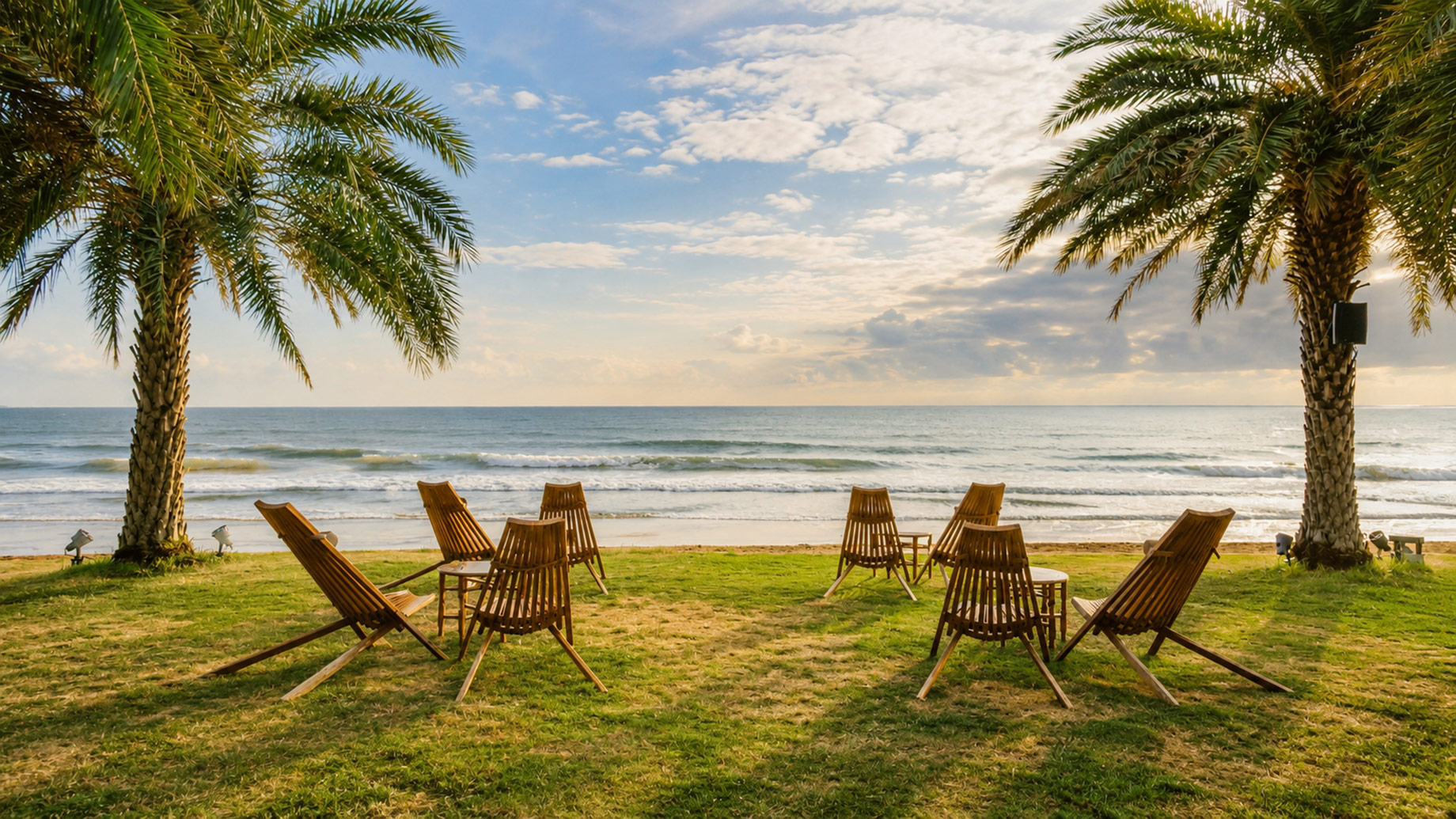
A coastal property is usually bought for the view. The lawn is where that decision quietly gets expensive.
Grass that would be unremarkable ten kilometres inland behaves completely differently within sight of the water. It thins, yellows in patches, dries out faster than the irrigation can keep up with, and never quite recovers between summers.
None of that is poor maintenance. It is three environmental loads acting at once, and no amount of fertiliser resolves any of them.
What a Coastal Site Actually Does to Grass
Salt is the first and least visible. Airborne salt spray settles on foliage and accumulates in the soil, and beyond a certain concentration it interferes with the plant’s ability to draw water even when water is present.
The visible result reads as drought stress on a lawn that is being watered adequately. Exposed positions take the worst of it, which is why the same street can have one healthy lawn and one struggling one depending on which way the property faces.
Sandy soil compounds it. Free-draining ground moves water past the root zone quickly and holds very little nutrient, so both irrigation and fertiliser have a short window to do anything before they are gone.
Then there is ultraviolet load. In subtropical positions the combination of intense summer sun and reflected light off water and pale sand puts grass under sustained stress through the months it is meant to be growing strongest.
The Irrigation Trap
The instinctive response to a struggling coastal lawn is more water. On sandy soil that usually makes things worse rather than better.
Frequent shallow watering encourages roots to stay near the surface, where they are most exposed to heat and salt. It also flushes what little nutrient the soil holds further down, past where the grass can reach it.
Deep and infrequent watering is the better approach, though on genuinely sandy ground even that has limits. At some point the honest conclusion is that the site is asking for a species or a surface it was never going to support.
Reaching that conclusion is easier once you know how the space will actually be used. Planning an outdoor entertaining space starts with walking the site and deciding where cooking, sitting and serving will happen, which tells you which zones need a surface that survives traffic rather than one that merely looks intact from the house.
Where Natural Lawn Still Makes Sense
This is not an argument against grass everywhere. Larger properties set back from the water, with reasonable topsoil and some wind protection, can carry natural lawn perfectly well with the right species selection.
Salt-tolerant varieties exist and perform. The question is whether the position, the soil profile and the maintenance appetite line up, and for a lot of coastal blocks two of those three do not.
The decision usually turns on which parts of the garden are load-bearing for how you actually live there. A lawn nobody walks on has a much easier time than one carrying furniture, foot traffic and a barbecue every weekend.
The Synthetic Option, and What Separates Good From Poor
Artificial turf removes the salt, soil and irrigation problem in one move, which is why it has become standard on exposed coastal sites. The variation in quality, though, is enormous.
Three specifications matter more than the rest. UV stability determines whether the colour holds or fades to a washed-out grey after a few summers.
Yarn technology governs surface temperature, which is the most common complaint about synthetic grass in a hot climate. Infill requirements determine both the cleanliness of the install and, on elevated surfaces, the load.
Lush Turf Solutions has supplied and installed artificial grass in Gold Coast QLD properties for over 20 years, from Southport down to Coolangatta, and their range illustrates what to look for. Their turf uses what the manufacturer calls Cool Yarn, described as running 20 percent cooler than other artificial turf, and requires no sand infill.
Pile height is the other specification worth understanding. Their range runs from a 35mm broad-blade product imitating palmetto buffalo, through a 30mm fine-blade turf mimicking couch, to a 12mm dense pile built for putting surfaces and true ball roll.
Pool Surrounds, Balconies and Terraces
Coastal properties concentrate the hardest conditions in exactly the places people spend most time.
Pool surrounds combine chlorine splash, constant foot traffic and full sun, which is a combination natural grass will not survive in any climate. Turf specified for that use handles all three without fading.
Balconies and rooftop terraces raise a different issue, which is weight. This is where the no-infill point stops being about cleanliness and becomes structural, since sand infill adds significant mass to a surface with a load limit. It also allows planters and furniture without the surface deforming.
Installation Decides the Outcome
The specification only matters if the base is right, and on sandy coastal ground that is not a given.
Site clearing and base preparation for drainage is the step that determines whether water moves away from the surface or sits under it. Lush Turf handles supply and installation with their own teams rather than selling the product and leaving the install to someone else, which removes the gap where responsibility usually disappears.
Warranty terms are the practical test of confidence. Theirs runs to 12 months on installation and 10 years on the turf itself, covering workmanship and product separately, and a standard residential backyard is typically completed in one to two days.
Conclusion
Coastal sites are not difficult gardens. They are specific ones, and the failure comes from treating them like inland gardens with a better view.
Work out honestly which zones can support natural lawn and which cannot. Positions taking direct salt exposure, pool surrounds and anything elevated generally cannot, regardless of effort.
For the rest, choose on UV stability, yarn temperature and infill requirement rather than on price per square metre, and get the base preparation right. That is where a coastal surface either lasts a decade or fails in two summers.
FAQ
1. Why does my lawn look drought-stressed even though I water it?
Salt accumulation in coastal soil interferes with a plant’s ability to take up water, so the symptoms mimic drought while the ground is damp. Sandy soil worsens it by draining moisture past the root zone before the grass can use it.
2. Does artificial grass get too hot in a coastal climate?
Surface temperature depends heavily on yarn technology, and it varies a lot between products. Some manufacturers produce yarn specifically engineered to run cooler, so it is worth asking for the specification rather than assuming all synthetic turf performs the same.
3. Can artificial grass go on a balcony or rooftop?
Yes, though weight matters on elevated structures. Turf that requires no sand infill is considerably lighter, which is the main reason it suits balconies and terraces where load limits apply.
4. How long does an artificial grass installation take?
A standard residential backyard is generally one to two days, depending on access and ground conditions. Commercial sites are scoped individually, and base preparation on sandy soil can extend the timeline.
