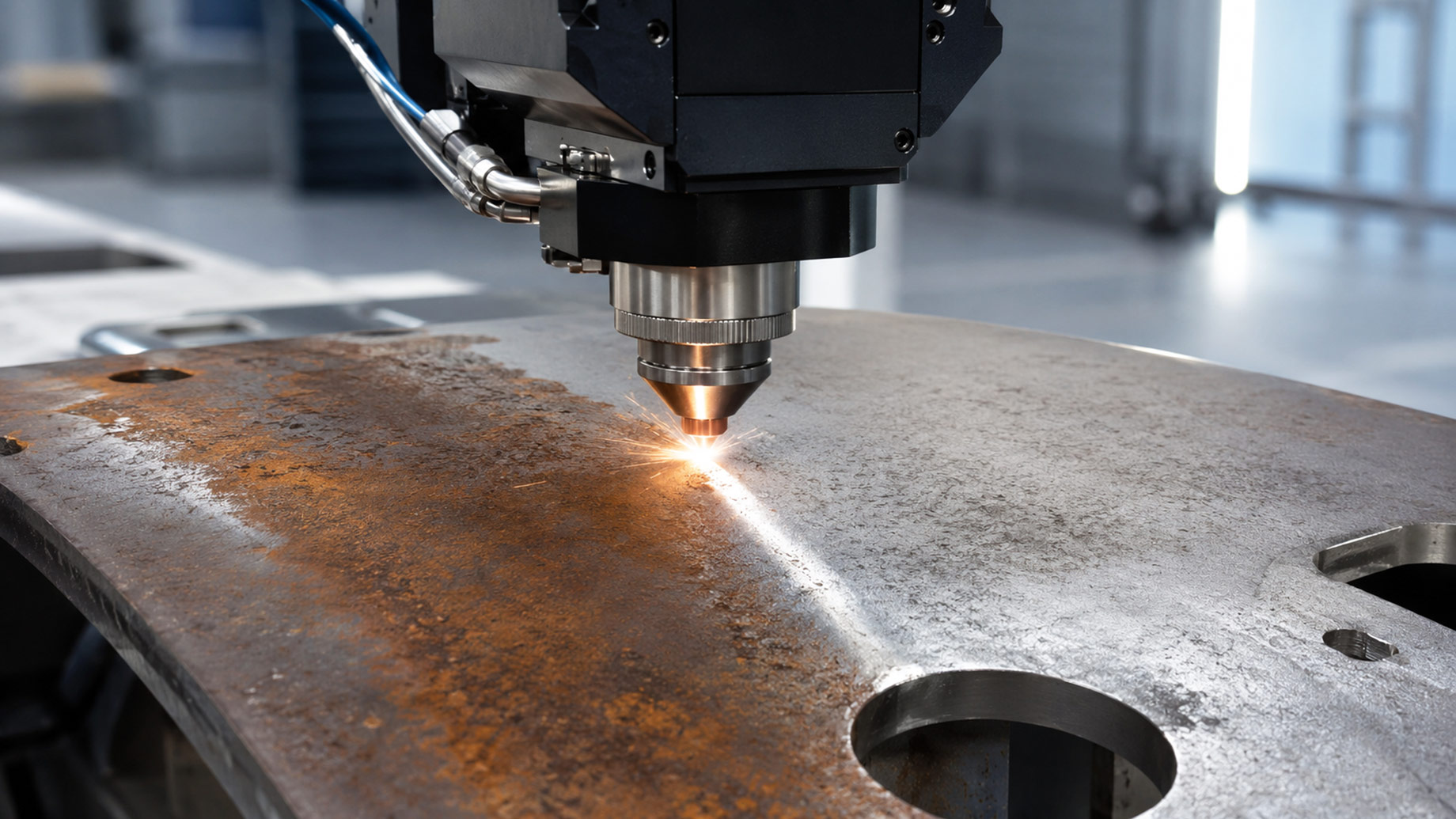
It is necessary to study the treatment of the surface in modern industries to be efficient. Cleaning happens with traditional ways and is time consuming & waste of energy. They can also involve chemicals or abrasive materials.
A new alternative is pulse laser cleaning. It is based on removing unwanted materials with short pulses of lasers. These materials may consist of rust, paint, oil, and oxide.
The technology ensures a controlled and precise surface treatment. It can also be used without touching the surface. Such benefits come in handy in various sectors.
What is Pulse Laser Cleaning?
Pulse laser cleaning: high-energy, but brief, laser pulses. Each pulse affects surface contamination only. In this case, the unwanted material absorbs the energy of the laser.
This dislodges the contaminants or disintegrates them. The surface over which the fluid moves can be only slightly altered.
Treatment options for various materials are provided using this control. It’s also simple enough to be used for in-depth applications in industry.
What is the reason that Industries employ the laser cleaning process?
In industrial environments, surfaces can be subject to regular maintenance. Rust, paint, grease, and oxidation can have a negative impact on performance.
Other issues may arise with traditional cleaning methods. Chemical treatments can result in waste and residue. For abrasive techniques, there is a risk of changes to the original surface.
There are certain desirable benefits obtained by using pulse laser cleaning:
- Gives accurate surface finishing.
- No physical contact is needed.
- Can help to lower chemical waste.
- It becomes suitable to automate production.
- It can clean complex surface areas and remove stains.
These benefits could have a positive impact on maintaining an efficient operational process. They may also help meet some of the elements of operation.
Removal of rust off industrial parts.
One of the most significant laser cleaning applications is removing rust. The corrosion of metal components can occur during storage or when operating.
A pulse laser cleaning machine is able to attack the rust without any abrasive contact. This will help to maintain the metal surface beneath it.
Can help make machinery and tools. It can also provide maintenance for structural components.
The operators can adjust the laser according to different rusting conditions. This might require less energy for light oxidation. Different settings may be needed if there is heavier corrosion. It’s still crucial to test beforehand for full-scale cleaning.
Removal of paint or coatings from surfaces of the vessel.
Components on industrial products such as boiler tubes and pipes are sometimes peeled off. May have to take away old paint prior to maintenance or repainting.
This is so that controlled surface preparation can be accomplished. It can also be used to minimize mechanical contact with the component. An effective technique for machinery, metal structures, and industrial tools.
Cleaning Before Welding
Surface preparation is a key factor before welding. The quality of the weld may be affected by oil, oxidation, and contamination.
Laser cleaning can be used to prepare metal surfaces before welding. Clearly, it takes it off without abrasion.
Manufacturers can step in and incorporate cleaning processes into manufacturing. This can contribute to optimizing the overall process.
Removing mold and cleaning tools.
Mold processing is able to trap by-products during the manufacturing process. Residuals can accumulate in the molds during manufacturing. Such residues can impact product quality at some time in the future.
That’s why it’s a good material for precision tooling. Production consistency can also be achieved by regular cleaning.
Large structures, including aircraft and precision manufacturing.
Surface treatments of aerospace components need to be carefully conducted. The cost of materials can be high and very technological.
If cleaning methods are too aggressive, it may cause unwanted surface change (WSC). Controlled treatment can be achieved using a pulse laser system.
They are able to get rid of contaminating elements and oxidations from particular locations. This can help maintain the consistency of the manufacturing and maintenance processes.
Aerospace and Precision Manufacturing
Precision is still crucial in the aerospace industry. Thus, operators will have to resort to proper laser parameters.
Testing and professional process control play a particularly important role. Working with delicate components and electronics.
Assisting with Electronic parts and electronics.
Special cleaning techniques are used in making electronics. The components can contain sensitive surfaces and be small in size.
Controlled cleaning using limited contact can be achieved with the use of pulse lasers. This allows them to be applied in certain precision applications.
Correct wavelength and settings are still vital. Too much energy can adversely affect sensitive materials. Manufacturers need to do material testing first, and also ensure that the materials used have a high refrigerant flow rate in order to keep costs down.
Beneficial for both the environment and operational purposes.
Improving the cleanliness of industrial processes is desired by many industries. They are seeking approaches for decreasing their use of chemicals.
Some solvents might be reduced in need through laser cleaning. It can also minimize the amount of abrasive used when cleaning.
For many applications, there’s less secondary waste from the process. BUT It is important to have proper collection of the contaminants removed. There is also less physical touch and handling of components with the use of laser systems too. This can make some cleaning tasks easier to undertake.
Choosing a Reliable Laser Cleaning Supplier
So, all of the equipment you use will influence your cleaning. Beníades should take the reliability of machines and technical support into consideration when choosing.
The supplier needs to supply the exact specifications of the equipment used. It is also important for training and post-sales services.
Companies should conduct tests on the machines they will be using with their materials. This is to help ensure the effectiveness of the cleaning and working speed.
Businesses looking into industrial solutions may want to see if there’s a viable option for their laser equipment needs with HANTENCNC. The machine setup ought to match the material used rather than be more powerful.
Future of Advanced Surface Treatment
Automation in surface treatment systems in industry is increasing. Faster and more uniform processes are desired by manufacturers.
This is certainly reflected in pulse laser cleaning. Systems can interact with robot machines and machines on production lines. Manual handling can be reduced with the help of automation. It can also increase repeatability in large-scale productions. With the progression of technology, laser cleaning could be more commonplace. It could be used more widely in routine maintenance of industries.
Conclusion
Pulse laser cleaning is a highly accurate method of treating surfaces in industry. It will selectively strip away rust, coatings, oxidation, and can remove contaminants. Its contact-free process can provide several practical benefits. Can also minimize the use of chemicals and abrasives.
There exist opportunities for benefit for industrial companies like automotive, aerospace, and manufacturing industries. Correctly choosing the appropriate equipment will continue to be key to good results.
By appropriately conducting the above, adopting a trained operator, as well as carrying out proper parameterization and optimization, pulse laser cleaning can contribute to an improvement in industrial maintenance. It is a modern solution to achieve a tidier and more controlled surface treatment.
