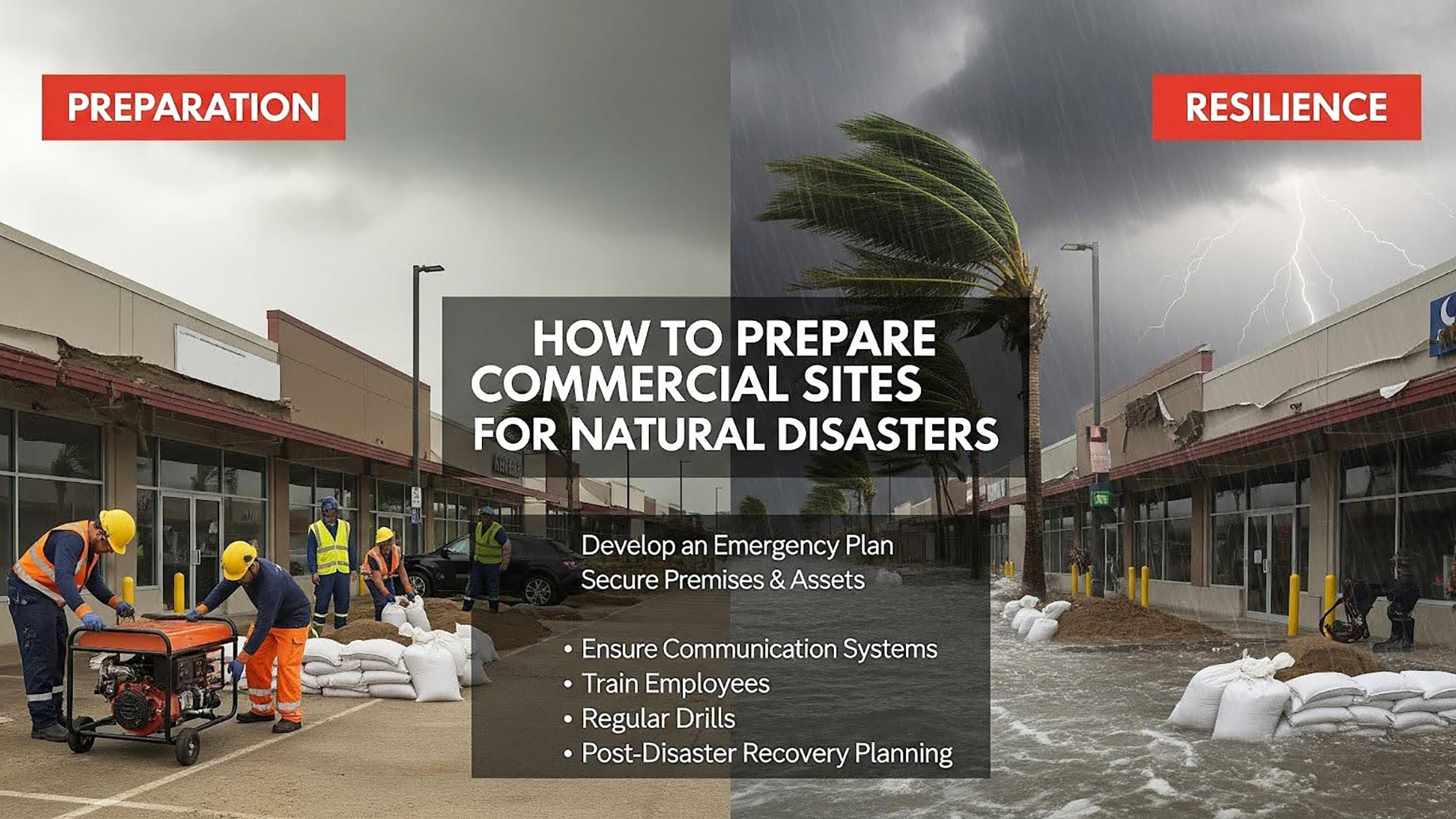
If you’ve been running businesses in Australia for a while, you probably know that our weather doesn’t do such things lightly. It can change overnight, in a heartbeat, from the scorching heat that drives bushfires to the heavy rain that transforms dry creek beds into raging rivers.
For property owners and facility managers, this unpredictability is not a morning coffee- talk piece; it is a real operational challenge for them. To be ready for natural disasters is not only about checking off boxes on a compliance checklist but also about ensuring that there will be a business to go back to after the dust (or mud) has settled.
Here is practical, down to earth advice on how to prepare your commercial site to whatever nature decides to bring upon it.
Conduct a Local Environmental Risk Assessment
You have to have an idea of what you are dealing with before you begin to buy sandbags or even improve your insurance. Australia is a large country and a warehouse in tropical Queensland has quite different threats as a boutique office in the Victorian hinterland.
Don’t guess. Go to the site of your local council and view their flood maps and bushfire prone land maps. You may find that your location is located in a 1-in-100-year flood zone or high Bushfire Attack Level (BAL) locality. Learning this allows you to set priorities. In the case of the coast, you may be interested in storm surges and salt corrosion; in the countryside, it would most likely be ember attacks and radiant heat.
Stormproofing and Structural Maintenance for Commercial Buildings
The shell of your building is the first defence. During a storm or a cyclone, the roof is prone to fall first. It will cost you to get a professional to have a look at your roofing integrity once in a year, to check whether there are loose sheeting, rusty screws or plugged box gutters.
To talk of gutters, they are the unspoken perpetrators of most commercial water damage claims. When they are stuffed with gum leaves and rubbish, a good storm will not drain out – it will fill your ceiling cavity.
Stroll in your yard or car park. All objects that are not tied down, such as signage, outdoor furniture, unused pallets can be turned into missiles during high winds. Lock these things up, or have a course of action in case of a storm warning, to move them indoors as soon as possible.
Erosion Control and Commercial Drainage Solutions
When the gates of the sky are opened, water must have a place to go. In case your site has poor drainage or bare earth, you are likely to cause serious damage not only due to the increased water, but also due to the ground washing off under you.
Uncontrolled runoff will cause instability in driveways, retaining walls and even the foundations of buildings. Site landscaping is a defensive strategy at this point. Effective installation of erosion control solutions such as turf reinforcement mats, riprap, or strategically placed vegetation can be used to hold the soil in place and maintain the topography of your site intact even when the water flows heavily.
Use drains and pits regularly. In the case of a basement car park, make sure that the sump pumps are operational and have an alternative source of power. You do not want to realize that they have failed and the water is already washing your driveway.
Bushfire Mitigation and Defensible Space Strategies
When your business location is close to bushland or dense vegetation, then it is not negotiable to establish a defensive space. This does not imply clearing all the trees but it does imply controlling the fuel load.
Have grass trimmed and trim overhanging branches that brush on your buildings. Fitting metal gutter guards to avoid leaf accumulation—embers can travel kilometers in front of a fire front and set fire to the debris in your gutters way before the fire even gets to you.
Think about putting evaporative air conditioning units and vents in the form of ember guards. These are the usual places where fire can enter an otherwise safe building.
Emergency Response and Commercial Flood Damage Restoration
Preparation is primarily prevention but it also involves acknowledgement of the possibility of things going wrong. In case of a disaster, how fast you can have yourself back on your feet, depends on how fast you react.
In the case of water damage, especially, it is a matter of time. Mould may begin to grow within 24 to 48 hours of a flood with long-term health hazards and structural problems. The most common mistake that many businesses commit is to wait until the floods subside before they begin to seek assistance only to discover that all the contractors in the town are fully booked over the next few weeks.
It is much smarter to wholesale it by pre-qualifying a relationship with a restoration expert now. To have a contact saved in your phone for commercial flood damage restoration so that you can get a team to pump out the water and dry your facility before the secondary damage sets in.
Employee Safety and Business Continuity Planning
Lastly, keep in mind that one can repair a building but not a person. Your employees must understand what they should do without hesitation.
Is everybody aware of the evacuation path? Do you have a phone tree or WhatsApp group to communicate with the staff in the event of a breakdown of the servers? Run a drill once a year. It may seem ridiculous at the moment, but when you are in a real crisis, muscle memory works and saves lives.
Also, back up your data. It could be to cloud or an off-site server, but be sure that your client lists, financial documentation, and operational data are secure. In situations where physical premises are off-limits for a week, having access to the digital realm ensures that one can continue to tread on the movement from a distance.
Conclusion
Getting your commercial premises prepared for natural disasters is not being paranoid, it’s being professional. It safeguards your assets, your employees as well as your bottom line.
These are practical steps to resilience in your business DNA: by knowing your risks, keeping your site, and knowing whom to call when things go sideways, you are creating resilience in your business DNA. This week, therefore, walk around your property. Some effort now would save you a colossal headache when the weather gets out of control.
