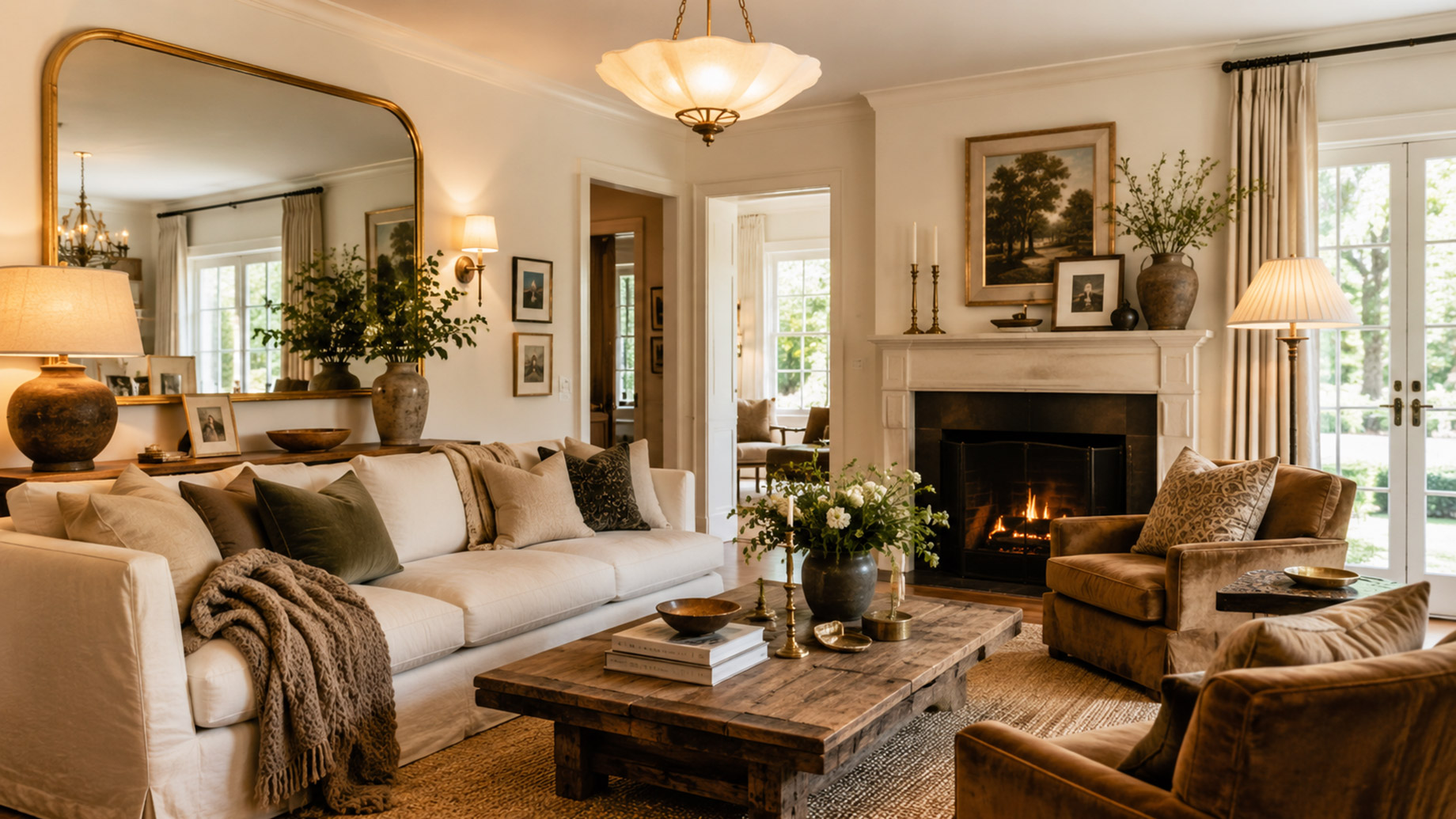
Making a home feel expensive is less about money and more about intention. Walk into any beautifully styled space, and you will notice it is not the price tags doing the heavy lifting.
It is the cohesion, the layering, the quiet confidence of every detail working together. Building material costs have been rising sharply, with renovation project costs averaging over $10,000 per home.
For most people, that kind of spending simply is not on the table right now. So we put together this guide to help you get that elevated, high-end look without tearing a single wall down or blowing up your savings.
Layer Your Lighting
Most homes are lit to be functional, not beautiful, and that one distinction changes everything. A single overhead light does the job, sure, but it also flattens a room and drains it of personality. There is actual science behind why this happens.
Overhead lighting creates high-angle illumination, which casts unflattering shadows downward and makes surfaces look harsh and one-dimensional. A multi-angle, dome-shaped LED fixture completely changes this.
It disperses light in several directions at once, softening the room evenly and adding that warm, layered glow you usually only see in high-end interiors. Make sure to have other light sources working at different heights.
Think floor lamp in the corner, a table lamp on the side table, along with a wall sconce, adding warmth at eye level. This layered approach creates what designers call luminous zoning, where different areas of a room carry their own distinct mood and depth.
Swap cool white bulbs for warm ones too, because colour temperature alone can make a room feel softer, cozier, and far more considered.
Add Character and Personality to the Interior
The fastest way to make a home feel richer is to give the eye something worth pausing on. A sense of character is what keeps a room from feeling flat, even when every piece is beautiful on its own.
As AD100 designer Brigette Romanek told Vogue in 2025, “People want their homes to feel alive and personal, with pieces that have history, character, and personality.”
So, how do you bring that feeling into a room without making it look busy? Think of personality as the details that make a space feel lived in, not copied from a catalogue. It could be texture, age, colour, shape, or a piece that carries some memory.
For instance, reclaimed wood table tops have a very distinct grain, patina, and depth compared to regular wooden tables. They bring warmth into the room, while still feeling grounded and refined.
Apart from being effortlessly impressive, these tabletops are also highly sustainable, adds Elmwood Reclaimed Timber. With the right care, they can last a lifetime.
If you are on a tighter budget, don’t worry. You can build the same feeling with vintage mirrors, handmade ceramics, old books, framed family photos, or travel finds.
Style these pieces in small, intentional groups instead of spreading them everywhere. Place old books under a ceramic bowl, lean a vintage mirror above a console, or frame family photos in matching finishes. A travel find can sit beside a lamp or a vase. Keep enough empty space around each piece so the room feels collected rather than cluttered.
Use Mirrors to Create the Illusion of a Bigger Space
How do you make a humble apartment appear bigger and luxurious without spending thousands on renovations? In 2026, interior designer Cortney McClure told House Beautiful, “The spaces that feel the most expansive are usually the ones that feel confident and intentional.”
That is the right way to think about mirrors. A well-placed mirror does not just reflect light, it multiplies it, making a room feel larger, brighter, and more open without touching a single wall. The science behind this is pretty simple.
Mirrors bounce both natural and artificial light across a room via specular reflection, the same principle that makes high-end hotel lobbies feel so effortlessly grand. Placement is everything here. Position a mirror opposite a window and watch it pull in daylight from across the room.
Lean a large floor mirror into a corner to visually push the walls outward. Go for frames with some character too, like aged brass, carved wood, or sculptural shapes. Add that layer of personality that makes a mirror feel like a deliberate design choice rather than an afterthought.
Add Texture Through Fabrics and Rugs
Texture is what makes a room feel warm before anyone even sits down. Smooth walls, flat furniture, and bare floors can make a space feel too polished in the wrong way. Texture is what gives a space its sensory depth.
Even better, it is one of the easiest things to build up gradually without a big budget. A chunky wool throw draped over the arm of a sofa or even a linen cushion sitting next to velvet ones can do the trick.
There is a scientific reason for this. Interior spaces trigger haptic perception, which means the brain responds to how surfaces might feel, even before you touch them. The mix of tactile surfaces creates haptic contrast, where different materials interact visually to make a space feel rich and considered.
Rugs in particular do a lot of the heavy lifting. A large rug that properly anchors the furniture in a room immediately makes the whole space feel more intentional and pulled together. Go for natural fibres where you can.
Choose wool, cotton, jute, and sisal because they age beautifully and hold their character far longer than synthetic alternatives.
FAQs
1. Do I need a big budget to make my home look expensive?
Not at all. Most of the changes that create the biggest visual impact, such as lighting layers, mirrors, texture, and collected pieces, cost very little. It is more about how you arrange and combine things than how much you spend on them.
2. What is the single most effective change I can make to a room right now?
Swap your bulbs. Changing from cool white to warm-toned bulbs costs next to nothing and immediately makes any room feel softer, more inviting, and far more considered. It is the lowest effort, highest return move in home styling.
3. How do I make a small room feel larger without renovating it?
Place a large mirror opposite your main window. It bounces natural light across the room through specular reflection, which visually expands the space without touching a single wall or spending significantly.
At a Glance: Key Takeaways
| Focus Area | What To Do | Why It Works | Budget Level |
|---|---|---|---|
| Lighting | Layer multiple light sources at different heights, swap to warm bulbs | Creates luminous zoning and adds depth through colour temperature | Low |
| Mirrors | Place opposite windows, choose frames with character | Specular reflection expands space and multiplies light | Low to Medium |
| Texture | Mix wool, linen, jute, and velvet through rugs and cushions | Haptic contrast makes surfaces feel rich and considered | Low to Medium |
| Character Pieces | Add reclaimed wood, vintage finds, and handmade ceramics | Brings history and personality that catalogues cannot replicate | Low to High |
The Best Homes Are Built Over Time
A beautifully styled home cannot be put together in a weekend. The ones that feel truly special are built up slowly, piece by piece, with patience and a good eye. So give yourself that same grace.
You do not need to do everything at once. Pick what resonates, try it, live with it, and adjust as you go. A home that reflects who you are will always feel more impressive than one that simply looks expensive. Trust the process and enjoy building it.
