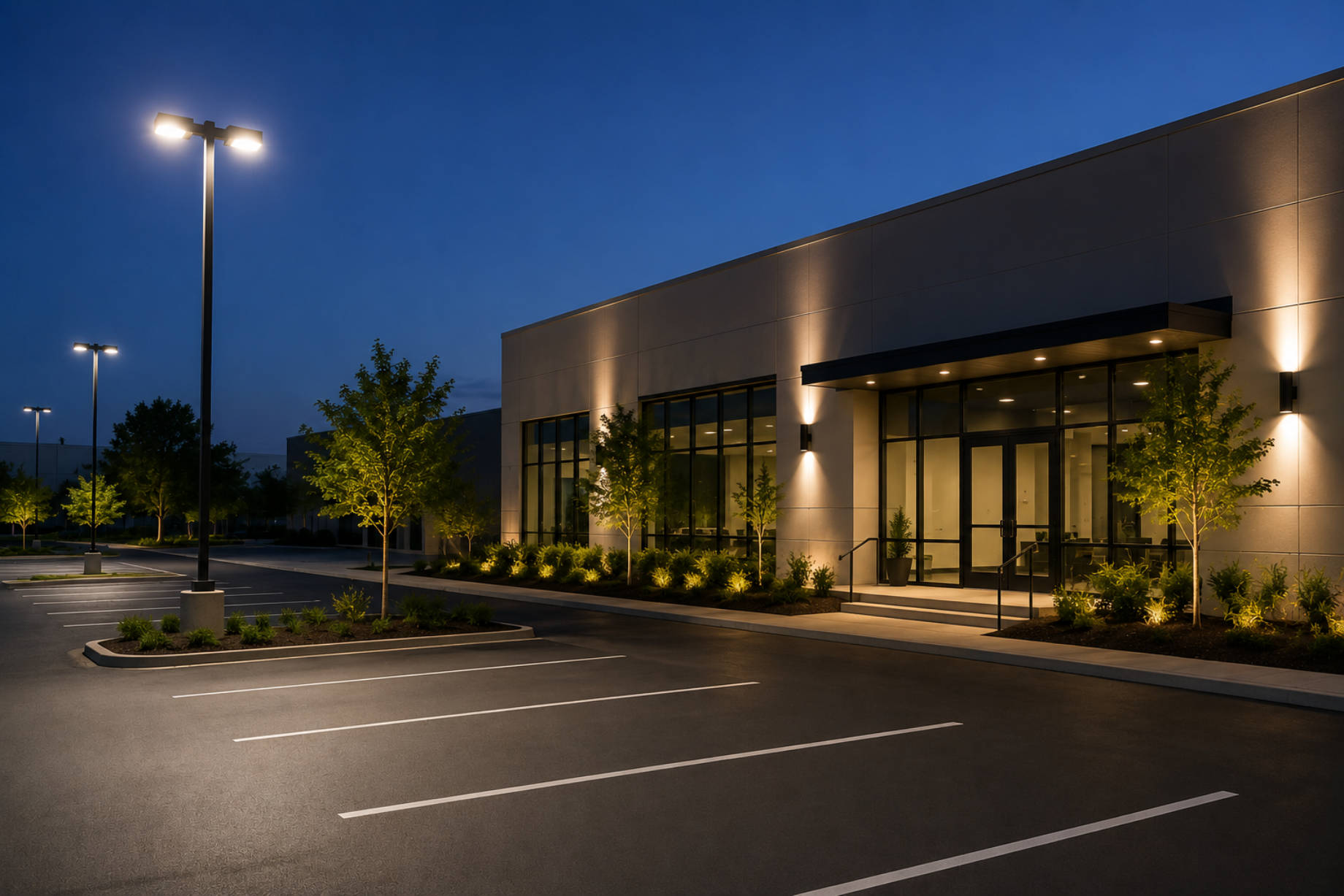
One of the most overlooked ways to increase property value is through outdoor lighting. By providing safety and security, extending the hours when the space can be used, and giving the impression that the building is orderly and intentionally designed, lighting can have a positive impact on property value. Per commercial real estate data, an upgrade to the exterior that is visible to the public, like adding lighting, is one of the most cost-effective ways to increase tenant retention, create a stronger first impression during leasing tours, and increase the appraised value when a property looks as if it is professionally managed.
The reason that this is effective is that it combines perception and function. A well-lit parking lot that feels safe at 9pm and a building facade that lights up the door after dark both show to tenants, customers, and buyers that the owner is attentive to the property. This perception has a direct influence on negotiations, lease rates, and the length of time a listing remains on the market.
Why Lighting Affects Appraised Value and Lease Rates
Appraisers do not More exactly mention “nice lighting” in their appraisal forms. Still, they consider occupancy, tenant quality, deferred maintenance, and operating costs, among other factors. And, lighting is involved in all of those four aspects. A retail strip or office park with a nice, uniform lighting generally retains tenants for longer periods. Why? Because tenants in such places get fewer security complaints and more foot traffic during evening hours. Fewer tenant replacements mean a more regular net operating income. And, with commercial property, the value Mostly depends on the multiple of that income.
Besides, there is a direct cost element. Typical wattage of the older metal halide or high-pressure sodium fixtures is two to three times higher than that of the newer ones for the same or worse light output. The buyer’s side who examine the property find energy liability and most likely near-term replacement cost related to the building using 400-watt metal halide pole lights across a lot, and maybe they price. A property that operates efficient lighting will remove that deduction from their offer. Less operating expense means more NOI just as rent does, which is why energy retrofits typically generate returns that the appraisal finds.
Insurance is a factor that is a little more subtle. Well-illuminated exteriors decreases slip-and-fall cases and at the same time, prevent vandalism and theft. And some insurers adjust the premiums or offer terms of coverage to reflect that. Having a safety record that partly depends on quality lighting makes the property easier and less costly to insure; this is very important for anyone financing a purchase.
What Good Commercial Lighting Actually Looks Like
At the commercial level, curb appeal isn’t just about the sheer brightness of light. Ideally, the lighting should be carefully planned and layered to not only attract people but also enhance the building appearance. Besides that, it should keep glare and harsh bright spots at bay so that the whole illumination looks natural. Usually, it’s about combining various outdoor lightings: high poles with floodlights in parking lots, wall-mounted lightings of entry points, spot lighting of the building’s main features and signages, and walkway lighting with bollards or path lights. The color temperature definitely really helps in this. Gentle 3000K light emanating a nice warm yellowish-white tone is considered inviting and Because of this it’s used in hospitality, retail, and mixed-use scenes quite often. Still, a 4000K to 5000K light which is much cooler and gives off bluish-white color is sharp and, That means, it is typical of parking and industrial areas where the main characteristics are alertness and clarity rather than warmth.
One of the errors that are frequently made is buying the wrong one. Blue-white 5000K light drenching a storefront of a boutique makes it quite similar to a warehouse But a dark and warm large lot may be perceived as unsafe. More importantly, the average level of illumination shouldn’t be compromised just by increasing the peak level. Lighting experts always refer to the difference in brightness between the dimmest and the brightest spots of an area and a smaller difference (less dark areas between the pools of light) is what contributes to the feeling of safety and looking good during a leasing tour or listing photos taken in the twilight. Depending purely on the positioning, the optics, and the spacing of the fixtures, two properties can use the same total amount of watts and still be totally different in appearance.
Costs, Timelines, and the Retrofit Process
For most of the commercial property owners, the question essentially boils down to whether they should retrofit the existing light fixtures or replace the entire units. The response hinges on the condition of the poles and wiring. If the underlying structure is still in good condition, simply changing the older lamps with LED retrofit kits or entirely new fixtures is the way of the fastest. In fact, this can be done for an entire building or lot in a matter of days, rather than weeks. Completely replacing the pole and the foundation is a large-scale project that usually takes weeks and involves permitting and electrical inspection.
There is quite a lot of variation in budget ranges from one site to another, but as a general guideline, a single LED wall pack or area light fixture is usually priced at a few hundreds of dollars for the unit alone, whereas the total cost of installation (including things like the height of the lamp, the electrical work involved, and the controls) can go up Much. A more extensive lighting retrofit of a parking lot can cost anywhere from a few thousand dollars for a very small lot to tens of thousands for a campus, and a lot of owners are able to get a good portion of their cost covered by utility rebate programs that incentivize switching to efficient lighting. One of the easiest ways to reduce your net cost is to look at your local utility’s incentive list before making a quote.
When specifying hardware, the things worth scrutinizing are lumen output, efficacy (lumens per watt), the warranty term, and the quality of the optics and driver, since cheap drivers are the usual failure point. Reputable lines such as TouchStone commercial LED fixtures are built around long warranties and DLC-listed efficiency that qualifies for rebates, which is the combination that makes the math work over a five to ten year hold. Smart controls, dimming, motion sensors, and photocells push the savings further by running full brightness only when an area is actually in use.
How the Right Approach Changes by Property Type
Each type of property, a medical office, a multi-tenant retail center, and a self-storage facility, has its own unique set of lighting needs. Treating them all the same is where building owners waste their money. Retail and restaurant owners rely on warm accent lighting and signage visibility since their buildings are part of the sales pitch, and lighting has to look good at the time when customers come. Office parks mostly focus on safe, well-distributed parking lot illumination and good wayfinding for employees who leave after dark.
Security is the main concern at industrial and logistics sites besides getting durable and low-maintenance lighting because putting a 30-foot pole back to light is both costly and inconvenient. Because of this, fixtures with long rated lifespans and surge protection are worth their premium. Hospitality is wholesale at the other end, where facade lighting is more like set design and the experience of arriving at night is part of the product. A buyer or appraiser who knows a specific asset class will understand the lighting from that perspective, and that is why a design that is well thought out, and each segment is treated differently comes across as a knowledgeable move, not just an expenditure.
Outdoor lighting features are also determined by climate and region. For example, coastal and high-humidity areas require housings that are corrosion rated, the cold-climate lots take advantage of LED’s reliable low-temperature startup, and regions with dark-sky ordinances necessitate using shielded, full-cutoff optics that direct light down rather than out, which also has the additional benefit of appearing cleaner and lowering glare complaints from neighbors. The International Dark-Sky Association explains how full-cutoff, shielded fixtures reduce light pollution and glare, which is exactly the standard these ordinances are built around.
