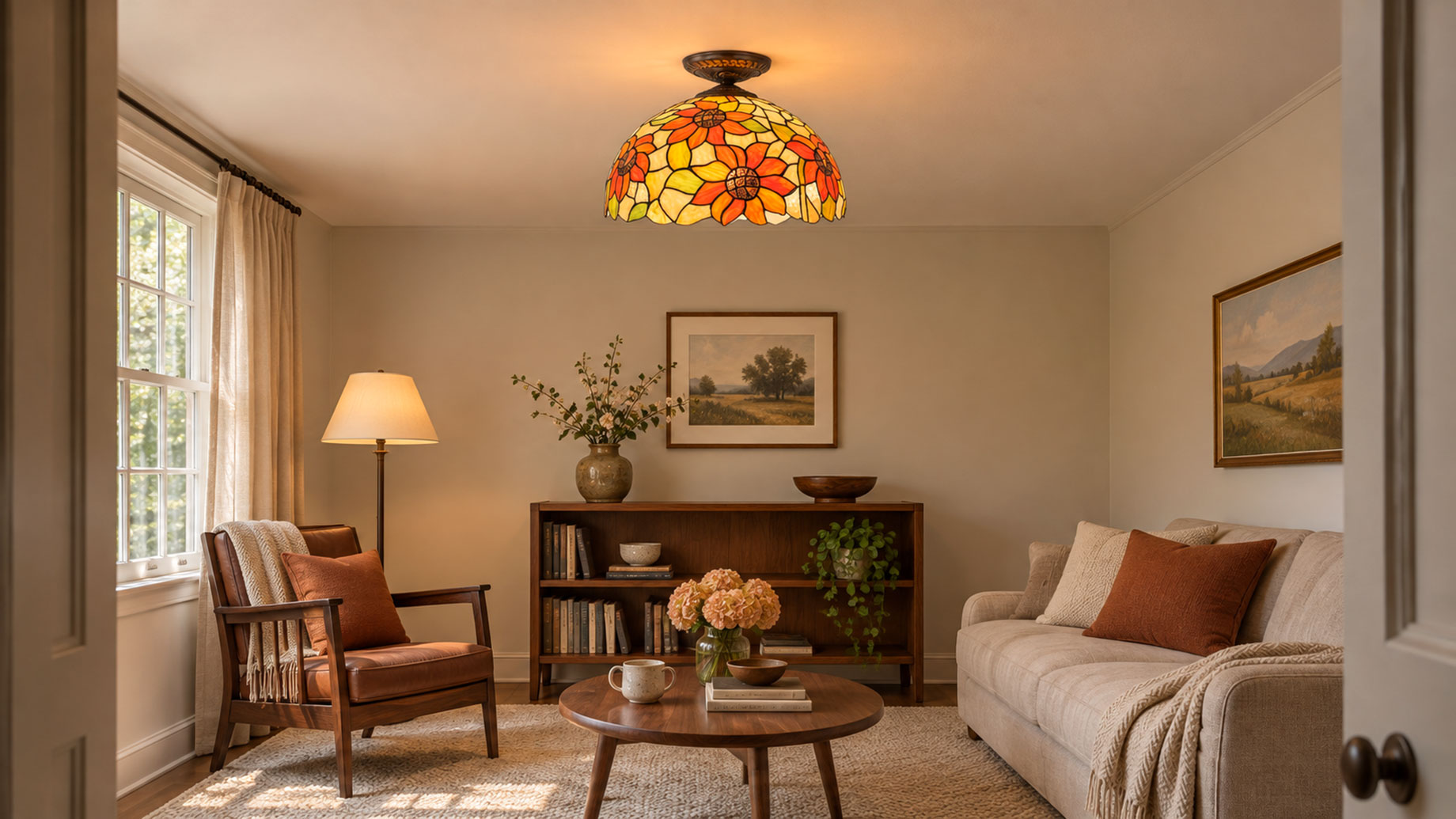
A room does not need a soaring ceiling to feel considered. Some of the most inviting spaces in a home are deliberately intimate: a sitting room overlooking the garden, a library tucked beside the main living area, or a bedroom with comfortable proportions and carefully chosen furniture. In these rooms, the ceiling light deserves the same attention as the upholstery or the joinery.
Stained glass introduces a particular design opportunity. Its pattern remains visible when the light is off, while illumination changes the relationship between the individual pieces of glass. A fitting that sits close to the ceiling can bring this richness into a room without the long suspension of a chandelier. The challenge is to give it enough presence to feel intentional while preserving the ease of the space below.
Read the Room from the Doorway—and from the Sofa
A ceiling fixture is experienced from several angles. From the doorway, its outline becomes part of the room’s overall composition. From a sofa, the underside of the shade is more prominent. From an adjoining space, it may appear against a window, a painted wall or a bookcase. A design that looks appealing in an isolated product photograph can feel quite different in each of these settings.
Before choosing a fitting, photograph the room from its main entrance and from the seats used most often. Look at what already attracts attention. A dramatic fireplace, a patterned rug and a large painting may leave little room for another visually complex element. Conversely, plain upholstery and quiet walls can give patterned glass a strong setting.
When comparing Tiffany style flush mount lights, consider the shade’s silhouette as carefully as its colors. A simple dome reads differently from a scalloped shade, even when their diameters are similar. The edge detail matters because it is often the part seen most clearly across the room.
Measure the Projection, Not Just the Diameter
“Ceiling light” covers several mounting arrangements. A flush fitting sits directly against, or very close to, the ceiling. A semi-flush design has a visible gap or short stem. Other fixtures use chains or longer supports. Category names alone do not establish how far a particular model will project into the room.
Check the total installed height, including the canopy, support and any finial beneath the shade. Diameter describes the fitting’s footprint; projection determines how much vertical space it occupies. Both affect its relationship with doors, tall furniture and the routes people use through the room.
There is also a difference between physical clearance and visual weight. Dense, dark glass can appear substantial even in a relatively compact shade. A lighter background with a more open pattern may feel less dominant. Neither effect is inherently preferable: the decision should follow the character of the room and the amount of decoration already present.
Let the Glass Suggest a Palette
Matching every color in a stained-glass shade usually creates more work than the room needs. A more restrained approach is to select one supporting color and allow the remaining tones to stay within the fixture.
An amber and green shade, for example, might sit comfortably above walnut furniture and oatmeal linen, with a muted olive cushion providing a small connection. A sunflower pattern could be echoed by terracotta upholstery rather than repeated in floral curtains, botanical wallpaper and decorative ceramics. The connection becomes more convincing when it crosses materials instead of duplicating motifs.
Browsing Tiffany flush ceiling lights with existing fabric and paint samples nearby can help narrow the selection. Look for a relationship with the room’s undertones rather than an exact color match. Product photography is a starting point; ask for unlit and illuminated views where available, since glass can appear markedly different between the two.
The ceiling itself should be part of this decision. A quiet, matte finish provides a restrained background for detailed glass. Elaborate ceiling decoration can also work, but it introduces another pattern and another set of proportions that must be considered together.
Give the Ceiling Light a Specific Role
A decorative fitting does not have to perform every lighting task. In a sitting room, it can provide a central glow while a shaded lamp beside an armchair illuminates a book. A separate light near a desk can support writing without requiring the entire room to become brighter.
This separation gives the room more flexibility. During conversation, the ceiling fixture and a low-level lamp may be sufficient for the desired atmosphere. During reading, the local light becomes more important. Daytime use may require neither, leaving the stained glass to function primarily as a decorative object.
Judge the result where activities actually happen. A beautiful shade does not, by itself, establish whether a page is adequately lit or whether a bright source is visible from a particular chair. If dimming is planned, confirm compatibility between the light source and the controls before installation rather than assuming that every combination will work.
A Sitting Room Built Around One Expressive Detail
Consider a compact sitting room with a low linen sofa, a walnut bookcase and a reading chair near the window. The furniture is modest in height, leaving the upper walls relatively quiet. A small collection of books and a single landscape painting give the room personality without filling every surface.
Here, a stained glass flush mount ceiling light can introduce the most expressive pattern in the room. A warm floral shade would sit naturally alongside wood and woven textiles, while one cushion could pick up a subdued version of its orange or green. The rest of the furnishings could remain plain.
The fitting’s position should be considered alongside the seating arrangement, ceiling features and existing electrical point. In an irregular room, the geometric center may not coincide with the visual center of the furniture. Resolve that relationship on a room plan before committing to changes, and have any electrical relocation assessed by a qualified installer.
Plan for the Room Beyond the Photograph
Living with a decorative light also means cleaning it, replacing compatible bulbs where applicable and maintaining access to its fittings. Check how the shade is removed and whether nearby furniture will obstruct routine maintenance. Follow the manufacturer’s care instructions for both the glass and the metalwork.
Finally, consider the view into neighboring rooms. A stained-glass fixture does not require matching lights throughout the house. Continuity can come from a recurring wood tone, a related metal finish or a restrained accent color. Letting one room carry the stronger pattern gives the home variation without making its spaces feel disconnected.
The appeal of a well-chosen ceiling light lies in these relationships: its scale above the furniture, its color against the walls and its contribution after daylight fades. In an intimate room, those decisions can make a compact fitting feel like a defining part of the architecture.
