Luxury real estate has always been sold through imagination. A buyer walks through a grand living room, studies the light, considers the scale, and quietly asks the real question: Can I see myself living here? For decades, the answer depended on physical staging, professional photography, architectural models, and a good agent’s ability to describe potential.
Now, augmented reality and AI are changing that moment entirely.
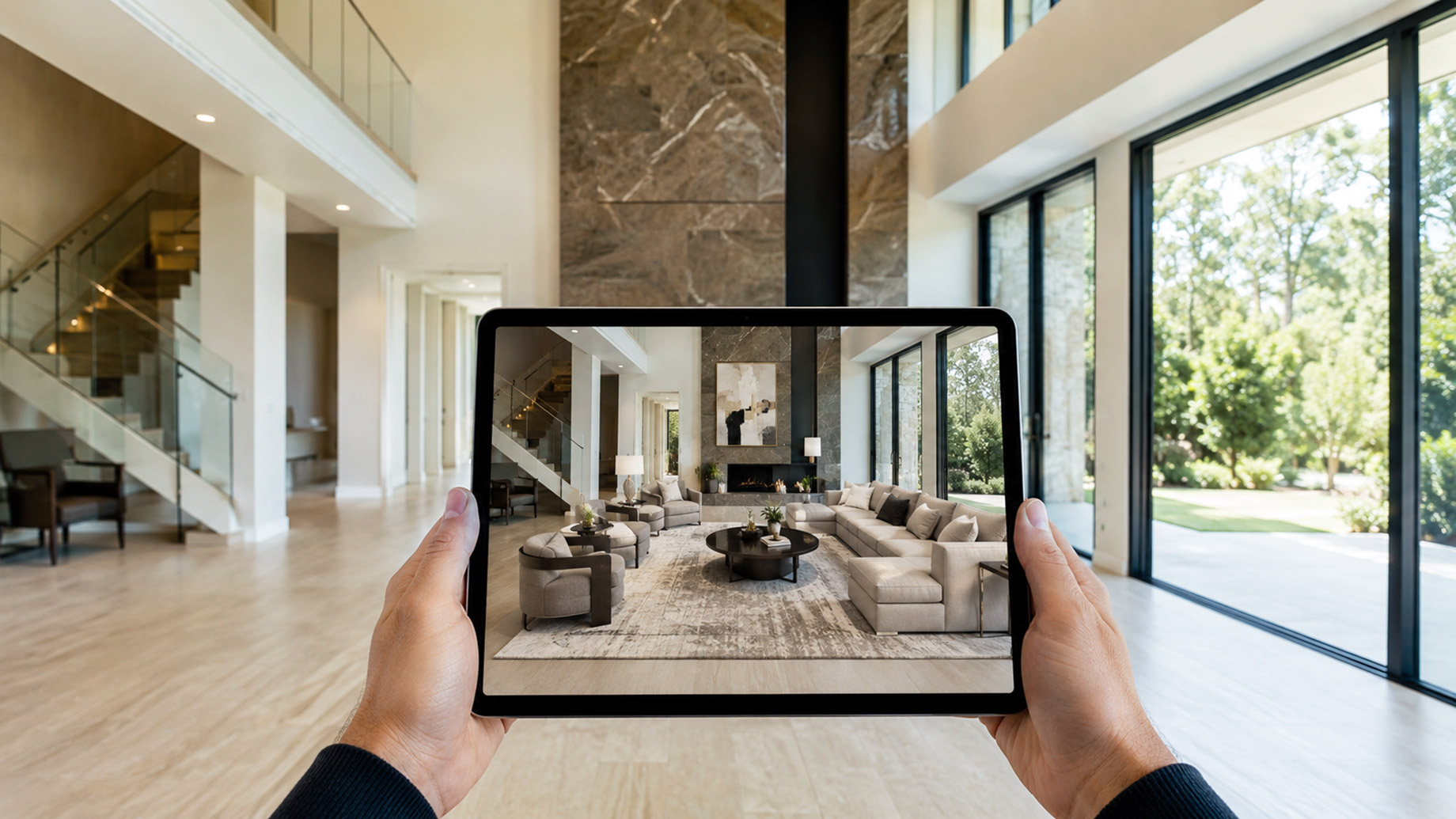
Instead of asking buyers to imagine what an empty room could become, agents can now show them. A tablet held up to a vacant living space can reveal a fully furnished interior in real time, placing sofas, rugs, artwork, lighting, and décor directly into the physical room. The walls, windows, floors, and ceiling remain real. The furniture is digital. The experience sits between both worlds.
That is the new power of AR in luxury real estate.
Why Empty Luxury Rooms Can Undersell a Property
Large luxury interiors are difficult to read when they are empty. A double-height living room may photograph impressively, but without furniture, the scale can feel cold or abstract. Expansive floors may seem too open. Minimal architecture can look unfinished. Buyers may understand that the property is valuable, but they may not emotionally connect with the lifestyle it offers.
This is why staging has remained so important. The National Association of Realtors’ 2025 Profile of Home Staging found that 83% of buyers’ agents said staging made it easier for buyers to visualise a property as a future home, with the living room ranked as the most important room to stage.
For luxury properties, that visualization problem becomes even more significant. A multimillion-dollar home is not simply selling square footage. It is selling atmosphere, taste, privacy, entertaining potential, and a complete sense of arrival.
Augmented Reality Makes the Showing More Persuasive
Augmented reality solves one of the core limitations of traditional staging: it lets the room remain flexible. A seller no longer has to commit to one physical furniture scheme. A broker can present the same space as a formal salon, a relaxed family lounge, a minimalist penthouse interior, or a warm contemporary retreat.
This matters because luxury buyers rarely share the same taste. One buyer may want European elegance. Another may prefer modern coastal restraint. Another may want a gallery-like interior with sculptural furniture and minimal visual noise. AR allows the agent to adapt the presentation to the buyer in front of them.
During a showing, that shift can be powerful. The agent can hold up an iPad and show how a seating area would be arranged around the fireplace. A buyer can see whether a large sectional fits without overwhelming the space. A developer can demonstrate how different finish packages and furnishings alter the character of the same residence.
The result is not just a better visual. It is a better conversation.
Where AI Enters the Process
AR provides the live visual layer. AI improves what appears inside it.
Modern AI visualization tools can analyse room proportions, natural light, architectural features, and design style, then generate interior concepts that feel more coherent than older virtual staging overlays. Instead of dropping generic furniture into a room, AI can help create a visual direction that respects the property’s architecture. Designers can now create visuals with ChatGPT Images 2.0 that match a property’s existing aesthetic directly from a single prompt.
In luxury real estate, that distinction matters. Buyers notice when furniture scale feels wrong, when lighting does not match the room, or when décor appears pasted into the scene. Poor virtual staging weakens trust. High-quality AI-assisted staging can do the opposite by making the room feel considered, intentional, and livable.
The broader real estate technology market is already moving in this direction. Matterport introduced a real estate marketing platform in 2025 that combines listing assets such as 3D tours, photography, floor plans, videos, and AI-powered descriptions, reflecting how property marketing is becoming more centralised, visual, and automated. Zillow has also experimented with AI-powered virtual staging in select Showcase listings, including design-style options such as modern, Scandinavian, luxury, and farmhouse.
The message is clear: AI presentation tools are no longer experimental side features. They are becoming part of the listing experience.
A Stronger Tool for Developers and Pre-Construction Sales
AR and AI visualization are especially valuable in new development sales. A buyer looking at a newly completed unit, a pre-construction residence, or a model suite often has to make decisions before the final lifestyle is fully visible.
Interactive AR presentation can reduce that uncertainty. A developer can show how a primary bedroom feels with different bed placements, how a living room changes with warmer materials, or how a terrace might function as an outdoor lounge. Instead of relying only on renderings, floor plans, and verbal explanation, buyers can see design possibilities at room scale.
For international buyers, this can be even more important. Many luxury purchases are made after limited in-person visits, sometimes with decisions influenced heavily by digital materials. AR-supported showings help make those limited visits more productive by turning blank or unfinished spaces into understandable environments.
Why This Does Not Replace Physical Staging Entirely
Physical staging still has value. A beautifully furnished residence can create a sensory experience that digital tools cannot fully replicate. Buyers can sit on the sofa, feel the materials, observe how sunlight moves across real textiles, and experience the property as a finished home.
But physical staging is expensive, slow, and inflexible. It also reflects one design interpretation.
AR and AI do not need to replace traditional staging to be valuable. Their strongest role is as a flexible presentation layer. They can help agents market vacant rooms, refresh stale listings, support remote buyers, test multiple design directions, and make luxury spaces easier to understand before any physical furniture arrives.
For some properties, physical staging will remain the right choice. For others, augmented reality may provide enough visual clarity to move the buyer from uncertainty to confidence.
The Future of Luxury Property Marketing Is Interactive
Luxury buyers are becoming more visually sophisticated. They expect high-quality photography, cinematic video, immersive tours, accurate floor plans, and polished digital presentation. Static listing galleries are still important, but they are no longer the full standard.
The next stage is interactive. Buyers will expect to see rooms change style, furniture, lighting, and mood in real time. Agents will use AI to generate tailored design concepts. Developers will use AR to demonstrate finished interiors before completion. Sellers will use these tools to make vacant homes feel less empty and more emotionally legible.
The best luxury marketing has always helped buyers imagine a better version of life. Augmented reality now makes that imagination visible. AI makes it faster, smarter, and more personalised.
For agents and sellers, the advantage is clear: the property no longer has to wait for the buyer’s imagination to catch up. With AR and AI, the future version of the home can appear directly in the room.