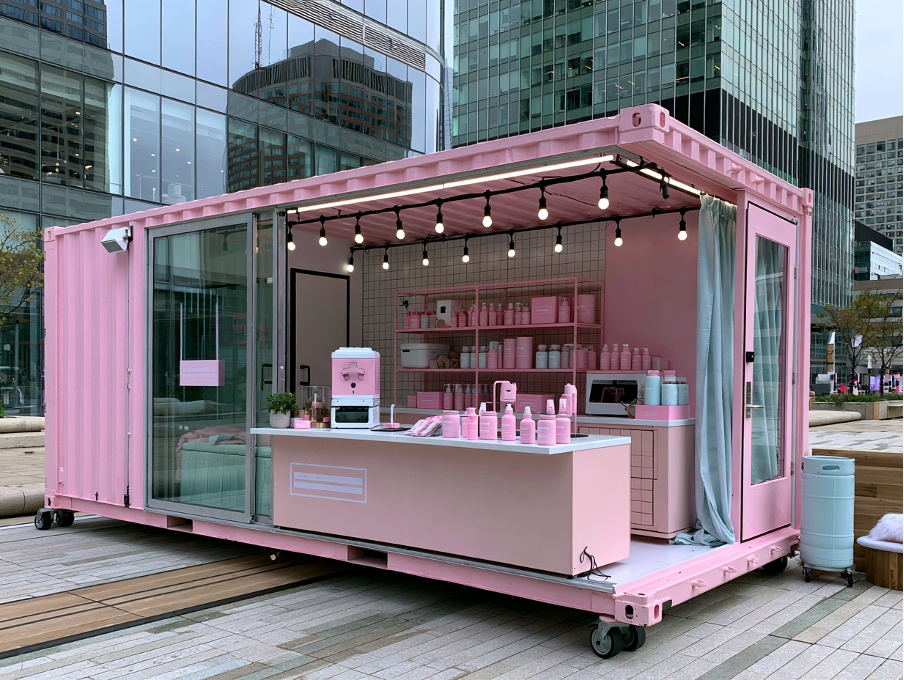
Retail is standing still less than it used to. Foot traffic shifts by neighborhood, by season, by news cycle, and a fixed pop-up shop can only meet an audience where the lease says it can. We’ve built our mobile pop-up shop capabilities around a different premise: the activation should move to where the audience already is, not the other way around.
A mobile pop-up shop keeps everything a traditional pop-up offers, curated product, a designed environment, a reason for people to stop, while removing the constraint of a single address. We think that flexibility is becoming less of a nice-to-have and more of a baseline expectation from brands planning a launch or a tour, especially as marketing budgets face more scrutiny and brands need every activation dollar to reach as many relevant audiences as possible.
What This Looks Like in Practice
When Brazilian footwear brand Schutz opened its Prince Street pop-up in SoHo, the goal wasn’t just foot traffic past the door, it was foot traffic through it. We produced a branded mobile marketing truck at the curb and two branded push carts flanking the entrance, serving all-natural ice pops and açai bowls to passersby throughout the opening weekend.
Our brand ambassador team, wearing custom branded apparel, used bounce-back cards and giveaways to pull people from the surrounding streets directly into the store. The mobile elements didn’t just create a moment on the sidewalk. They actively converted proximity into sales for a fixed retail location, which is often the exact outcome brands are trying to solve for when they consider a mobile format.
Why We Moved Away from Fixed Locations
A fixed pop-up asks an audience to come to the brand. A mobile pop-up shop reverses that. We can take a mobile marketing truck to multiple markets in a single campaign window, adjusting the route based on where engagement is strongest as the tour progresses. That kind of real-time flexibility isn’t available to a brand that signed a two-week retail lease before the campaign even started. If a market underperforms, a fixed pop-up is stuck with the outcome. A mobile format lets us pivot.
Consistency Across Every Stop
One thing we hear from clients considering a mobile tour for the first time is concern about quality control across multiple markets. We’ve built our production process to solve for that directly. The same fabrication, the same staffing standards, and the same brand experience travel with the vehicle, so a stop in one city feels identical in quality to a stop in another, even if the crowd and the context are completely different. That consistency is what separates a professional mobile tour from a loosely coordinated string of local events.
Built for the Moment, Not Just the Location
We think the strongest mobile pop-up activations treat each stop as its own event rather than a repeat performance. Local partnerships, market-specific timing, and small adjustments based on the audience in front of us all factor into how we plan a tour. That’s part of why we don’t treat mobile pop-up shops as a scaled-down version of a fixed retail activation. We treat them as their own format with their own advantages, built around movement and adaptability rather than permanence.
What Brands Underestimate About Mobile Logistics
The operational side of a mobile pop-up shop is more demanding than it looks from the outside. Permitting varies by city, staffing has to travel or be sourced locally at a consistent standard, and the vehicle itself has to hold up across a multi-stop route without downtime. Our Schutz activation, for example, required permitting directly in front of an active retail storefront, along with security on-site to manage the crowd it generated. Brands new to the format often focus on the creative concept and underestimate the logistics required to execute it well.
When a Fixed Pop-Up Still Makes Sense
We’ll be direct about this: a mobile format isn’t the right call for every brand. If the goal is a long-term retail presence in a single high-traffic location, or the product requires infrastructure that can’t reasonably travel, a fixed pop-up is still the better tool. We’d rather tell a client that upfront than force a format that doesn’t fit the goal.
For brands weighing where to put their activation budget, we believe the calculation is shifting. A mobile pop-up shop reaches more markets, adjusts in real time, and gives a brand multiple first impressions instead of one. That’s the bet we’ve built our mobile marketing truck program around, and it’s one we expect more brands to make in the years ahead.