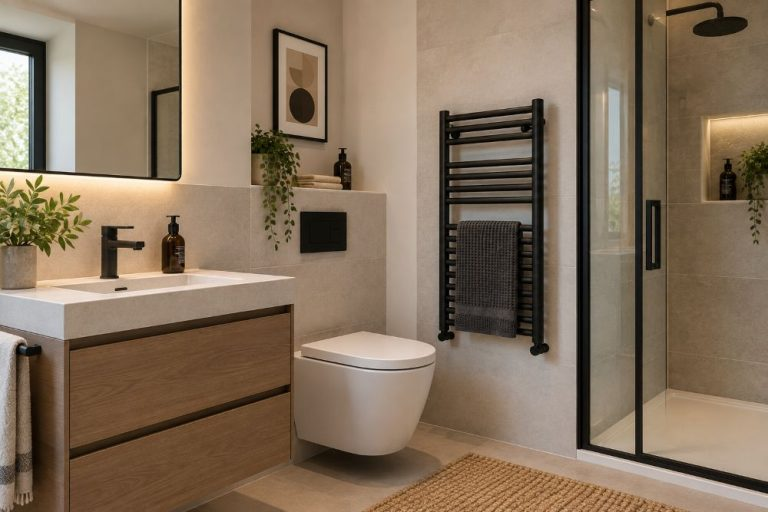
In a compact bathroom, good design is often less about adding more and more about making better use of what is already there.
This is particularly true in UK homes, where bathrooms, cloakrooms and en-suites frequently occupy some of the smallest rooms in the property. A door opening into the room, a compact vanity unit, a shower enclosure and a toilet can quickly consume most of the usable wall area.
Heating then becomes another element that has to compete for space.
For years, the usual response was simply to install the smallest radiator that would fit. But today’s bathroom heating market offers another approach: using narrow vertical space more intelligently.
A slim towel radiator can turn a previously awkward strip of wall into a functional heating and towel-drying area without allowing the radiator to dominate the room.
Why small UK bathrooms present a different design challenge
Compact bathrooms require a different approach from larger spaces.
In a generous bathroom, moving a radiator 200mm to one side may have little impact on the overall layout. In a small cloakroom or en-suite, those same 200mm can determine whether a vanity unit fits comfortably or whether a door can open fully.
The challenge becomes particularly obvious during renovations.
Once the positions of the toilet, basin, shower or bath have been established, the radiator is sometimes expected to fit whatever wall space remains.
That can result in compromises: an oversized radiator protruding into a circulation area, a conventional towel rail squeezed too close to furniture, or a radiator being positioned primarily because it fits rather than because the location works well.
Thinking about bathroom heating earlier in the design process can produce a much cleaner result.
Look for the wall spaces that normally go unused
Small rooms often contain surprisingly useful areas that are overlooked.
A narrow section of wall between a vanity and shower enclosure, a vertical strip beside a door or a small return wall may be unsuitable for a conventional radiator but large enough for a slim towel rail.
This is where vertical design becomes valuable.
Instead of requiring a large horizontal footprint, a narrow towel radiator uses height to provide useful heating surface while preserving valuable wall width.
The approach is particularly relevant in:
- small family bathrooms;
- downstairs cloakrooms;
- compact en-suites;
- converted loft bathrooms;
- apartment bathrooms;
- narrow shower rooms; and
- bathrooms with awkward wall layouts.
Rather than treating these spaces as a design limitation, they can become part of the heating strategy.
Why 350mm can be a useful middle ground
There is an important difference between choosing the smallest possible radiator and choosing the most appropriate narrow radiator.
An extremely narrow model can solve particularly restrictive installations, but there are bathrooms where a little more width is available and can be used productively.
This is where a 350mm format becomes interesting.
A collection of 350mm wide black towel radiators can occupy a relatively narrow section of wall while providing more usable towel-hanging width than some ultra-slim alternatives.
For homeowners and designers dealing with compact spaces, that makes 350mm something of a middle ground: narrow enough to solve many difficult layouts while still providing a practical towel rail rather than simply minimising dimensions at all costs.
The important consideration is not whether 350mm is universally the “best” width. No single radiator size is suitable for every bathroom.
It is whether the dimensions make better use of the particular wall available.
Think vertically when horizontal space is scarce
Vertical planning is already familiar in small-room design.
Tall bathroom cabinets provide storage without occupying large areas of floor. Wall-hung furniture exposes more visible floor and can make a compact bathroom feel less crowded. Recessed shelving creates storage within otherwise unused wall depth.
Heating can follow the same principle.
If only 350mm of suitable wall width is available, increasing the height of the towel radiator may allow more useful heating surface to be incorporated without making the radiator wider.
This is one reason why narrow towel radiators are often available in several heights.
A short model can work where both width and height are restricted, while a taller version can make better use of vertical wall space in an en-suite or small bathroom.
However, dimensions alone should never determine radiator selection. The required heat output for the room still needs to be established and compared with the manufacturer’s declared output.
A tall narrow radiator may make excellent use of the wall, but it still has to perform its primary heating function.
Pipe centres matter in tight spaces
A compact installation leaves less room for error.
For a 350mm-wide ladder towel radiator, the connection centres may be narrower than the overall radiator width. A typical 350mm model, for example, can use 300mm pipe centres.
That distinction becomes particularly important during refurbishment.
If pipes have already been installed or emerge through a tiled floor, choosing a radiator purely by its advertised overall width can lead to additional plumbing work.
For new bathrooms, checking both the overall dimensions and pipe centres before first fix gives the installer an opportunity to position the pipework accurately.
For replacement projects, existing pipe centres should be measured before the radiator is ordered.
It is a small technical detail, but in a compact bathroom good design often depends on getting exactly these small details right.
Don’t forget projection into the room
Width isn’t the only dimension that matters when space is limited.
Projection from the finished wall can have a surprisingly large effect on how a small bathroom feels.
A towel radiator installed beside a doorway or opposite a vanity may fit perfectly when looking only at its width and height, yet protrude further into the circulation space than expected once brackets and valves are included.
The complete installed dimensions should therefore be considered.
This is particularly important where the radiator is close to:
- an inward-opening door;
- a shower screen;
- a WC;
- a vanity unit;
- bathroom storage; or
- a narrow walkway.
In a large bathroom, an additional few centimetres may barely be noticed. In a cloakroom, it can make the difference between a comfortable layout and one that feels unnecessarily cramped.
A towel radiator can perform more than one role
Multifunctional elements are particularly valuable in small interiors.
A conventional radiator heats the room. A towel rail can provide heat while also giving towels somewhere to hang, warm and dry.
Combining those functions can reduce the need to find additional wall space for separate towel bars or rails.
This doesn’t mean every towel radiator will automatically provide sufficient heat for every bathroom. Heat requirements should still be calculated properly.
But where the specified output is appropriate, combining room heating and towel storage into one wall-mounted element can be an efficient use of limited space.
That principle is particularly useful in en-suites and cloakrooms, where every additional fitting affects the visual simplicity of the room.
Matt black can give a narrow radiator more architectural presence
Space-saving doesn’t have to mean visually insignificant.
One of the more interesting changes in bathroom design has been the move away from treating radiators as something that should disappear into the background.
Matt black taps, shower frames, handles and accessories have made darker finishes familiar in contemporary bathroom interiors. A black towel radiator can become part of the same visual language.
Against pale tiles or neutral walls, the vertical lines of a narrow black radiator can create definition without requiring a large area of wall.
It can work particularly well in monochrome schemes, industrial-inspired bathrooms and interiors combining black fittings with stone, concrete, timber or textured tiles.
The key is restraint.
In a compact bathroom, repeating the same finish across a few carefully selected elements can create continuity. Using too many competing statement finishes can have the opposite effect and make the room feel visually crowded.
A black towel radiator works best when it appears to belong to the overall scheme rather than being added as an isolated feature.
Small cloakrooms deserve proper heating too
Downstairs cloakrooms are easy to overlook when planning heating.
They may be used for relatively short periods, but they can still feel uncomfortable in winter, particularly where the room has an external wall or limited insulation.
The difficulty is that a cloakroom may have almost no conventional radiator space.
The basin and WC already occupy much of the room, and homeowners understandably don’t want a bulky heat emitter making an already compact space feel smaller.
A narrow towel radiator can offer an alternative where a suitable vertical wall section exists.
In addition to providing heat, it gives guests somewhere practical to dry a hand towel without requiring a separate rail.
The result is a relatively small change that can make the room feel more considered.
En-suites benefit from the same thinking
The same principle applies to en-suite bathrooms.
An en-suite is often created by taking space from an existing bedroom, which means dimensions are usually tightly controlled from the beginning.
A shower, toilet and basin take priority. Heating has to work around them.
Rather than allocating a large section of wall to a conventional radiator, a narrow vertical towel rail can sometimes be positioned in a space that would otherwise provide little practical value.
This can help preserve room for a larger shower enclosure, useful storage or a more comfortable circulation route.
It is a good example of why radiator dimensions should be considered during the design stage rather than once everything else has been decided.
Don’t choose on width alone
A narrow profile solves only one part of the problem.
Before selecting a towel radiator, the room’s heat requirement should still be calculated.
Room dimensions, glazing, insulation, external walls and the operating temperatures of the heating system all affect the output required.
Two radiators of the same width can also produce substantially different outputs because of differences in height, construction and tube configuration.
This is particularly relevant with narrow radiators because increasing height can provide additional heating surface without requiring additional horizontal wall space.
The goal should therefore be to find the right combination of:
width, height, heat output, pipe centres and projection.
Once those practical requirements have been satisfied, finish and styling can be considered.
Designing around the millimetres
Successful small bathrooms rarely depend on one dramatic design decision.
They are usually the result of many smaller decisions working together: a slightly shallower vanity, a better door position, wall-mounted storage, carefully planned lighting and fixtures selected to suit the actual dimensions of the room.
Heating should be approached in exactly the same way.
A narrow section of wall that initially appears too small to be useful may be capable of accommodating a vertical towel radiator. A 350mm width that seems like a minor specification detail can free valuable wall space elsewhere.
For UK cloakrooms, en-suites and small bathrooms, those few centimetres can have a disproportionate effect on the finished room.
The objective isn’t simply to install the smallest radiator available.
It is to choose a heating solution that provides the required performance while using the available architecture intelligently.
When every millimetre matters, good bathroom design begins with recognising that even the narrowest sections of wall can have a purpose.