Getting the begin-construction date wrong is one of the most expensive mistakes a clean energy developer can make. Not by 10 or 20 percent of credit value. By 100 percent, in the worst cases, when a project fails to qualify under the credit regime the sponsor modeled into their capital stack.
For legacy Section 48 projects, IRS Notice 2018-59 recognizes two methods for establishing begin-construction status: the Physical Work Test and the 5 Percent Safe Harbor. Most new clean-electricity projects placed in service after 2024 fall under Section 48E instead, where current wind and solar begin-construction rules may differ. Both are designed to give developers certainty about which version of the Investment Tax Credit rules apply to their project. Both are also full of technical requirements that trip up first-time filers and even experienced sponsors who assumed the rules hadn’t changed since the last project.
Why Begin-Construction Matters
The Section 48 credit has evolved through multiple statutory versions with different rates, adder structures, and eligibility rules. The applicable credit regime can depend on both when construction began and when the project is placed in service, particularly during the transition from Section 48 to Section 48E.
Establishing a defensible begin-construction date does three things:
- Locks in the credit rate under the rules in effect at that time
- Determines which bonus adders are available and at what thresholds
- Starts the continuity clock (the “continuous construction” requirement)
- Preserves eligibility if statutory changes occur before placed-in-service
For projects straddling regulatory transitions, begin-construction status can be worth tens of millions in credit value.
The Physical Work Test
The Physical Work Test qualifies a project when the taxpayer begins physical work of a significant nature on the property. The IRS has clarified that “significant” is a quality standard, not a quantitative one. Small amounts of physical work can qualify if the work is meaningful to the project.
What qualifies as physical work of a significant nature:
- Excavation for foundations
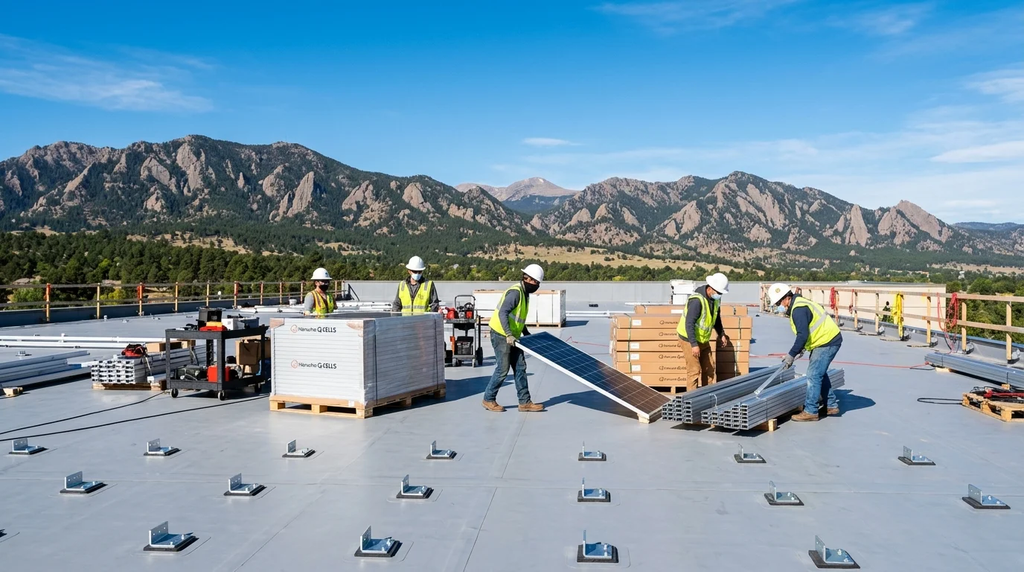
- Installation of racking or mounting structures
- Pouring of concrete pads for equipment
- Manufacturing of custom components at an off-site facility under a binding written contract
- Physical work on custom-designed transformers or other property integral to energy production; electrical transmission property itself does not qualify.
What does not qualify:
- Preliminary activities like planning, designing, or securing financing
- Site clearing, grading, or removal of existing structures
- Test drilling or environmental studies
- Ordering equipment without a binding written contract
The off-site manufacturing provision is particularly useful for developers. If your OEM begins production of custom components specifically for your project under a binding written contract, that work counts toward begin-construction, even though nothing has happened yet at the project site.
Documentation for the Physical Work Test needs to include:
- Photographs of the physical work with timestamps
- Contracts covering the work being performed
- Invoices and payment records tied to the qualifying activity
- Engineering certifications describing the work performed
The 5 Percent Safe Harbor
The 5 Percent Safe Harbor qualifies a project when the taxpayer pays or incurs 5 percent or more of the total project cost during the qualifying tax year.
- Paid or incurred (under the taxpayer’s method of accounting)
- Reasonably expected to be included in the depreciable basis of the project
- Actually attributable to the specific project claiming the safe harbor
- Documented with invoices, contracts, and proof of payment
The 5 percent calculation uses the reasonably expected total project cost, not the final cost. This matters because cost overruns during construction can push the qualifying spend below the 5 percent threshold, potentially disqualifying safe harbor status.
| Test Component | Physical Work | 5% Safe Harbor |
| Trigger | Significant physical work begins | 5 percent of project cost incurred |
| Documentation | Photos, contracts, engineering certs | Invoices, payment records, cost basis |
| Off-site work | Qualifies if under binding contract | Qualifies if attributable to project |
| Cost overrun risk | None | Cost overruns may limit safe-harbor coverage if the amount paid or incurred falls below 5% of actual total cost; multi-property projects may still qualify partially under the IRS 20-times rule. |
| Best fit | Custom-manufactured components | Standard equipment procurement |
Many sponsors use both tests in parallel as a belt-and-suspenders approach. Establishing qualification under either test preserves flexibility if one gets challenged.
The Continuity Requirement
Meeting the Physical Work Test or the 5 Percent Safe Harbor establishes begin-construction status. Keeping that status requires satisfying a continuity requirement through placed-in-service.
The IRS provides two ways to satisfy continuity:
Continuous construction or continuous efforts. The taxpayer must maintain a continuous program of construction (for Physical Work Test projects) or continuous efforts to advance the project toward completion (for 5 Percent Safe Harbor projects).
Safe harbor for continuity. Projects placed in service within four calendar years after the year construction began are automatically treated as satisfying the continuity requirement. This is the cleaner path for most sponsors.
What breaks continuity:
- Extended pauses without documented justification
- Failure to make continuous efforts toward completion
- Abandonment of the project followed by later resumption
The IRS recognizes certain excusable disruptions (permitting delays, litigation, force majeure events, natural disasters) that don’t break continuity. Documentation of these disruptions is essential.
Practical Pitfalls Worth Flagging
Assuming preliminary work qualifies. Site surveys, environmental impact assessments, and engineering studies feel like construction.
Missing the binding contract requirement. Off-site component manufacturing only qualifies if the OEM is producing under a binding written contract specific to your project. Speculative production doesn’t count.
Cost basis miscalculation. The 5 Percent Safe Harbor uses reasonably expected total project cost, but the reasonableness of that expectation gets tested against actual project economics. Wildly optimistic cost estimates can invalidate safe harbor status.
Continuity gaps during permitting delays. Long permitting cycles can strain the continuity requirement. The four-year safe harbor protects most sponsors, but projects with genuinely long timelines need to document excusable disruptions carefully.
Cross-contamination between projects. Sponsors running multiple projects sometimes allocate costs across projects to hit safe harbor thresholds.
Conclusion
The Section 48 begin-construction rules aren’t a formality. They’re the foundational determination of which credit regime applies to your project, and every downstream financial model depends on getting this right.
For projects currently in early development, three actions deserve immediate attention.
Build the continuity documentation habit from day one. Every construction milestone, every permitting delay, every excusable disruption goes into a dedicated file with contemporaneous documentation.
The credit structure Section 48 provides is the largest federal incentive in the history of clean energy. The begin-construction determination is what locks that value in. Get it right and the rest of the compliance work protects a credit that’s already secured. Get it wrong and no amount of downstream discipline can recover what was lost on day one.