For decades, financial advisors have preached a standard gospel of diversification: stocks, bonds, real estate, and perhaps a small allocation of precious metals. But in recent years, a new asset class has ticked its way into the portfolios of the ultra-wealthy and the savvy investor alike. It doesn’t pay dividends, it isn’t regulated by the SEC, and you can wear it on your wrist.
We are talking, of course, about luxury Rolex watches.
While the Swiss giant is primarily known for marketing lifestyle and achievement, the secondary market tells a different story. For many, a Rolex isn’t just an accessory; it is a store of value that has historically outperformed gold, real estate, and the S&P 500 during specific economic periods. Understanding why this specific brand commands such economic power requires looking beyond the dial and into the mechanics of modern luxury economics.
The Architecture of Scarcity
The fundamental driver of value for luxury Rolex watches is a carefully maintained imbalance between supply and demand. Unlike other luxury goods, where production ramps up to meet buyer interest, Rolex operates with a level of restraint that borders on frustrating for the average consumer.
The company produces roughly one million watches per year. While this sounds like a high number, it is nowhere near enough to satisfy the global appetite for the Crown. Each watch is hand-assembled and tested, a process that takes a year from raw materials to finished product. This creates a natural bottleneck.
However, the scarcity is also strategic. By not flooding the market, Rolex ensures that its product never feels “common.” When you walk into an authorised dealer and see empty display cases, it reinforces the idea that obtaining one of these timepieces is a privilege, not a transaction. This psychological positioning turns a consumer good into a treasure hunt, driving up desirability and, consequently, resale value.
Material Value vs. Brand Equity
Sceptics often argue that the price of luxury Rolex watches is inflated by marketing hype. They aren’t entirely wrong—marketing plays a massive role—but dismissing the intrinsic value of the object would be a mistake.
Rolex is one of the few watchmakers that is vertically integrated to an extreme degree. They operate their own foundry, creating their own alloys. Their 904L steel, branded as “Oystersteel,” is more resistant to corrosion and holds a polish better than the industry-standard 316L steel. They formulate their own lubricants and create their own luminescent material (Chromalight).
When an investor buys a Rolex, they are buying a tangible asset that is incredibly durable. Unlike a vintage car that might rust or a designer handbag that might fray, a well-maintained Rolex can function perfectly for generations. This durability is a key component of its investment thesis. An asset that lasts forever is an asset that can be traded forever.
The Blue-Chip Models
Not all luxury Rolex watches are created equal in the eyes of the market. While a standard Datejust might hold its value well, specific “professional” sports models act as the blue-chip stocks of the watch world.
The Cosmograph Daytona
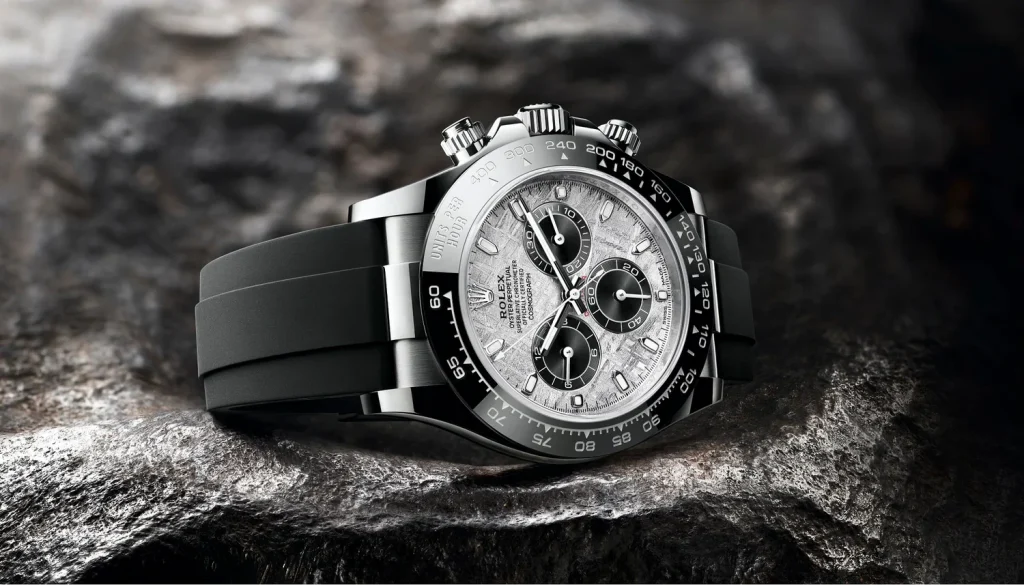
The Daytona is arguably the most coveted production watch in the world. Originally designed for racing drivers, it gained mythical status thanks to actor Paul Newman. Today, getting a steel Daytona at retail price is statistically improbable for anyone without a lengthy purchase history. This disparity means that the moment a buyer walks out of the store with a steel Daytona, it is instantly worth double or triple what they paid on the secondary market.
The Submariner
If the Daytona is the high-growth tech stock, the Submariner is the reliable index fund. It is the archetype of the dive watch. Because it is universally recognised and culturally significant (worn by everyone from Sean Connery’s James Bond to Steve McQueen), demand never truly wanes. It is the liquidity provider of the watch market; you can sell a Submariner for cash in almost any major city on Earth within hours.
The GMT-Master II
Famous for its two-tone bezels (the “Pepsi” blue and red, or the “Batman” blue and black), the GMT-Master II appeals to travellers and business people. Like the Submariner, its robust functionality, combined with distinct aesthetics, makes it a safe harbour for capital.
The Secondary Market Ecosystem
The rise of trusted online platforms has transformed watch collecting from a hobby into a tradable market. In the past, selling a watch meant going to a pawn shop and taking a steep loss. Today, platforms offer transparency and authentication that rival financial exchanges.
This infrastructure has allowed luxury Rolex watches to become a liquid asset class. Collectors can track the “market cap” of specific references, viewing charts that track price history over five or ten years. This data-driven approach attracts investors who might not care about horology but do care about yield.
Furthermore, the pre-owned market has a unique feature: vintage appreciation. As Rolex updates its models, it makes slight changes to case sizes, movements, and dials. This instantly turns the discontinued models into “vintage” collectables. A flaw in a dial (such as the famous “spider dials” where the lacquer cracked) can essentially turn a standard watch into a six-figure rarity. In this world, imperfection creates value.
Weathering Economic Storms
One of the most compelling arguments for holding luxury Rolex watches is their performance during inflation. When fiat currency loses purchasing power, investors flock to hard assets.
Gold is the traditional hedge, but gold is heavy, hard to transport, and generates no utility while you own it. A Rolex, conversely, is a portable store of wealth. It is an international currency. During times of geopolitical instability or high inflation, high-end timepieces tend to retain their value because they are priced globally. A Rolex in New York costs roughly the same as one in Tokyo or London, adjusting for taxes. This global consensus on value provides a safety net that few other luxury goods possess.
The Risks of the Watch Market
It would be irresponsible to discuss the investment potential without acknowledging the risks. The watch market, like any market, is subject to correction.
Between 2020 and 2022, prices for luxury Rolex watches skyrocketed to unsustainable levels, driven by cheap credit and crypto-wealth. When the economy cooled, so did the secondary market prices. Those who bought at the absolute peak saw their asset values drop.
Additionally, the cost of ownership must be factored in. Insurance premiums and service intervals (a full service can cost upwards of $800) eat into potential profits. And unlike a stock, physical assets can be stolen, lost, or damaged. The rise of “superclones”—fake watches that are nearly indistinguishable from the real thing—also poses a significant risk to amateur investors navigating the secondary market without professional help.
A Tangible Legacy
Luxury Rolex watches offer more than investment potential—they combine financial value with personal experience. Unlike stocks or crypto wallets, a Rolex is wearable, tangible, and heirloom-worthy, carrying the memories of life’s milestones while remaining a lasting symbol of craftsmanship and prestige.
While the potential for financial appreciation is real, the best reason to acquire a Rolex remains the appreciation of the object itself. The fact that it might pay for your retirement one day is just a complication on the dial.