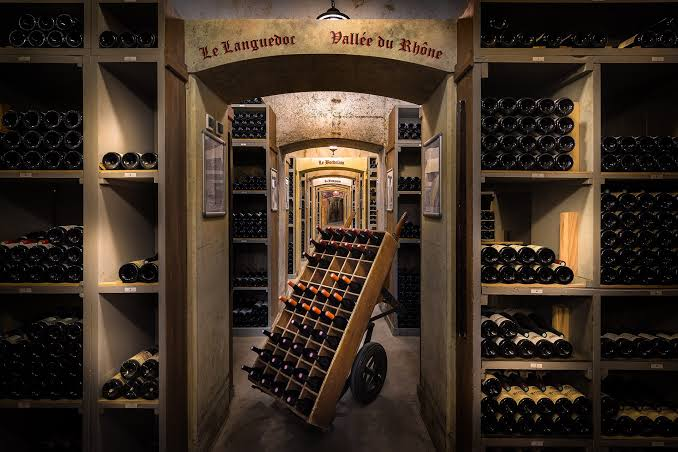
At estates from Napa Valley to the Loire, a new kind of trophy room has emerged. Not a home theater. Not a wine fridge tucked beside the kitchen. A dedicated cellar, engineered with the same precision as the vintages it holds.
For the world’s most serious collectors, a wine room is no longer a decorative flourish. It is an investment vehicle, a climate-controlled vault, and increasingly, a centerpiece of the home itself.
The New Standard for Private Cellar Design
Fine wine has become a recognized asset class, and the values reflect it. Bottles that once sold for modest sums now command dramatically higher prices at auction, and collectors are treating storage accordingly.
This shift has changed what architects and estate builders are asked to deliver. A cellar is no longer judged only on capacity or ambiance. It is judged on whether it can protect a collection worth more than the room around it.
How Today’s Cellars Protect a Collection
The mechanics behind a world-class cellar are deceptively complex. Temperature, humidity, light exposure, and vibration all interact, and getting even one variable wrong can compromise a collection slowly, often invisibly, over years.
The best designs treat these variables as one connected system rather than separate problems to solve.
Temperature and Humidity as a Single Discipline
Wine ages best around 55 degrees Fahrenheit, but temperature alone tells only part of the story. Humidity levels between roughly 60 and 70 percent are intended to keep corks from drying out, which can help prevent the slow oxidation that ruins a bottle years before its time.
Too much humidity, though, invites mold and label damage. Too little, and evaporation accelerates. Some of the most ambitious private cellars now rely on engineered systems built specifically for this balance, and manufacturers such as Smart Fog design winery humidity control systems intended to hold stable moisture levels without wetting racks, labels, or surfaces.
Materials, Racking, and Light Control
Beyond climate, materials matter enormously. Reclaimed limestone, hand-finished oak racking, and UV-filtered glass have become signatures of the highest-tier cellar builds, chosen as much for their light-blocking properties as their appearance.
Vibration control matters too. Many luxury cellars now isolate racking systems from HVAC equipment and foot traffic entirely, since even subtle, sustained vibration can disturb sediment and accelerate aging in ways a collector never intended.
What This Means for Collectors and Estate Owners
For homeowners building or renovating at this level, the cellar is no longer an afterthought in the architectural plan. It is often designed before the rest of the lower level takes shape.
Insurance underwriters have taken notice as well. Some high-value policies may request documentation of climate control systems before covering a collection at full replacement value. A poorly regulated cellar can quietly erode both the wine’s condition and its insurability.
There is also the matter of resale. Provenance increasingly includes storage history, and buyers at the top of the market ask pointed questions about how a collection was kept before it changes hands.
Choosing a Cellar That Matches the Collection
Not every collection calls for the same approach. A room built to hold two hundred bottles of everyday drinking wine has different requirements than a vault designed for first-growth Bordeaux meant to age for decades.
Size and orientation matter early in the planning process. Below-grade rooms benefit from the earth’s natural insulation, while above-ground cellars require more deliberate engineering to replicate those same stable conditions.
Working with specialists who understand both the architecture and the science behind preservation tends to produce better long-term outcomes. A beautifully designed room that cannot hold a steady humidity range is, in the end, just a beautiful room.
Collectors serious about longevity are increasingly commissioning custom mechanical plans alongside their interior design, treating the two as inseparable from the outset.
Final Thoughts
As fine wine collecting continues to draw new buyers and higher price points, the cellar itself is becoming as much a statement of discernment as the bottles inside it. Expect the next generation of private cellars to blend architectural ambition with increasingly precise mechanical engineering. These spaces are built to impress guests, but their real purpose is protecting a collection’s value for decades to come. For those planning such a space, the smartest investment may not be the rarest bottle acquired, but the room built to keep it exactly as it should be.