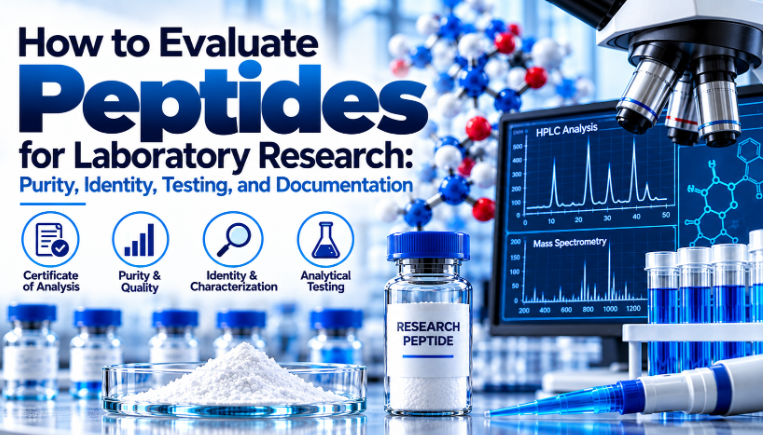
Evaluating peptides for laboratory research requires more than looking at a product name or choosing the material with the highest advertised purity percentage. Researchers working with peptides need to understand what a particular material is, how its identity was assessed, what purity means in the context of the stated analytical method, and whether the available documentation actually belongs to the product and lot being considered. This distinction becomes especially important when research peptides are accompanied by certificates of analysis, chromatograms, mass spectrometry data, or other analytical records. Research Peptides can be considered within this broader research framework, where the objective is to evaluate scientific materials using identifiable documentation rather than treating a single specification as proof of overall quality. A careful evaluation considers identity, purity, content, analytical method, batch information, testing date, documentation, and relevant research literature as separate but connected pieces of information.
Why Peptide Evaluation Requires More Than a Purity Number
Peptide quality is often discussed in terms of purity, but purity is only one part of a broader analytical picture. A number such as 98%, 99%, or 99%+ may appear precise, yet the meaning of that number depends on the method used, the sample tested, the calculation approach, and the reporting criteria. A purity result does not automatically establish molecular identity, confirm every possible impurity, demonstrate stability, or predict how a material will behave in an experimental model. Researchers should therefore avoid treating a high percentage as a universal quality score. Instead, peptide testing should be interpreted alongside information about the specific material, its batch or lot, the analytical method, and the date of testing. This approach is particularly useful when reviewing peptide suppliers because it shifts the focus away from promotional claims and toward traceable evidence. The central question is not simply whether a peptide has a high reported purity, but whether the available documentation provides enough context to understand what was actually tested and what the result means.
Identity and Purity Are Different Questions
Peptide identity and peptide purity answer different analytical questions. Identity concerns whether the material being examined is consistent with the peptide it is reported to be. Depending on the analytical strategy, researchers may examine molecular mass, sequence related information, chromatographic behaviour, or other characteristics relevant to identification. Purity, by contrast, concerns the proportion or analytical profile of the intended material under a particular testing method. A material may have a reported purity result while still requiring separate evidence to establish its identity. Likewise, confirming identity does not mean that every potential impurity or degradation product has been excluded.
This distinction is important because researchers sometimes interpret one analytical result as though it answers several unrelated questions. A purity percentage cannot automatically establish biological activity, stability, formulation characteristics, or suitability for a particular experiment. Good peptide characterization therefore considers the analytical purpose of each test. When reviewing a research material, the product name, selected strength or form, lot number, identity information, purity result, testing method, and supporting documentation should be examined together rather than compressed into a single general statement about quality.
What Researchers Should Look for in a Peptide COA
A peptide COA, or Certificate of Analysis, is primarily a documentation record describing stated analytical testing for a particular material or batch. A useful COA should be traceable to the product and lot being evaluated. Researchers should begin by checking the product name and then confirming that the batch or lot number corresponds to the material under review. The test date, issuer or laboratory information where available, analytical methods, reported results, and any additional notes should then be examined. If a chromatogram or mass spectrum is included, it should be considered together with the named method and sample information rather than viewed as an isolated image.
NextWave Peptides’ current COA library, for example, provides searchable product and batch records and displays fields such as product, size, batch number, test date, purity, net content, and other available testing information. The site also instructs readers to match the product name, strength, and batch number before interpreting a certificate. This illustrates why a COA should be treated as a traceability document rather than a general marketing statement. The usefulness of the document depends on what it actually records and whether that record can be connected to the specific research material being evaluated.
Understanding HPLC Peptide Purity
HPLC, or high performance liquid chromatography, is commonly used as an analytical technique for separating components within a sample. In peptide analysis, chromatographic data may provide information about the main component and other detectable peaks under the conditions used for the test. When a report provides an HPLC peptide purity result, researchers should review the stated method and understand that the percentage is associated with that analytical procedure.
The presence of an HPLC result does not mean that every possible substance in a sample has been comprehensively identified or excluded. Detection depends on the analytical conditions, instrumentation, sample preparation, and reporting approach. Consequently, a chromatogram should not be interpreted without its surrounding documentation. Researchers should look for the sample or lot identifier, method information, reported result, date, and any relevant analytical notes. Comparing two purity percentages also requires caution because different methods, detectors, integration procedures, or reporting conventions can make apparently similar numbers difficult to compare directly. A higher number is not automatically evidence of a universally superior material if the underlying analytical conditions are different.
The Role of Mass Spectrometry in Peptide Characterization
Mass spectrometry can provide valuable information about the molecular mass of a peptide and can contribute to peptide identity and characterization. Unlike chromatography, which primarily separates components according to their interactions with the analytical system, mass spectrometry measures mass-to-charge information under defined conditions. The two techniques can therefore provide complementary forms of evidence.
When reviewing mass spectrometry data, researchers should consider the expected molecular characteristics of the peptide and the way the laboratory reports the observed result. Instrument settings, ionisation conditions, charge states, adducts, sample preparation, and data interpretation can all affect how a spectrum is presented. A spectrum that appears convincing visually should still be interpreted in the context of the stated method and sample identity. The important principle is that analytical evidence should remain connected to the question it was designed to answer. Mass spectrometry can contribute to identity assessment, but it should not automatically be treated as evidence of purity, biological performance, safety, or clinical effectiveness.
Why Lot Specific Documentation Matters
Lot specific documentation is particularly important because research materials can be produced or tested in separate batches. A certificate associated with one lot should not automatically be treated as evidence for another lot unless the documentation explicitly supports that connection. This is why researchers should record the product name, selected strength or configuration, lot number, test date, and relevant analytical results when evaluating a material.
NextWave’s documentation guidance similarly emphasises matching the exact product and lot before interpreting a COA and distinguishes a product page, lot specific analytical record, and research literature as separate sources of information. This separation is scientifically useful because each source answers a different question. A product record describes what is being offered, a COA documents stated testing for a particular lot, and a research paper describes the material and experimental model used by the authors. None should automatically be substituted for another.
Evaluating Peptide Suppliers and Documentation
When comparing peptide suppliers for laboratory research, researchers should focus on transparency and traceability rather than relying only on advertising language. Useful documentation should make it possible to identify the material, understand the reported testing, and determine which batch the results apply to. Researchers may also consider whether analytical methods are identified, whether test dates are available, and whether supporting documentation can be accessed without ambiguity.
A strong research documentation process also means recognising what the available records do not establish. A COA may provide analytical information about identity or purity, but it does not replace scientific literature, experimental validation, institutional review, or appropriate laboratory controls. Similarly, a research paper can provide valuable information about a peptide in a defined experimental model but cannot authenticate a separate commercial lot. Keeping these sources separate makes peptide research more reproducible and reduces the risk of drawing conclusions that extend beyond the available evidence.
What a COA Does Not Prove
A Certificate of Analysis documents stated analytical testing. It does not automatically establish biological performance, human safety, therapeutic effectiveness, or regulatory approval. NextWave’s own COA guidance makes this distinction explicit and notes that a COA should be matched to the exact product and lot while being interpreted according to its stated methods and results.
This limitation is important for scientific communication. Even a well documented research material should not be presented as though analytical purity establishes a clinical outcome. Laboratory research, preclinical research, human clinical research, and regulatory approval represent different stages of evidence. Results from one stage should not be presented as proof of conclusions belonging to another. Researchers should therefore use COAs for the purpose they are designed to serve: documenting analytical information about an identified material under stated testing conditions.
Frequently Asked Questions
What should researchers look for when evaluating peptides?
Researchers should review the exact product identity, selected strength or form, lot or batch number, testing date, analytical methods, reported purity, identity information, and available documentation. Relevant scientific literature should be considered separately for experimental context.
What does peptide purity mean?
Peptide purity generally refers to the reported proportion or analytical profile of the intended material under a stated testing method. The meaning of a purity percentage depends on the method, sample, calculations, and reporting conditions.
What is a peptide COA?
A peptide COA is a Certificate of Analysis that records stated analytical results for a particular product or lot. It may include information about identity, purity, testing methods, date, and other analytical fields.
Why does lot matching matter?
Lot matching connects the analytical record to the specific material being evaluated. Results from one batch should not automatically be treated as though they describe every other batch of the same product.
Does a COA prove biological effectiveness?
No. A COA documents analytical testing and does not independently establish biological performance, human safety, therapeutic effectiveness, or regulatory approval.
Research Use and Safety Disclaimer
This article is provided for educational and laboratory research information only. Research peptides should not be presented or interpreted as products intended for human or veterinary use, administration, diagnosis, treatment, cure, or prevention of disease. Analytical documentation does not establish human safety or therapeutic effectiveness. Researchers should follow applicable laws, institutional requirements, laboratory safety procedures, and relevant scientific and regulatory guidance when conducting research.
Conclusion
Evaluating peptides properly requires a broader approach than comparing purity percentages or reading product descriptions. Researchers should examine identity, purity, analytical methods, batch information, testing dates, COAs, and relevant scientific literature as separate sources of evidence that work together to provide context. HPLC can provide useful chromatographic information, while mass spectrometry can contribute to molecular characterization, but neither technique should be interpreted beyond what its method and data support. Most importantly, documentation should remain connected to the exact product and lot being evaluated. A careful approach to peptide quality information helps researchers understand what a particular analytical record actually demonstrates while avoiding assumptions about biological performance or medical use. When documentation, analytical evidence, and research literature are kept within their proper scope, peptide evaluation becomes more transparent, reproducible, and scientifically responsible.