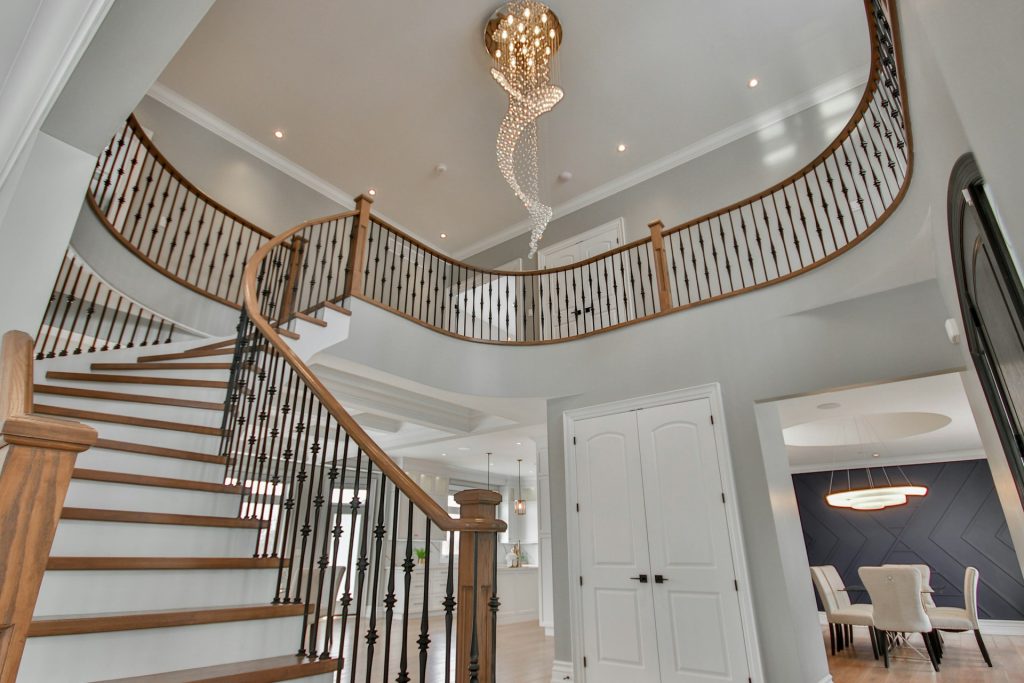
Custom wrought iron handrails upgrade a luxurious staircase not only by making safety a less visually obvious part of the house but also by making it the focus and center of attention. Hand-forged scrollwork, customized balusters, and the heaviness and finish of genuine iron evoke a feeling of constancy and artistry that standard aluminum or wood products cannot replicate. In high-end houses, often the staircase railing is the first thing a visitor notices, and custom ironwork visually and symbolically characterizes that first impression as intentional, custom-made, and luxurious at the highest level.
What differentiates custom wrought iron from ready-made metal is that every single element is manufactured to fit the exact dimensions and style of your stairs. Not only the design, and the rail profile, but also the baluster spacing, finish, and so on, are all made by choices rather than by defaults, which is why designers go for it on their landmark projects. Having this much freedom is also what enables a railing to visually organize a two-story foyer instead of visually clashing with the surrounding architecture.
What Makes Wrought Iron the Material of Choice for Luxury Stairs
Wrought iron deserves its reputation by blending these three aspects: strength, malleability, and time. The very nature of the metal is such that it can be remelted and by-hand shaped into arcs, coils, and scrolls that are extremely difficult for cast or extruded metals to imitate, which is why original and retro interiors greatly depend on it. An experienced blacksmith, for instance, is able to create either a vine ornament with smooth flowing lines or a plain grid of squares from the same piece of metal, That’s why the variety of styles is huge.
Besides, iron has a structural benefit that is significant for a grand staircase. It is strong enough to meet the building codes that most residential buildings in the U.S. follow, e.g. a guardrail height of 42 inches on upper landings and baluster spacing so that a sphere of 4-inch diameter cannot pass through, all this without resorting to large and heavy components for rigidity. As a result, the railing will be sturdy to the touch but visually will be very thin. The professionals in the market are commonly of the opinion that solid iron railings if kept in good condition can last longer than the homeowners themselves which explains why they seem to be a matter of generational investment rather than a finish-out cost.
The Design Choices That Separate Custom From Catalog
The difference between an unforgettable iron railing and a one-time use railing depends on a few choices. First, the baluster design will determine the mood, whether you choose simple straight pickets, hammered textures, twisted duck details, or decorative panels with scrolls and rosettes. Spacing and rhythm are as important as the design itself, because a repeating pattern that nicely aligns with the stair stringer appears intentional, whereas one that is mismatched looks like an afterthought.
The handrail profile is the part that people really touch, so its shape and material have great importance. For example, many high-end projects combine an iron baluster system with a stained hardwood top rail in walnut, oak, or mahogany to bring some warmth, while others use a continuous forged iron rail for a more dramatic, monolithic appearance. The finish is the last option that people have. In fact, matte black continues to be the most popular choice. Yet oil-rubbed bronze, antique pewter, hand-applied gold leaf accents, and weathered patinas are alternatives that change the character of the same basic frame. Curved and helical staircases are the ones that challenge the craft the most, as each baluster on a sweeping staircase is positioned at a slightly different angle and that means it has to be custom-made to fit its precise location.
What Custom Wrought Iron Costs and How the Process Works
Pricing varies widely because custom means custom, but it helps to have realistic ranges. Basic powder-coated iron baluster replacement often runs somewhere in the range of 75 to 150 dollars per linear foot installed, while fully bespoke forged designs with ornamental panels and premium finishes can climb past 300 to 500 dollars per linear foot and beyond for elaborate work. A signature curved staircase railing in a large foyer can become a five-figure line item on its own, which is consistent with its role as a focal point rather than a commodity.
The process usually starts with a designer or fabricator measuring the stairs and discussing style direction, followed by shop drawings or renderings you approve before any metal is cut. Fabrication then happens off-site, which for a custom project typically takes several weeks, depending on complexity and the shop’s queue. Specialists such as the team behind sihandrails handle this end-to-end, from design and forging to powder coating and on-site installation, which keeps the geometry accurate and the finish consistent across every piece. Installation itself is often the quickest phase, sometimes a day or two, since the hard work of fitting each element to the stairs was solved in the shop.
How the Right Railing Changes How a Home Feels and Sells
A staircase is one of the few things in a home you really interact with through your whole body – your hand grasping the rail, your eyes tracing the line up to the next floor. A custom wrought iron railing alters this everyday experience; the handrail feels physically weighted and the pattern brings the eye a considered rest point. In open-plan houses where the stairs are seen from the entry, kitchen and living area all at once, the railing acts as a piece of furniture that is visible from every angle.
Speaking from a resale standpoint as well. Real estate agents often mention staircases as very attractive elements in high-end properties and a custom iron railing indicates that the rest of the home is of a similar high standard. The matter is different for each housing type. A grand curved iron staircase in a double-height foyer of a spacious new build. In a period home that has been renovated, hand-forged iron is used to bring back the period features while builder-grade systems would much detract from the appearance. A minimal blackened iron railing with a very slim top profile in a modern penthouse would be considered as an instance of understated luxury rather than decorative. One and the same material can work very well for all three types because the one that is getting designed is the concept, not the metal.
Matching the Railing to Your Home and Budget
Honesty is the best policy when it comes to figuring out whether or not you’re going to commission a new staircase. Is the staircase the grand, architectural centerpiece of your home? Then perhaps it is worth spending a lot of money on fully forged custom metalwork and a hardwood top rail. But, if this is a secondary or back staircase, just upgrading to a simpler iron baluster will give you most of the visual impact at a much lower cost, and you can even consider saving your budget for the stair that your guests actually see.
Spending the most does not necessarily mean style coherence. A highly ornate scroll pattern may try to dominate a minimalistic modern interior, just as a very geometric profile may make a traditional home, with all its woodwork, feel unnaturally cold. The railing should be in harmony with the architecture and other elements in the room, like your flooring, lighting, and trim, so that it looks like it’s always been there.
Before finally approving a design, you should also take a walk along your real staircase and imagine the rail at eye level from the rooms that it connects to and not just the stairs themselves. The daily angles you have to live with are the ones that will determine if the railing is your quiet luxury that you stop noticing or a magnificent piece that keeps justifying its cost even years after the installation crew vacates the site.