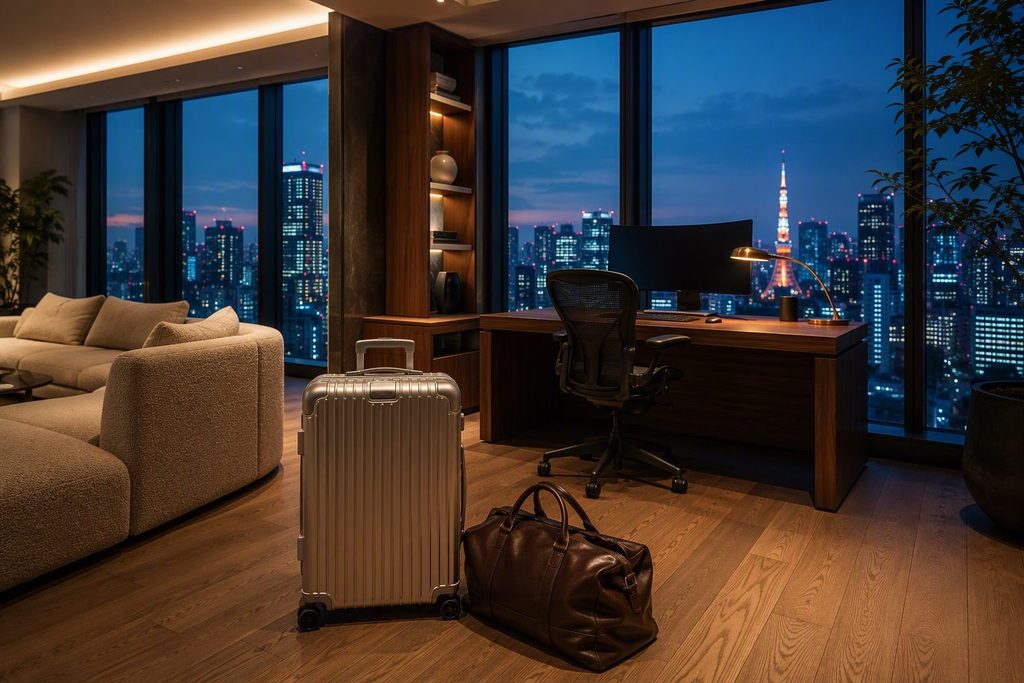
Furnished apartments in Tokyo have become a practical answer for executives who arrive with work already underway. A conventional lease runs on a slower clock. You commit to a longer term, then wait out furniture delivery and internet installation while the apartment sits half empty.
The shift is measurable. In fiscal 2025, fixed-term listings in Tokyo’s 23 wards made up 9.2% of the total, the fifth straight year of growth, according to IBTimes Japan. A fixed-term lease has a specific end date, which can line up with an executive assignment of uncertain length.
Anyplace has built its Tokyo offering around that kind of stay: furnished residences that pair a home with a workspace meant for a full working day.
Why Furnished Apartments in Tokyo Are Drawing Executive Demand
Corporate Moves Reward Flexible Housing
An executive arriving for a project that might run six months or eighteen has little use for a standard two-year lease designed for a household that intends to stay for years. Probation periods and delayed family moves can leave you in a contract that no longer fits. So can a business calendar that shifts mid-assignment.
You can see the demand in the serviced-apartment segment, where operators rent furnished units with services attached. Tokyo and Osaka portfolios posted occupancy above 90% in 2024 alongside rising average daily rates, according to Mordor Intelligence. Occupancy that high signals real demand. It doesn’t prove corporate relocation filled those units, and the report doesn’t claim that it did.
Location Can Shape an Executive’s Working Day
Rail access can matter more than square footage. Tokyo meetings scatter across districts, and every transfer on a morning commute costs time and energy. A home on a direct line to your main office can save hours each week.
Proximity to a useful station can shape an executive’s daily schedule more than additional floor area.
Almost half of relocations surveyed in Tokyo’s five central wards and Shinagawa in fiscal 2022 were to office buildings directly connected to, or within a one-minute walk of, the nearest metro or train station, according to Real Estate Asia. But that research tracks office decisions rather than apartment choices, and it still shows how highly professionals value convenient rail access.
Match the neighborhood to the office, not a brochure. An office in Marunouchi or Otemachi supports choosing a home on a direct line. Meetings split between Shibuya and Nihonbashi favor a location that minimizes transfers. No single district fits every assignment.
Furnished Apartments Versus Traditional Luxury Leases
Compare what each option demands of you before day one, not just the monthly rate. Among furnished rentals, the speed at which a unit becomes usable for work and rest distinguishes the executive-ready tier.
Compare the Setup and Daily Experience
The table below compares three routes an executive can take. Lease details vary by property and landlord, and residency status can affect availability.
| Consideration | Executive-Ready Furnished Residence | Traditional Luxury Lease | Extended-Stay Hotel |
| Typical commitment | Flexible or fixed short-to-mid-term booking | Often designed for a longer tenancy | Nightly or monthly booking |
| Furniture | Included | Often absent unless specified | Included |
| Kitchen and laundry | Usually residential, but property details vary | Depends on the unit | Often limited or shared |
| Internet | May be active before arrival | May require setup | Usually included |
| Workspace | Can include office equipment | Usually requires resident setup | Often limited to a table or business center |
| Privacy | Residential setting | Residential setting | Hotel environment |
| Upfront setup | Usually lower when utilities and furnishings are included | May require deposits, utilities, furniture, and internet arrangements | Limited setup |
| Personalization | Lower than an unfurnished home | Greater freedom to furnish | Usually limited |
Move-In Readiness Goes Beyond Furniture
Move-in-ready should mean something specific. The internet is active before you arrive. Furniture is present and usable, with bedding details stated in advance. The kitchen needs practical equipment, and you should verify laundry access rather than assume it.
A furnished unit isn’t automatically work-ready. A sofa and a dining table furnish a living room, but neither supports eight hours at a desk.
Move-in-ready covers daily life on arrival. Executive-ready adds the workplace layer, where video calls stay private and shifting assignment dates don’t break the arrangement.
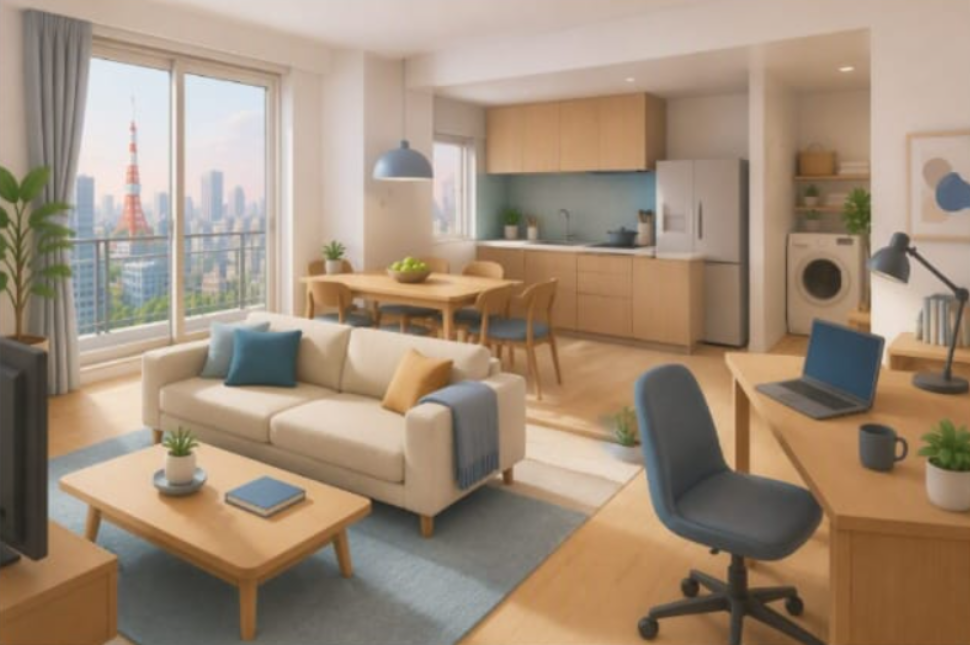
A residential kitchen and living area distinguish a furnished apartment from an extended-stay hotel room.
Compare Total Setup Cost, Not Rent Alone
Monthly rent is only part of the cost. A traditional lease can add furniture purchases and utility activation to the advertised price, with agency fees and deposits pushing the upfront total higher still. And internet installation eats time you may not have.
Include the value of your time. When a professional lands at Haneda on Sunday and attends a client meeting on Monday, the apartment must function as a home and an office from the first hour.
Furnished apartments can suit executives when immediate occupancy and reduced setup outweigh a higher advertised monthly rate. Calculate both totals, including all lease-related costs, before deciding which option is less expensive.
How Anyplace Redefines Corporate Housing in Tokyo
A Workspace Designed for a Full Working Day
Anyplace designs its premium furnished residences in Tokyo around a clear premise: an extended professional stay requires a dedicated, work-ready environment. As a premier provider of corporate housing in Tokyo, Anyplace delivers fully furnished accommodations built specifically for 30+ day stays, pairing residential comfort with high-grade office infrastructure standard rentals omit.
Basic Wi-Fi and a dining chair don’t make a productive remote office. Every Anyplace residence features private high-speed internet, a height-adjustable standing desk, and an ergonomic chair, paired with a widescreen monitor, wireless keyboard, and mouse. For professional video conferencing, units include a dedicated microphone, HD webcam, key lighting, and a collapsible green screen—with full equipment inventories confirmed directly on each listing page.
Flexible 30+ Day Terms and Seamless Extended Stays
Anyplace streamlines corporate housing in Tokyo by eliminating traditional lease friction. Built for business travelers, relocating executives, and remote founders, bookings require a 30-day minimum, with flexible extensions as project timelines evolve.
The entire process is optimized for international arrivals, allowing professionals to complete online screening and secure their furnished, work-ready accommodation before boarding their flight. The apartment is turn-key ready on landing day, with customer support to help with logistics, mid-stay requests, or schedule changes.
What to Check Before Booking Executive Housing
Confirm the Exact Workspace
Ask for specifics before you commit. Desk dimensions and chair type determine whether you stay comfortable during long working days. Confirm the monitor specifications and how the internet connection is delivered. Check the lighting and whether video calls can stay private from the rest of the unit. A promotional reference to a “workspace” means little unless the listing identifies what is included.
Read the Booking and Extension Terms
A flexible stay is not an open-ended tenancy. Confirm the minimum duration and cancellation terms in writing. Ask how extensions work and when notice is due. Screening requirements and payment schedules deserve the same scrutiny. For questions about enforceable lease rights or renewal protections in Japan, consult a qualified Japanese housing professional.
Evaluate the Neighborhood Around the Workday
Map the commute at the hour you plan to travel, since a 7 a.m. train and a 10 a.m. train are different experiences. Check the walking time to the nearest useful station. Groceries and a pharmacy within reach also matter during a busy first week. Use this checklist before booking:
- Exact apartment address or verified neighborhood
- Walking time to the nearest useful station
- Included desk and video-call equipment
- Internet access and expected connection details
- Total charges and cancellation terms
- Extension process and building-specific amenities
Verify What Varies by Property
Building amenities differ by property. Some buildings have gyms and resident lounges, while others offer rooftop terraces and meeting rooms. Dishwashers can vary even within a single operator’s portfolio, and Anyplace marks them as unit-dependent in Japan. Verify the individual listing rather than relying on a general category description.
Practical Questions About Renting and Relocating to Tokyo
Are Tokyo Rentals Commonly Furnished?
No. Most standard long-term apartments in Japan come empty, and tenants supply their own beds and appliances, often down to the curtains and light fixtures. Furnished apartments are a separate category aimed at residents who need a faster setup for a posting or temporary stay. What counts as furnished varies widely: one listing may provide a bed and washing machine, while another includes kitchen equipment and office furniture. Japan’s Ministry of Land, Infrastructure, Transport and Tourism provides an English-language apartment search guide for foreign residents. Review the item inventory and included utilities for the specific unit before you book.
How Should Executives Evaluate Corporate Housing in Tokyo?
Focus on four operational benchmarks: workstation capabilities, lease flexibility, transit connectivity, and transparent billing. Ensure the unit includes purpose-built office infrastructure—such as a height-adjustable standing desk, ergonomic chair, external monitor, and private high-speed internet—rather than a standard hotel dining table. Prioritize flexible 30+ day terms that eliminate traditional key money, nonrefundable deposits, and Japanese guarantor requirements. Choose locations with direct, transfer-free rail connections to your primary business hubs (such as Marunouchi, Otemachi, or Roppongi) to protect your daily schedule. Finally, verify that quoted monthly rates fully bundle utilities, internet access, cleaning fees, and Japanese Consumption Tax (JCT) to streamline corporate expense reporting.
What Is Typical Monthly Rent for a Tokyo Apartment?
No single average accurately describes the entire city. Rent varies by ward and apartment size, while building age and proximity to the nearest station also affect it. Furnished units are also priced differently from unfurnished ones. The Statistics Bureau of Japan publishes the Housing and Land Survey, but a citywide figure still obscures substantial differences among properties. Compare current listings in your target ward against your actual requirements instead of leaning on one general number.
Is Tokyo Living Cheaper Than Living in the US?
Sometimes. It depends on which American city you compare it with and on household size. Your housing standard and the exchange rate at the time of comparison also affect the numbers. Tokyo may cost less than some high-cost US cities but more than less expensive regions, especially for premium housing. Build a side-by-side budget using Japanese housing and household data together with the US Bureau of Labor Statistics’ Consumer Expenditure Surveys. Make sure the figures cover comparable years and household types.
Can a US Citizen Relocate to Tokyo Long Term?
Yes, as long as the person obtains appropriate residence status. Renting a home and receiving permission to live or work in Japan are separate processes. The Ministry of Foreign Affairs explains that US passport holders are among those eligible for visa-exempt short-term visits, but temporary visitor status does not authorize ordinary long-term employment. The Immigration Services Agency publishes the official status-of-residence categories and application information. Check the applicable requirements before committing to a move or an employment start date.
Is $1,000 a Month Enough for Life in Japan?
Not for the premium executive housing covered here. Actual costs depend on where you live in Japan and the type of housing arrangement you have. Household size changes the math, and so can an employer subsidy for rent or commuting. Someone in shared housing outside central Tokyo has a very different budget than an executive seeking a private, work-ready residence. Compare current housing prices and essential expenses in yen, and record the exchange rate date when converting the total to US dollars.
A More Practical Landing in Tokyo
Executive-ready housing is less about the furniture than about what each option takes off your plate during a move. A traditional luxury lease leaves the setup to you. A work-ready furnished residence handles it.
Anyplace sits on the furnished side of that line. Its Tokyo residences trade the standard two-year commitment for that 30-day minimum, and the desk arrives ready rather than as a weekend project.
Work through the checks above before you reserve anything. The right residence is the one whose specifics match the assignment’s shape. Everything else is furniture.