If you have ever stood in your backyard trying to figure out why it does not feel the way you imagined it would, there is a good chance the answer comes down to one thing: the balance between hardscape and softscape.
These two words get thrown around in landscape conversations all the time, but most homeowners in Highland Park are not entirely sure what each one covers, how they interact with each other, or why getting that balance right is one of the most important decisions in any outdoor project. Before you start pulling permits or meeting with contractors, understanding the distinction between these two elements can save you a significant amount of money, time, and disappointment.
This article breaks it down clearly, with a focus on what it means specifically for the properties and expectations of Highland Park homeowners.
What Hardscape Actually Means
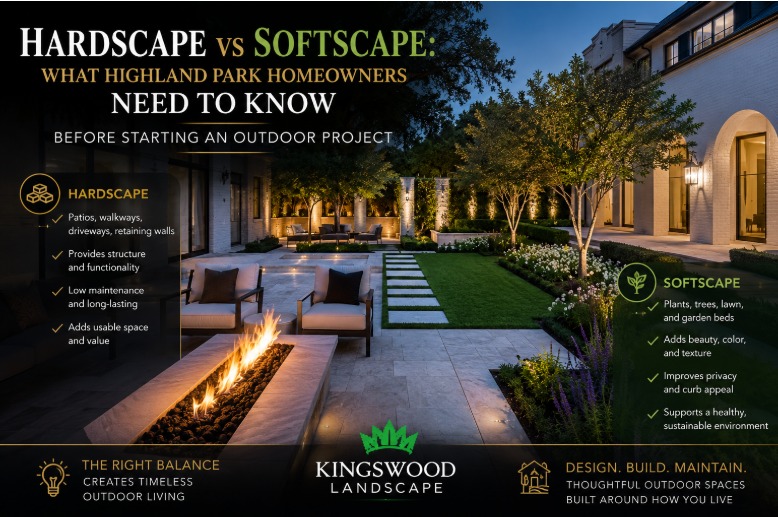
Hardscape refers to all the non-living structural elements of an outdoor environment. Patios, walkways, pool decking, retaining walls, outdoor kitchen structures, pergolas, driveways, steps, seating walls and fire features all fall under this category. These are the elements made from stone, concrete, brick, pavers, steel, timber, or other hard materials.
Hardscape defines the architecture of the outdoor space. It determines how people move through the environment, where they gather, what surfaces they stand on, and how the space connects to the home. Think of hardscape as the bones of the outdoor environment. Everything else is built around it, and changes to it after the fact are expensive.
In Highland Park, where properties tend to have architectural character, mature tree canopies, and expectations for material quality that match the homes themselves, Hardscape decisions carry particular weight. A poorly chosen patio material looks wrong against a traditional Highland Park exterior. An awkwardly placed retaining wall disrupts the visual flow of a property that would otherwise be seamless. Getting these decisions right from the beginning is not optional at this level.
What Softscape Actually Means
Softscape covers all the living elements of an outdoor environment. Trees, shrubs, perennials, ground covers, grasses, seasonal plantings, and turf all fall into this category. Softscape is the layer that brings the outdoor environment to life, provides seasonal interest, frames the Hardscape, softens hard edges, and connects the built environment to the natural landscape.
While hardscape establishes the structure, softscape establishes the character. Two identical patio installations can feel completely different depending on the planting that surrounds and defines them. A planting plan that works with the site conditions and the home’s architectural style transforms a hardscape into an environment. One that was selected without that context makes even beautiful hardscape feel incomplete.
In North Texas, softscape planning requires genuine expertise. The climate is demanding, the soil conditions across Highland Park and the Park Cities are specific, and plant selection decisions made without local knowledge tend to result in expensive replacements after the first Texas summer. A landscape professional who understands what performs well in these conditions, what provides year-round visual interest, and how to layer plants at different scales produces results that look intentional and hold up over time.
Why the Balance Between the Two Defines the Outcome
The most common mistake homeowners make in outdoor projects is treating hardscape and softscape as sequential decisions rather than integrated ones. The hardscape gets designed and built, and then planting is added around the edges to fill in the gaps. The result almost always feels like exactly what it is: two separate decisions stacked on top of each other rather than one cohesive environment.
When hardscape and softscape are planned together from the beginning, the relationship between them is intentional. The patio size accounts for the scale of the surrounding planting. The material palette of the hardscape complements the colors of the plant selection in every season. The planting beds are sized and positioned to frame the hardscape elements rather than compete with them. Paths lead somewhere that makes sense in the context of both what you walk on and what you walk through.
This integrated approach is what separates outdoor environments that feel designed from ones that feel assembled. In Highland Park, where the visual standard of the neighborhood is genuinely high and properties are evaluated seriously, that difference is visible and it matters at the point of sale as much as it matters to the homeowner living in the space every day.
The Highland Park Context
Highland Park presents a specific set of conditions and expectations that make the Hardscape versus softscape conversation particularly important.
The neighborhood’s architectural character leans traditional, with homes that have strong exterior detailing, brick and stone facades, and mature landscaping that has been established over many years. A new outdoor project on a Highland Park property needs to respect and extend that character rather than contradict it. That requires a material palette in the hardscape that relates to the home’s exterior and a planting plan that connects the new work to the established landscape on the property and the street.
The lot sizes in Highland Park vary, and in many cases the usable outdoor space is more constrained than in Southlake or Westlake. That makes the planning decisions more consequential, not less. When space is limited, every square foot of hardscape needs to serve a clear purpose, and every plant placement needs to contribute to the overall environment rather than just filling space. Good design under constraints is harder than good design with unlimited room to work.
The demand for experienced landscape design companies in Highland Park TX reflects this reality. Homeowners here are not looking for generic outdoor renovation services. They are looking for firms with the design depth to work within the specific context of their property and the construction capability to execute at the material standard the neighborhood expects.
Common Hardscape Mistakes Highland Park Homeowners Make
Understanding what goes wrong in outdoor projects is often more useful than a list of what to do right. Here are the most frequent Hardscape mistakes that result in costly corrections.
Choosing materials without considering the home’s architecture
Travertine looks beautiful in isolation but can feel disconnected on a traditional brick Highland Park property. Material selection needs to reference the home’s exterior palette, not just the homeowner’s personal preference.
Undersizing or oversizing the patio
A patio that is too small for the intended use feels cramped before it is finished. One that is too large overwhelms the space and leaves insufficient room for meaningful planting. Proper sizing requires understanding how the space will actually be used, not just how it looks on a plan.
Installing hardscape without addressing drainage
Highland Park properties are not immune to drainage challenges. Hardscape that is not graded correctly, or that does not account for how water will move across and around it, leads to pooling, erosion, and in some cases, water that moves toward the foundation rather than away from it.
Treating retaining walls as purely functional
Retaining walls on a Highland Park property are visible architectural elements, not just structural necessities. A retaining wall that is engineered correctly but designed without attention to material, proportion, and finish looks utilitarian in a setting where it needs to look considered.
Separating the Hardscape and softscape decisions
As discussed above, this is the most common and most expensive mistake. Fixing the relationship between structure and planting after both are installed typically requires removing and reinstalling elements that were done correctly in isolation but do not work together.
What a Well-Balanced Outdoor Project Looks Like in Practice
A Highland Park property that has been done right shares several observable characteristics.
The patio surface material relates to the home’s exterior finishes in color, texture, and character. The planting frames the hardscape at multiple scales, with larger structural plants defining the perimeter of the space, medium-scale shrubs providing seasonal interest and privacy, and ground-level plantings softening the transition between hardscape edges and lawn or bed areas.
Pathways lead logically from the home’s entry points to the primary outdoor use areas, with surfaces that feel appropriate to their function. Retaining walls, where they exist, look like they belong on the property rather than like engineering solutions dropped into the landscape. Lighting has been planned rather than added after the fact, so it contributes to the atmosphere of the environment rather than simply illuminating it.
This is exactly the standard that professional hardscape design and installation in Highland Park TX delivered by a firm with genuine design expertise produces. It is not accidental and it is not the result of selecting good individual products. It is the result of a design process that treats hardscape and softscape as one integrated decision from the beginning.
Frequently Asked Questions
What is the difference between hardscape and softscape in simple terms?
Hardscape covers all the non-living structural elements of an outdoor space: patios, walkways, retaining walls, pergolas, outdoor kitchens, and pool decking. Softscape covers all the living elements: trees, shrubs, perennials, turf, and ground covers. A well-designed outdoor environment uses both in deliberate relationship to each other rather than as separate decisions.
Which should I plan first, hardscape or softscape?
They should be planned together from the beginning, not sequentially. The size, placement, and material selection of Hardscape elements directly affects the planting plan, and the planting plan defines how the Hardscape will be experienced. Designing them separately almost always results in a disconnect between the two that is expensive to correct after installation.
How long does hardscape last compared to softscape?
Quality hardscape installed with proper materials and drainage preparation typically lasts several decades with minimal maintenance. Natural stone and travertine in particular are extremely durable in North Texas conditions. Softscape is more dynamic, with some plants establishing quickly and others taking several seasons to reach their intended scale. The investment in quality softscape compounds over time as plants mature.
Does hardscape add value to a Highland Park property?
Yes, particularly when it is designed and installed at a standard that matches the property and the neighborhood. In Highland Park, where buyers evaluate properties carefully and the visual standard of the neighborhood is high, a well-executed hardscape that integrates with the home’s architecture and the surrounding landscape contributes meaningfully to property value.
What materials work best for hardscape in Highland Park?
Material selection depends on the home’s architectural character, but natural stone, travertine, and high-quality concrete pavers consistently perform well in North Texas conditions. They hold up through the heat, do not fade quickly, and can be maintained over many years. Brick, used thoughtfully, works well on traditional Highland Park properties where it relates to the home’s exterior. A landscape architect with local experience can guide material selection based on the specific property.
The Bottom Line for Highland Park Homeowners
Outdoor projects in Highland Park are not simple undertakings. The properties have character, the neighborhood has expectations, and the decisions made early in the process have long-term consequences that are expensive to reverse.
Understanding the difference between hardscape and softscape is not just a vocabulary exercise. It is the foundation for making good decisions about what your outdoor project will actually involve, who you need to work with, and how to evaluate whether the plan being proposed to you reflects a genuine understanding of your property.
The homeowners in Highland Park whose outdoor environments stand out are the ones who treated design as seriously as execution, who understood that the structure and the planting needed to work together from the start, and who worked with firms that approached the project the same way.
That is the standard worth setting before any project in this neighborhood begins.