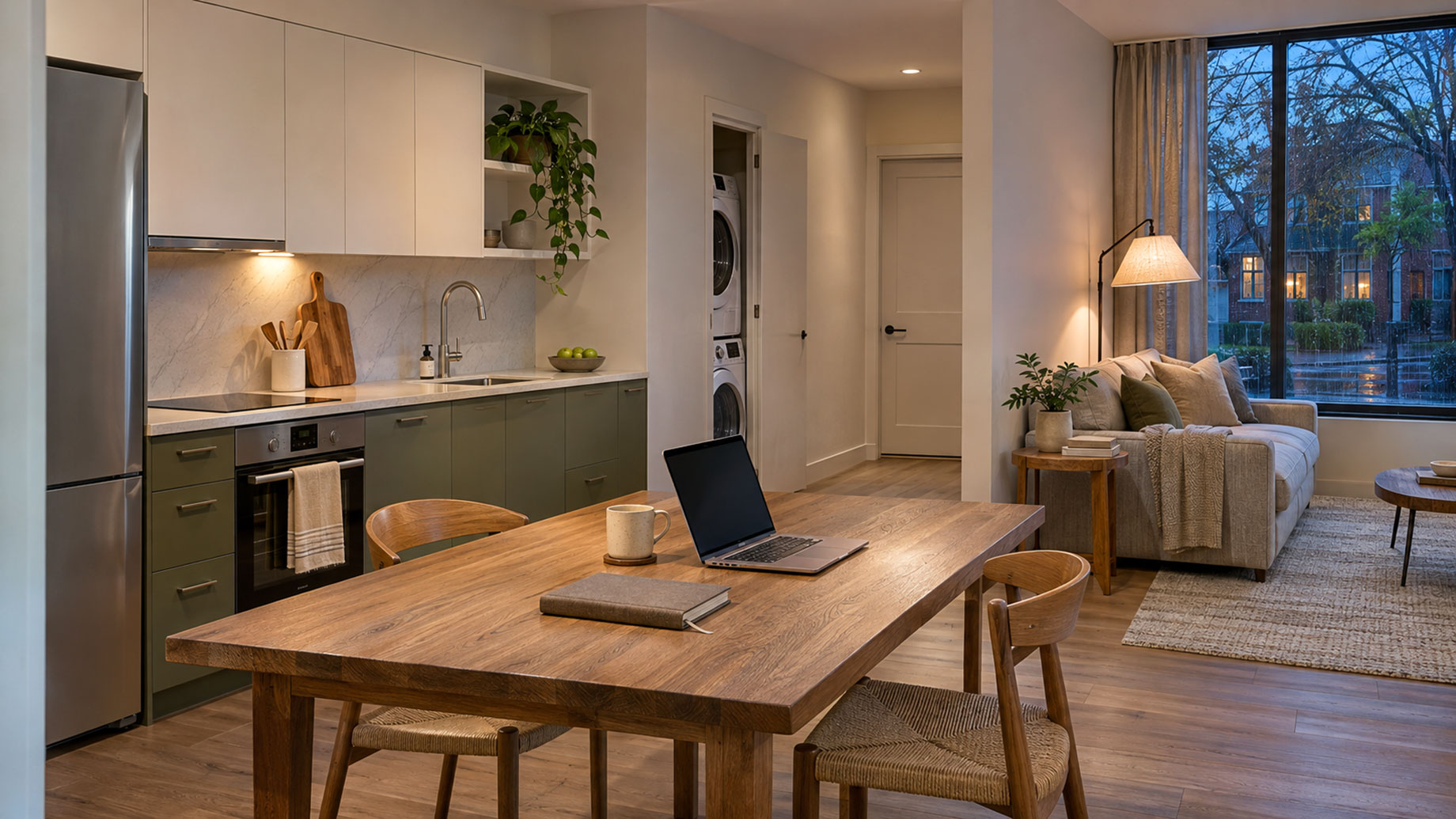
A well-designed hotel room is a remarkable thing for a short stay. It is compact, efficient and ready at any hour. It is also designed around a few nights, not a few months. When work keeps someone in a city for weeks at a time, the limits of that model start to show: the same narrow room, meals taken out, laundry sent away, and a lobby that never quite becomes a neighborhood.
For traveling professionals, and for the companies that send them, furnished housing has become a more considered alternative. The idea is simple. If the assignment is long enough to feel like living somewhere, the place itself should support living, not just sleeping between meetings or shifts.
Why the hotel model starts to fray on a long assignment
Hotels excel at arrival. Check-in is quick, housekeeping is included and the first night feels easy. By the second or third week, the same qualities can become constraints. There is rarely a proper kitchen. Storage is limited. A table large enough to spread out drawings or a laptop for the evening is not a given. The room is cleaned on a schedule that may not match a working day that starts before dawn or finishes late.
Cost follows the same curve. A nightly rate that looks reasonable for a conference becomes hard to justify over a six-week installation or a three-month project assignment, especially once meals, parking and laundry are added. The guest also remains, in a subtle way, a visitor. There is no familiar kitchen, no quiet corner that belongs to them, and no sense of a street outside the door.
None of this makes hotels the wrong choice for a short visit. It does mean that a long stay deserves a different brief: a furnished home or apartment that can be lived in, not merely occupied.
What furnished needs to mean for a working stay
“Furnished” is a loose word. A property can be advertised as ready and still lack the things that make a working week possible. A bed and a sofa are a start. A long stay also needs a kitchen stocked for real cooking, a table, decent lighting, reliable internet, a washing machine and enough storage that suitcases do not remain part of the furniture.
Specialists such as Comfy Workers source furnished homes and apartments for traveling project teams and keep the bookings under one account, which is useful when a company is placing people in a city they do not know well. The property still has to be judged on its own merits. Privacy matters as much as the inventory list. A one-bedroom apartment can be the right answer for a project lead who needs a quiet base. A house with several proper bedrooms can work well for a small team that already collaborates during the day, provided people are not sharing rooms or queuing for a single bathroom each morning. The standard should feel closer to a residence than to a dormitory. A good provider narrows the search. It does not replace a careful look at the floor plan, the light, the noise and the way the place will feel on a Sunday evening.
Location is a daily ritual, not a postcard view
In luxury residential writing, location is often about aspect, address and the quality of the surroundings. For a working stay, those things still matter, but they sit alongside a more ordinary test: what does the daily journey actually look like?
A beautiful apartment in a lively center can be a poor base if the workplace sits across a slow commute, or if there is no practical place to leave a car. A quieter residential street closer to the job may offer a better morning and a calmer night, even if it is less photogenic. The route should be checked at the hours the person will travel, not at midday.
The neighborhood also has to work in the evening and at the weekend. A grocery store, a place to walk and a sense of ordinary life around the property make a long stay more sustainable. Isolation looks peaceful on a listing and can feel bleak after three weeks.
Space, light and the difference between sharing and crowding
People who care about houses already know that square footage is a crude measure. Layout, light and acoustic separation do more to determine whether a place feels generous or tight. The same is true of temporary housing.
Bedrooms that sit away from the kitchen and the front door help when someone is on a different schedule from the rest of the household. A living room that is not also the only circulation route gives people a way to be together without being on top of one another. Natural light and a comfortable place to sit matter more when the stay lasts long enough for the room to become familiar.
If a team is sharing, it is worth being honest about capacity. A house listed for six is not automatically a good home for six working adults, each with luggage, laptops and a need to sleep. It is usually better to house people a little more spaciously than to squeeze the last bed into a plan that was designed for a different kind of stay.
The quieter comfort of a kitchen and a laundry
The features that improve a long stay are not theatrical. A kitchen in which you can cook a proper meal, a table where you can eat it, and a laundry room or a washing machine close to the living space change the rhythm of the week. They also change the cost. Eating out three times a day is tiring and expensive. So is sending out laundry because there is no machine.
Climate control that actually works, blackout curtains in the bedrooms and a shower that does not have to be negotiated each morning are the same kind of quiet quality. They rarely appear in a headline. They decide whether someone finishes a long assignment reasonably intact.
These are, in a way, residential values applied to a temporary address. The property does not need to be grand. It needs to be complete.
How companies book and pay for these stays
The other change is administrative. A hotel can be booked on a card, night by night. A furnished home for a project team usually needs a clearer arrangement: confirmed dates, a named coordinator, an understanding of deposits and extensions, and invoices that a finance team can match to a job.
It helps to agree early how changes will be handled. Assignments overrun. People are swapped. A phase that was meant to last four weeks runs to six. If the cancellation and extension terms are clear at the outset, those changes are a process rather than a Friday-afternoon emergency.
Keeping several stays, or several team members, under one account also reduces the risk that each booking becomes a separate trail of emails and receipts. The living quality of the housing is the point. The booking process should be calm enough that it does not undo that advantage.
A temporary address will never be a permanent home, and it should not pretend to be. It can, however, be a well-chosen furnished place in which work travel feels less like a succession of rooms and more like a period of living in a city with care. For anyone who already believes that the quality of a house shapes the life inside it, that is a natural next step beyond the hotel.
