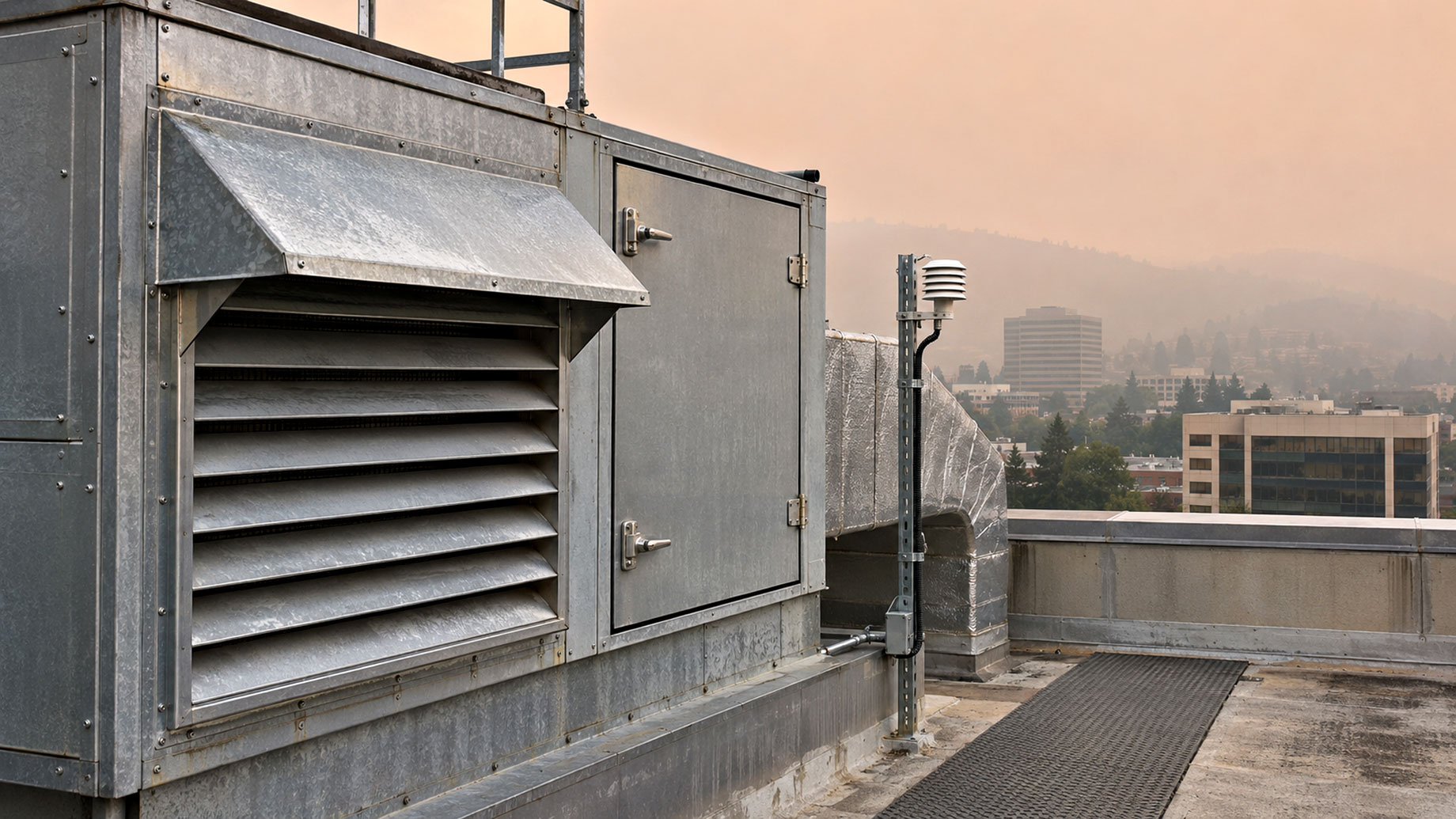
Wildfire smoke is now a recurring operating condition for commercial buildings well beyond the fire zones themselves, and plumes routinely travel hundreds of miles. The buildings that handle smoke days with the fewest complaints are usually the ones whose facilities teams made their decisions before the sky turned orange. Those decisions cover filter capacity, outdoor air and damper positions, building pressure, and the readings that tell the team when it is safe to return to normal operation. Filters do the heavy lifting throughout, and some buildings add measures that help existing filters capture more of the finest particles, which is where commercial particle pollution control solutions based on particle agglomeration come into the plan.
The checklist below follows the sequence most teams work through, from preparation to recovery. It draws on ASHRAE Guideline 44-2024, Protecting Building Occupants from Smoke During Wildfire and Prescribed Burn Events, and on EPA’s best practices guidance for indoor air quality during wildland fire smoke events, which includes an example smoke-ready checklist for building managers.
Start with a written smoke readiness plan
Guideline 44 is built around a written, building-specific Smoke Readiness Plan. The plan should name who has authority to switch the building into smoke mode, which air handlers are affected, what the control changes are, and what conditions trigger the switch in each direction.
Document the building’s normal control settings before anything changes. Record damper positions, economizer settings, minimum outdoor air setpoints, fan schedules, and any overrides. Teams that skip this step often spend days after a smoke event trying to remember how the building was supposed to run.
Install or verify PM2.5 sensing both outdoors and indoors. Guideline 44 recommends sensors in both locations so the team can see what is reaching the intake and whether indoor conditions are holding. Public AQI data from sources such as AirNow is useful for the regional picture, but it does not show what is happening at a specific building’s intake or inside its occupied floors.
Filter upgrades and filter supply
ASHRAE’s planning framework and Guideline 44 both recommend MERV 13 or higher filtration during smoke events where the HVAC system can accommodate it. Most wildfire smoke particles are smaller than one micron, which is the size range where lower-rated filters capture the smallest share of particles.
Before smoke season, confirm that each air handler can run MERV 13 filters without dropping below design airflow. Higher-efficiency filters carry a higher initial pressure drop, and older fans or units without variable frequency drives may not have the margin to absorb it. A mechanical contractor or test-and-balance firm can check fan curves and available static pressure for each unit.
Check filter racks for bypass. A MERV 13 filter in a rack with gaps around the frame lets smoke flow around the media instead of through it. Gaskets, clips, and properly sized frames matter as much as the filter rating.
Stock extra filters. Smoke loads filters quickly, and a multi-day event can require changes well ahead of the normal schedule. Some teams keep a MERV 8 prefilter in place to extend the life of the higher-efficiency final filter. Where outdoor air intakes have accessible locations for supplemental filter racks, adding MERV 13 filtration at the intake reduces the smoke load entering the system.
Portable air cleaners sized for specific rooms are a reasonable supplement in spaces where central filtration can’t be upgraded, or in rooms that will be used as cleaner-air refuges during a prolonged event.
Outdoor air dampers and recirculation strategy
The core operational move during a smoke event is to reduce outdoor air while continuing to run the system and filter recirculated air. Guideline 44 describes this as minimizing outdoor airflow while maintaining positive building pressure and using air cleaning to maintain indoor air quality.
Disable economizer operation. An economizer that opens to 100 percent outdoor air on a cool smoky morning will pull smoke directly into the building, so economizer lockout should be part of the smoke mode sequence.
Reduce minimum outdoor air to the lowest level that still meets code requirements, pressurization needs, and the building’s specific constraints. Some buildings can close outdoor air dampers fully for short periods. Others cannot because of combustion air, exhaust makeup, or specific space requirements. The smoke readiness plan should specify the level for each air handler in advance, with input from the engineer of record.
Keep fans running. Turning the system off stops filtration entirely. Running supply fans continuously in recirculation mode, with the filters doing the work, generally produces lower indoor particle levels than shutting down. Where the building automation system allows it, set occupied mode schedules to run longer during smoke events.
Review exhaust systems. Kitchen hoods, toilet exhaust, and process exhaust all pull air out of the building, and that air is replaced by whatever leaks in through the envelope. Reducing nonessential exhaust during a smoke event helps preserve positive pressure.
Particle agglomeration as support for existing filters
Even with filter upgrades, the smallest smoke particles are the hardest for any media filter to capture. Particle agglomeration is one way to help existing filtration perform better in that size range.
GPS Air’s needlepoint bipolar ionization (NPBI®) equipment is a soft ionization technology that uses bundled carbon fiber emitters to create an ion-rich cloud distributed through the duct system. As those positive and negative air ions interact with airborne particles, the particles take on a charge and cluster together into larger particles. Larger particles are easier for filters to capture, so the same filter bank removes more fine particulate from the recirculated air than it would on its own.
The point of agglomeration is to support filtration, not replace it. A smoke plan still depends on properly rated filters, sealed filter racks, and regular filter changes. Agglomeration works alongside those measures by improving how much of the fine particle load the existing filters can capture. GPS Air’s NPBI products are UL 2998 validated for zero ozone emissions, which matters when any device is placed in an occupied building’s airstream.
Pressurization
Positive building pressure keeps smoke-laden outdoor air from infiltrating through doors, windows, and envelope gaps. When a building runs negative relative to outdoors, it draws unfiltered air in through every leak path, bypassing the filters entirely.
Monitor building pressure during smoke mode. Differential pressure sensors between indoor and outdoor locations give the team a direct reading. Where permanent sensors aren’t installed, handheld manometers at representative locations provide a workable check.
Test smoke mode before an event. Guideline 44 and the companion checklists recommend placing the building into smoke-ready mode during a clear day to confirm it can hold positive pressure at the reduced outdoor air setting. Testing ahead of time shows whether exhaust needs to be cut back further or whether outdoor air can’t drop as low as planned.
Seal what can be sealed. Weatherstripping on frequently used doors and gaps around penetrations and unused openings all contribute to infiltration. Envelope sealing is a longer-term project, but it makes every smoke event easier to manage.
How to tell when conditions have cleared
Returning to normal operation too early can pull a fresh wave of smoke into the building. Waiting too long keeps outdoor air reduced longer than necessary.
Use the outdoor and indoor PM2.5 readings together. Establish reversion thresholds in the smoke readiness plan before the event, and wait until outdoor levels have dropped and stayed down for a sustained period rather than responding to a single good reading. Smoke conditions can shift quickly with wind direction.
When outdoor conditions have cleared, restore outdoor air in stages and watch indoor readings as dampers open. A controlled flush with clean outdoor air helps clear residual smoke from the building.
Inspect and replace filters after the event. Filters that loaded heavily during the smoke event will carry higher pressure drop and may hold odor. Replace them according to the plan rather than waiting for the normal schedule.
Restore documented settings. Return economizers, minimum outdoor air setpoints, fan schedules, and exhaust to the normal values recorded before the event, and confirm that no temporary overrides remain in the building automation system.
Review what happened. Note how quickly filters loaded, whether the building held pressure, and how long indoor levels took to respond. Those notes become the revisions that make the next smoke event easier to manage.
