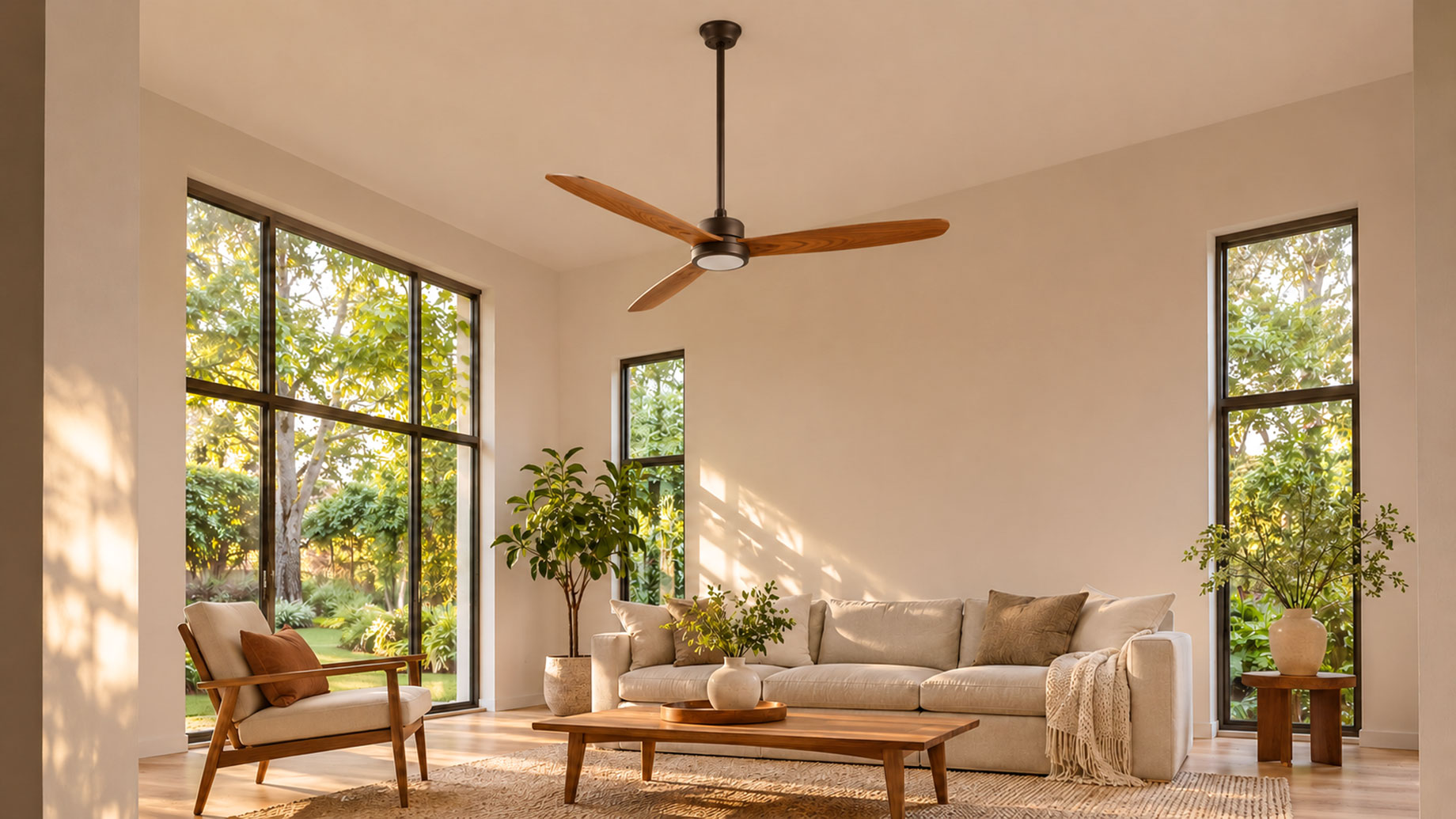
A high ceiling creates generous sightlines, but it also makes ceiling-fan selection a three-dimensional problem. The length of the rod is only one part of the distance between the ceiling and the finished fixture. AirSurferHome’s downrod and assembled-height comparison provides a useful starting point for separating those measurements. A considered plan brings together the complete assembly, the blade position, the occupied area and the access needed to maintain the fan later.
Measure the ceiling at the proposed mounting point
Record the finished floor-to-ceiling height where the fan will attach. On a sloped or stepped ceiling, a measurement taken at the doorway or the highest point of the room may not describe that location.
Add the ceiling shape, beams, nearby lights and any changes in level to the drawing. Note whether the proposed position is above a seating area, a circulation route or another specific zone. These details help the installer evaluate the actual arrangement instead of working from a broad description such as “double-height living room.”
Photographs are useful context, but a photograph cannot establish a dimension or a mounting approval. Pair the room images with measured information and the exact product documentation.
Distinguish rod length, blade height and lowest point
The downrod connects parts of the mounting assembly; it is not the complete fan. The canopy, motor, blade position and any lower light or housing affect the finished geometry.
For planning, keep two vertical dimensions separate. Ceiling-to-blade-plane distance is used to calculate blade height above the finished floor. Ceiling-to-lowest-point distance describes the lowest part of the complete assembly. They can differ, so one should not silently replace the other.
As an illustration, suppose the mounting point is 144 inches above the floor. A documented configuration puts the blade plane 30 inches below the ceiling and its lowest component 34 inches below it. The calculated blade height is 114 inches, while the lowest component is 110 inches above the floor. Those are geometry results, not installation approval; the manufacturer’s limits and site requirements still apply.
Compare complete configurations
Ask for a dimensioned drawing for each configuration under consideration. A table of rod lengths is less useful if it does not identify the resulting installed dimensions.
| Information | What it resolves | What it does not establish |
|---|---|---|
| Finished ceiling height | The starting vertical measurement | The correct rod by itself |
| Approved rod and mounting assembly | Whether the components belong together | Suitability for every ceiling slope |
| Ceiling-to-blade-plane distance | The calculated blade height | The lowest point of the fixture |
| Complete assembly drop | Overall projection into the room | Airflow performance |
| Model airflow data | A basis for comparing operating performance | The appearance of the fixture in the room |
A longer rod should not be treated as a universal remedy. Check the specified diameter, connections and support system. Similar-looking parts or matching nominal lengths do not prove compatibility.
Treat a slope as a separate condition
If the ceiling slopes, record the angle and check the selected fan’s permitted mounting arrangement. An approved adapter, where required, must be compatible with that model and its mounting system.
Increasing rod length does not, by itself, authorize a steeper mounting angle. Nor does it resolve every relationship between blades and a beam. The installer needs to review both the connection at the ceiling and the space around the complete fan.
This is especially important where a pitched roof produces a strong visual axis. A fan can look perfectly centered in a photograph while its actual blade envelope conflicts with the roof geometry. Resolve the physical arrangement before committing to the aesthetic one.
Design for the seating zone, not only the room volume
High rooms often contain more than one activity: conversation around a sofa, reading near a window and passage to another space. Identify where people need comfortable air movement and review the chosen fan’s performance information for that layout.
Do not use diameter as a substitute for airflow data. Blade shape, motor configuration and operating speed all affect performance. Similarly, a larger fan is not automatically the right answer because the ceiling looks expansive.
Consider what the fixture will look like from below and from adjoining rooms. A shallow-looking silhouette in an online product image can become a prominent element when viewed across a mezzanine. The visible motor housing and light deserve the same attention as the blades.
Keep lighting and controls practical
A fan-mounted light may offer useful illumination, but a tall ceiling can still call for separate lighting at reading and dining positions. Decide which activities need light near the task rather than asking one ceiling fitting to serve every purpose.
Confirm which functions the supplied control actually operates. Check how fan speed, direction and lighting are controlled, whether the light is dimmable, and what happens after power is interrupted. The details should come from the selected model, not from another product in the same collection.
Plan where the control will live. A remote that disappears among sofa cushions is not a complete control strategy. A consistent storage position or compatible installed control can make everyday operation more predictable.
Plan service access before installation
The appeal of a tall ceiling should not conceal the practical question of reaching the fixture. Discuss how cleaning, inspection and any permitted light-source replacement will be carried out safely. Access may require suitable professional equipment rather than an ordinary household step stool.
Choose the maintenance approach before furniture and decorative elements make access more difficult. If the fan uses an integrated light, establish how service is handled. If it takes replaceable lamps, check the specified base, rating and access procedure.
The final selection should therefore include more than a diameter and finish. It should identify an approved assembly, verified installed dimensions, suitable operating performance, usable controls and a realistic maintenance plan. That combination allows the height of the room to remain an architectural advantage rather than a source of avoidable compromises.
