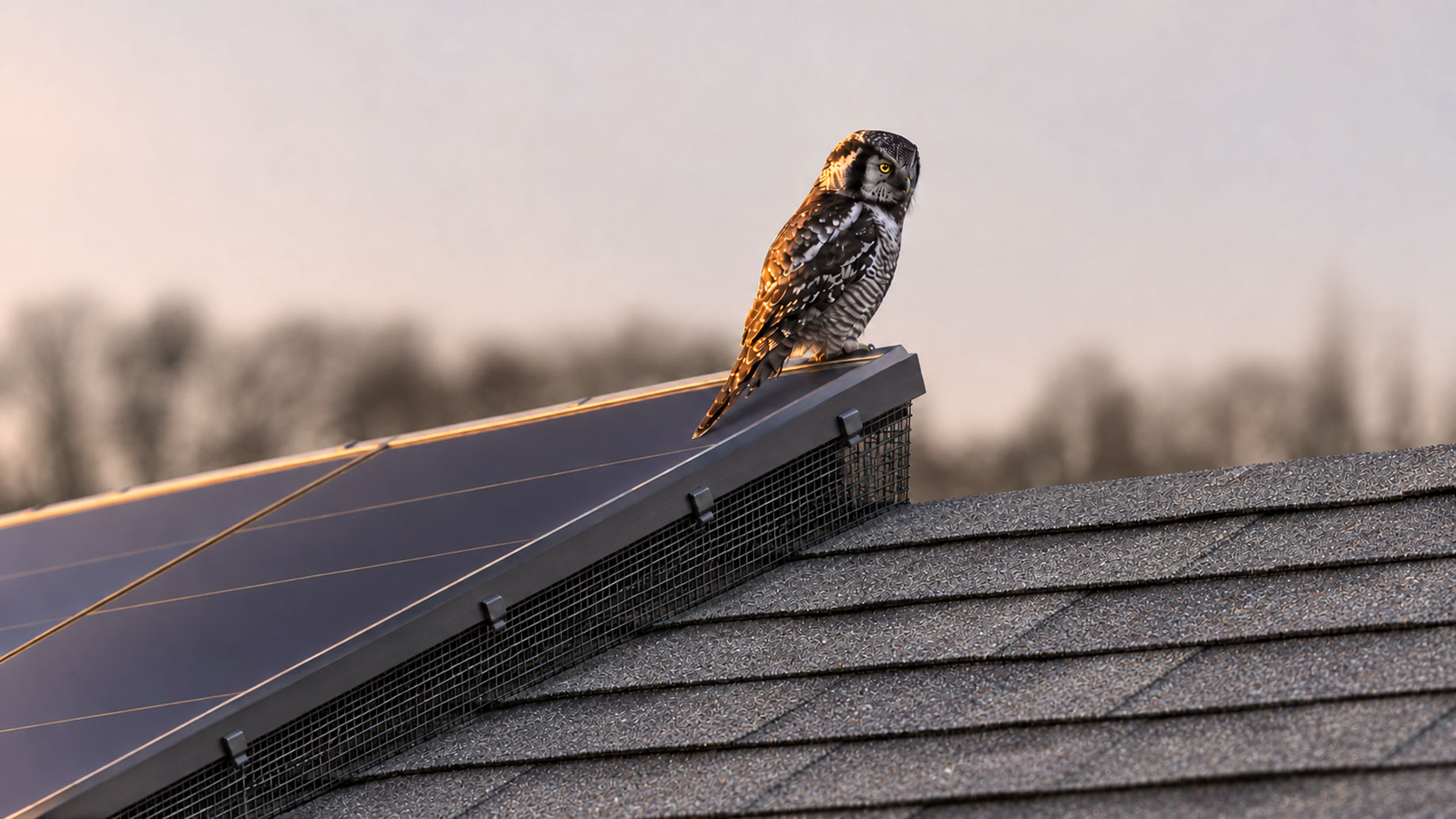
The cooing on your roof isn’t cute. It usually means a pair of birds has found the shaded gap under your solar panels and is building a nest.
Here’s the short version of solar panel bird proofing: the order matters. First, find out what kind of bird it is and whether the nest is active, because the law protects some nests and not others. Next, clean out the droppings the safe way: wet, with a respirator, and never with a high-pressure blast. Then check the wiring while the space is open. Only after that should you seal the gap with mesh that clips to the panel frame. Skip a step, and you can trap birds inside, spread dust, or create a warranty problem.
Why do birds nest under solar panels?
The gap between a panel and the roof is shaded, sheltered, and hard for predators to reach, which makes it a good place to nest. Once one pair moves in, more tend to follow, and the nest and droppings pile up the longer they stay.
Ethan Radford, the owner of All Clear Solutions, a pressure washing, solar panel cleaning, and bird guard installation company in Bakersfield, California, that serves homes and businesses, says the first step is always to look before you touch anything.
Most people call us after the birds have been there a full season. The first thing we do is look: what kind of bird it is, whether the nest is active, and what the wiring under the panels looks like. A bird guard over a nest just traps the problem inside, so the cleanup comes first and the guard comes second. And the guard has to clip onto the panel frames. If anyone tells you they need to drill into your panels or your roof, find someone else.
What damage can birds do under solar panels?
The damage adds up quietly because you can’t see it from the ground. Installers commonly point to four problems:
- Chewed or fouled wiring. Birds and other animals can chew or dislodge the cables under the array, and one damaged wire can take part of a system offline.
- Droppings. They can shade cells and cut output, and they can stain and wear down roofing materials over time.
- Blocked airflow. Nesting material can trap heat under the panels, and hotter panels produce less power.
- Health risks. Accumulated droppings are a real concern for the person who has to clean them up, as the next section explains.
Is it safe to clean up bird droppings?
It depends on how much has built up and how old it is. One state health department’s histoplasmosis guidance explains that the fungus behind histoplasmosis grows in soil enriched by accumulated bird or bat droppings, and that fresh bird droppings haven’t been shown to present a risk for it. People get sick by breathing in spores when dried droppings or contaminated debris get stirred up.
That points to a few simple rules:
- Wet first. Dampen the area with a low-velocity mist before you clean it. The same guidance warns that a high-pressure stream can send spores into the air before they’re soaked.
- Wear the right gear. Use disposable clothing and a properly fitted N95 or better respirator, not a paper dust mask.
- Bag it wet. Collect the damp material in sealed bags and remove your protective gear at the end of the job.
- Keep vulnerable people away. Anyone with a weakened immune system should stay out of the work area.
- Leave big piles to a professional. The health department recommends that large accumulations be removed by a professional cleanup firm.
That’s also why it’s a bad idea to blast old droppings with a pressure washer. It feels efficient, but it can throw the dust where you don’t want it.
Is it legal to remove a nest?
Sometimes, and sometimes not. In the United States, the Migratory Bird Treaty Act protects most native birds, and Cornell Lab of Ornithology explains the rule: an inactive nest with no eggs or young can be removed, but an active one can’t. Three common species are the exceptions. House sparrows, European starlings, and feral rock pigeons aren’t protected under federal law.
That makes identification the first job. If you can’t tell what species built the nest, or whether there are eggs or chicks, don’t guess. Local rules can add their own requirements, so check with your wildlife agency, and wait until a nest of a protected species is empty before you remove it.
The takeaway for anyone with panels: don’t install a barrier over a nest with birds in it. Besides being cruel, sealing birds in can put you on the wrong side of the law for protected species.
When should you install bird guards?
After the space is clean and the nest is gone. A good sequence looks like this:
- Inspect. Check the array, the roof, the mounting system, and any existing nests or damage.
- Clean out. Remove the nests, droppings, and debris from under the panels, using wet methods.
- Check the wiring. Look for chewed insulation and loose connections while everything is exposed.
- Install the barrier. Seal the gap around the array.
- Walk the perimeter. Confirm every gap is closed and every clip is secure.
How does solar panel bird proofing work?
The standard fix is a metal mesh, often galvanized or coated steel, that runs around the edge of the array from the panel frame down to the roof. It closes the gap so birds can’t get in. Clips grip the panel frames, so there’s no need to drill.
Other deterrents have a place, but they don’t solve the same problem. Spikes and spinners discourage perching on edges and ledges. They don’t seal the space underneath, which is where the nesting happens.
Will bird guards void your solar warranty?
Drilling into a panel frame or the roof is where warranty trouble usually starts. Clip-on systems that attach to the frames without drilling are the common way to avoid it.
Warranty terms differ, though, so don’t rely on a general rule. Read the panel, inverter, and roof warranty documents, and ask your installer to confirm in writing that their method won’t affect them.
Can you do bird proofing yourself?
DIY mesh kits exist, and a small, low roof with no existing nest may be a reasonable project. The risks go up quickly from there:
- Working on a roof is a fall hazard.
- Wiring under an array shouldn’t be handled without knowing what you’re touching.
- Existing droppings and nests bring the health and legal issues above.
- Roof tiles and shingles can crack under foot traffic.
If the roof is high, the array is large, or birds have been there a while, hire a professional.
How do you choose who to hire?
Look for an installer who inspects first, identifies the problem before quoting, and explains how they’ll clean and seal the array. Then check how the company shows up online. Editorial HQ, a link-building agency that works with local home services companies, says photos of past installs and reviews that describe the actual job are worth asking for before you book.
Then ask these questions:
- Will you identify the birds and check for an active nest before starting?
- How do you clean droppings: wet methods, respirators, sealed disposal?
- Does your system attach to the frames without drilling into panels or the roof?
- Will you check the wiring while the space is open, and tell me what you find?
- What’s guaranteed, and for how long?
Frequently asked questions
Do bird droppings reduce solar panel output?
They can. Droppings shade cells, and nesting debris under the array can trap heat. Cleaning the panels and clearing the nest helps restore performance.
Can I pressure wash bird droppings off my roof or panels?
Health guidance warns against blasting accumulated droppings with a high-pressure stream because it can put spores in the air. Wet the area first with a low-velocity mist, and have a professional handle large buildups.
Are pigeons protected?
Feral rock pigeons aren’t protected under the federal Migratory Bird Treaty Act in the United States, but many other birds are. Identify the species before you disturb a nest, and check local rules.
Will bird guard mesh affect my panels’ performance?
Properly installed mesh should keep nests and debris out without blocking the airflow that cools the panels. Ask your installer how they handle airflow and access for cleaning.
Final Thoughts
Birds under your panels are a problem you can solve, but the order matters. Identify the bird, check the nest, clean it safely, inspect the wiring, then seal the gap with a barrier that doesn’t involve drilling.
Do it in that order, and you protect the system, your health, and the birds. Do it out of order, and you can end up with a bigger repair or a legal headache.
