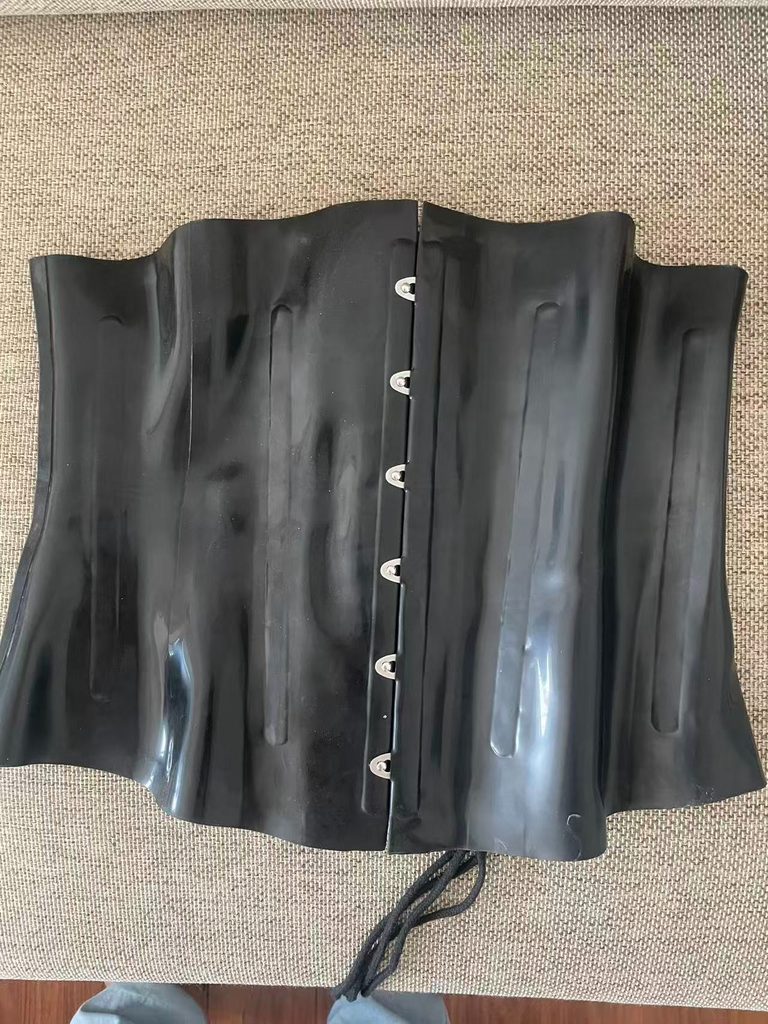
It is frustrating to like a garment and still feel that it is not doing what you bought it to do. One customer described their latex corset as very nice, but wanted a smaller waist and more support around the lacing. Their request was detailed: reduce the size by one inch, add a full extra layer of latex, increase the boning and replace the eyelets that were beginning to gape.
On paper, each change sounded like an addition or adjustment. Taken together, they described a substantially different corset.
After reviewing the returned garment and the requested changes, our design team concluded that we could not carry out those alterations without compromising its existing structure. That was a decision about this particular corset, not a claim that latex corsets can never be altered.
What the customer wanted to change
The brief called for an extra sheet of 0.80 mm latex bonded across the entire corset, rather than reinforcement limited to a few areas. The customer also wanted additional bones at the front, hips and back, with a bone on either side of each eyelet row.
There was a fit change too: the corset was to be reduced by one inch. The customer felt they could almost close it fully before achieving the silhouette they wanted.
These were not simply requests to replace a loose fitting. They changed the proposed size, material build-up and support layout at the same time. We needed to consider the whole brief rather than approve each item separately.
One inch smaller needs a defined meaning
Before making any alteration, “reduce it by one inch” needs to become an agreed measurement. Does it mean the finished waist circumference? Is the customer asking to change only the waist, or also the top and lower edge? What lacing gap is intended?
Those questions matter because a finished corset already has fixed relationships between its panels, closures and support positions. A waist change cannot be treated as an instruction to remove an arbitrary strip wherever it is easiest.
In this case, our team did not approve a reduction to the existing garment. A replacement would need its own agreed dimensions rather than an assumption that making the original smaller would resolve every concern.
An extra layer is not the same as a local repair
There is an important distinction between repairing an isolated area and adding a new layer across an entire corset. The latter changes the construction being requested, including the areas occupied by the existing bones, eyelets and front closure.
A useful detail to clarify in any brief is what “extra thickness” actually means. A full additional sheet, a folded edge and a local reinforcement are different arrangements. A nominal sheet thickness alone does not describe where the material sits or how the finished components are assembled.
For this request, we could not promise that a full 0.80 mm layer could simply be added to the completed piece while leaving the rest of its construction unchanged. The team’s conclusion was to discuss a new build rather than present an extensive reconstruction as a straightforward repair.
A boning count is not a construction drawing
The customer asked for fourteen bones and supplied a list of positions. However, the quantities in the final list did not clearly reconcile with that total, and some of the earlier location descriptions overlapped. The busk was also included in the list, which made the counting convention another point to clarify.
That is not a reason to dismiss a detailed customer brief. It is a reason to turn it into something both sides can read in the same way.
Before agreeing to a new corset, we would need a labelled front-and-back layout showing each proposed bone, the two eyelet rows and the front closure. Each position would need to be counted once, with the busk identified separately. A higher total on its own would not tell us whether the requested arrangement could be accommodated.
This is where a short sketch can be more useful than another paragraph saying “add one on the other side”. The aim is not to make the customer learn technical vocabulary, but to remove ambiguity before cutting begins.
Eyelets that gape deserve attention
The customer reported that the eyelets were beginning to gape while tightening the corset. That concern needed to be assessed on its own terms, not reduced to a request for more decoration or a preference for a different appearance.
Replacing an eyelet, changing the surrounding reinforcement and moving a support position are separate tasks. They should not be assumed to be interchangeable fixes. Our decision not to carry out the requested reconstruction did not, by itself, establish what caused the original problem.
If eyelets are visibly moving, the surrounding material is stretching or damage is developing, stop tightening and contact the maker. Do not keep pulling in order to reach a target gap or to test whether an alteration is needed.
We also would not treat additional layers or a higher bone count as a guarantee that a garment is suitable for tight lacing. That intended use needs a separate discussion, not an assurance based on a number in the specification.
Why we offered a fresh start
Once our team had reviewed the brief, we explained that we could not make the requested changes to the returned corset without compromising its structure.
We offered two alternatives: return the original corset with a complimentary made-to-measure dress, as previously discussed, or make a new corset at no charge with the design and construction details agreed before production.
Those were options offered in this individual case, not a general replacement policy. Nor was the offer of a new corset confirmation that every requested feature had already been approved. The specification still needed to be resolved together.
Agree the new garment before rebuilding the old one
There is a point where a repair request becomes a redesign. Here, the combination of a smaller waist, a full additional layer, a new boning arrangement and revised eyelet reinforcement took us to that point.
For a similar enquiry, the useful starting materials are the current measurements, photographs of the affected areas, the intended finished dimensions and a clear layout of any structural changes. They let the maker assess what is practical without promising that every finished garment can be rebuilt.
Sometimes the responsible answer is not to add more to what is already there. It is to pause, agree what the next piece needs to be and begin with a construction plan that reflects it.