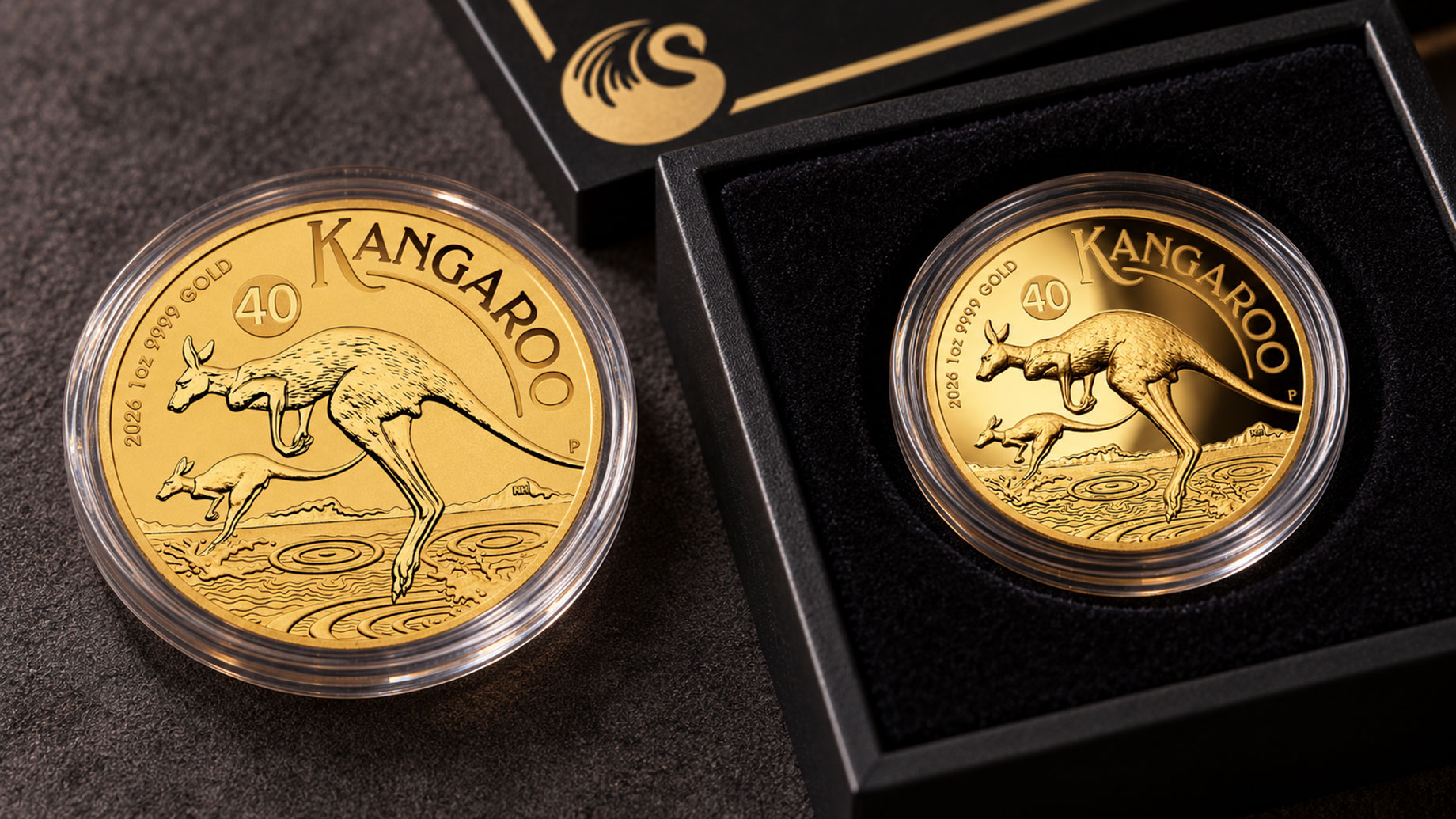
The Perth Mint sells two versions of its 2026 Australian Kangaroo in one troy ounce of 99.99% gold, both carrying an AUD 100 face value. The bullion coin has an unlimited mintage and ships in a plain acrylic capsule. The high relief proof is capped at 200 pieces and arrives in a display case with a wooden lid and a numbered certificate of authenticity. Same metal, same weight, two very different purchases.
The United States Mint draws the line plainly on its bullion page. Bullion coins are sold on the prevailing market price of the metal plus a small premium, unlike numismatic coins, which the Mint says are valued by limited mintage, rarity, condition and age. Every gold coin you consider sits somewhere between those two poles, and knowing where is the first decision a careful buyer makes.
Bullion pieces are the easier place to start, because they are widely stocked and simple to compare. Bitgolder’s gold coins, for example, include 2026 Britannia, Kangaroo, Maple Leaf, Krugerrand and Philharmonic issues, and the catalogue can be sorted by issuing mint, with South African Mint, Royal Canadian Mint and Münze Österreich pieces next to Perth Mint and Royal Mint coins. Proof and limited editions are usually bought from the mints’ own shops or from specialist coin dealers.
What You Pay For in a Proof Coin
A proof is defined by how it is made, not by how rare it is. The Royal Mint explains that its proof coins are struck at least twice, with the second strike deepening the relief, and that the die is polished and the coin aligned by hand between strikes. Its presses turn out proofs at 50 to 100 an hour, while Brilliant Uncirculated coins can be produced at up to 300 a minute.
That gap in time and handling is what the higher price reflects. You are paying for frosted relief against a mirror field, careful inspection and presentation. None of it adds gold. If what you want is the most metal for your money, a bullion coin does that job. If you want an object you will enjoy looking at for decades, the finish is the point.
Reading a Mintage Figure Properly
A low number on a product page is persuasive, so read it closely. “Maximum mintage” is a ceiling, not a count of coins actually struck or sold, and some issues never reach their limit. Look for the final figure the mint publishes after the sales window closes, and compare it with similar coins from earlier years.
Scarcity also only matters if other collectors care. A small run of a widely followed series, such as a lunar or a long-running animal design, tends to find buyers more easily than a one-off theme with a tiny audience. A useful habit is to ask who else would want this coin in ten years, and why.
Grading by PCGS and NGC
The best-known third-party graders, PCGS and NGC, seal coins in tamper-evident holders with a grade on the 1 to 70 Sheldon scale. NGC uses the prefix MS, for Mint State, on coins made for circulation and PF for proofs made for collectors. A grade of 70 means no post-production imperfections are visible at five times magnification.
Labels can add their own layer. PCGS gives its First Strike designation to coins issued in the first 30 days of a mint’s release, which describes timing rather than quality. Before paying extra for a graded coin, compare the price of the same coin in the same grade with and without the special label, and ask whether the difference is something you value or simply something a seller is promoting.
For plain bullion coins, grading is rarely needed. For collector pieces, a respected grade gives a future buyer a shared reference point, which can make a sale far simpler.
Boxes, Capsules and Certificates
Packaging tells you which kind of coin you are holding. When the United States Mint released its 2025 American Eagle Gold Proof Coins on March 20, 2025, each coin came encapsulated in a black presentation case with a certificate of authenticity carrying matching imagery. The Perth Mint’s proof Kangaroo comes with a numbered certificate, while its bullion version is simply sealed in a capsule.
Keep every part of a collector set together: outer sleeve, box, capsule and certificate. Dealers commonly treat a proof without its original packaging as a lesser item. Never remove a proof from its capsule or touch its surface, since fingerprints can mark a mirror finish permanently. Bullion coins are more forgiving, though they still deserve a capsule or tube.
Storage, Delivery and Contents Cover
A collection only holds its value if it stays in good condition and in your possession. At home, a bolted safe in a dry room is the usual choice, with silica gel packs to control moisture. Bank boxes and professional vaults are the alternatives for larger holdings. Whatever you choose, tell your contents cover provider what you keep, check the single-item limit for valuables, and store dated receipts, certificate numbers and photographs somewhere separate from the coins.
Delivery terms deserve the same attention as the coins themselves. Look for transit cover, a signature on delivery and tracking from dispatch to door. Bitgolder’s delivery terms, checked on October 25, 2026, list shipments as fully insured in transit, tracked end to end and signed for, with each parcel filmed during packing, sealed with a unique code and weight-checked. The page lists 77 delivery countries and says customs duty and import taxes are included in the checkout price.
Building a Collection That Suits You
Many serious buyers settle on a blend. A core of well-known bullion coins gives them metal that any dealer will recognize, while a smaller number of proofs or graded pieces reflects personal taste: a favorite series, a birth year, a design they admire. Writing down which coins belong to which group keeps each purchase honest about what it is meant to do.
The Bottom Line
Gold coins reward patience. Decide first whether you are buying metal or craftsmanship, then read mintage figures, grades and certificates with the same care you would give a property survey. Store the pieces well, keep the paperwork together and buy from sellers whose terms are written down. A collection built that way is easier to enjoy now and simpler to pass on later.
