Property executives can refer established operating companies to an AI data licensing program without ever touching a tenant list, buyer file or lease.
SPONSORED CONTENT FROM SOURCEX
Concept illustration: introduce the operating company while client records stay locked.
The facilities contractor you have used for twelve years runs its whole service desk on software. So does the proptech platform your portfolio adopted, and the management operator across the hall. Each is an established business with years of recorded work, and you already know who runs it.
That network can be genuinely useful in an AI data licensing referral. What it can never be is a reason to hand over a tenant roster, a buyer database or a confidential deal file.
Real estate business referrals in this context are simple to describe and easy to get wrong. You introduce an authorized decision-maker at an operating company. That company evaluates its own records and decides what, if anything, to license.
Refer the company, not the clients
Before making introductions, obtain an approved partner account and sign the SourceX Channel Partner Agreement. Check any employment, client or professional obligations, disclose your potential reward and ask the company’s permission. Approval to introduce a company never authorizes access to its records.
The relevant opportunity is a substantial business with years of support cases, internal procedures, engineering records or CRM history that document real work. Think of a property management operator, a building-services firm or a real estate software company.
Your first screen uses broad facts only: approximate headcount, years in business, the kinds of systems it runs and where it is based. You need a credible reason an owner or executive might find an assessment worthwhile, and a relationship strong enough to ask.
An individual’s property transactions, or a modest contact list, are not the same opportunity as a substantial company’s operating archive. Do not present them as if they were.
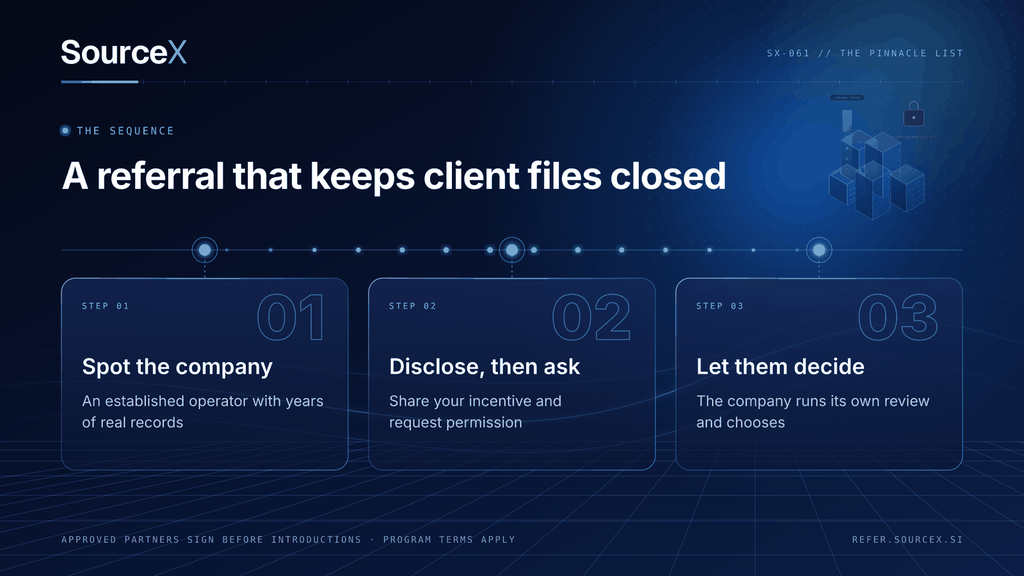
A referral that keeps client files closed. A conceptual sequence drawn from this article, not a measured result or a completed transaction.
What does a qualifying referral pay?
Before any introduction, you should be able to explain the economics in plain spoken terms. Under the SourceX referral program, the standard reward is 25% of Actual Supplier Payout, excluding separately itemized taxes and expense reimbursements, with a cumulative cap of US$100,000 per referred company unless signed terms say otherwise.
Actual Supplier Payout is the compensation actually paid for selected data that reaches Closing and the qualifying completed handoff. It excludes separately itemized taxes and expense reimbursements, the partner reward, SourceX’s fees and the buyer’s full transaction price. Unpaid estimates do not count; rewards accrue as supplier installments are paid.
The $100,000 cap applies cumulatively to each referred company across installments, agreements, repeat licenses and renewals; it never resets. SourceX pays the reward separately, without reducing the supplier’s agreed compensation. The signed Channel Partner Agreement’s Schedule A and agreed addenda control the rate, calculation base and cap.
On a purely hypothetical qualifying supplier payout of US$200,000, that formula gives a US$50,000 reward. It illustrates the arithmetic; it is not a forecast or a reported property-industry deal.
A lead, meeting or signed agreement alone earns no payable reward. Disclose that limitation before the company decides whether an introduction would help, alongside the rate and possible cap.
The reward deadline is 60 calendar days after the later of the buyer’s final written, unconditional acceptance and completed handoff of the complete, validated and approved dataset. Payment also requires cleared buyer funds at SourceX, supplier payment, finance approval, the partner’s required payment and tax details, and lawful payment. If a condition is outstanding at the deadline, payment follows promptly once it is met; no new 60-day period starts. The supplier’s invoice timetable is separate.
Passing on the lead, landing the meeting, even seeing the agreement signed: none of those on its own earns the fee. In a relationship business, the incentive you mention up front builds trust. The one a client discovers later can cost you the relationship.
Check your own rules before anyone else’s
Licensed real estate professionals and other advisers often operate under strict rules on referral compensation. Check your licensing obligations, fiduciary duties, employer policies and client agreements first. No commercial program can authorize a fee those obligations prohibit.
Keep the introduction separate from any property transaction, listing or service the company already relies on you for. The leader should understand your incentive and feel completely free to say no, with nothing else in your working relationship riding on the answer.
And make no promises about a payout. Nobody can predict one before the company and its dataset have been assessed.
In a relationship business, the incentive you mention up front builds trust.
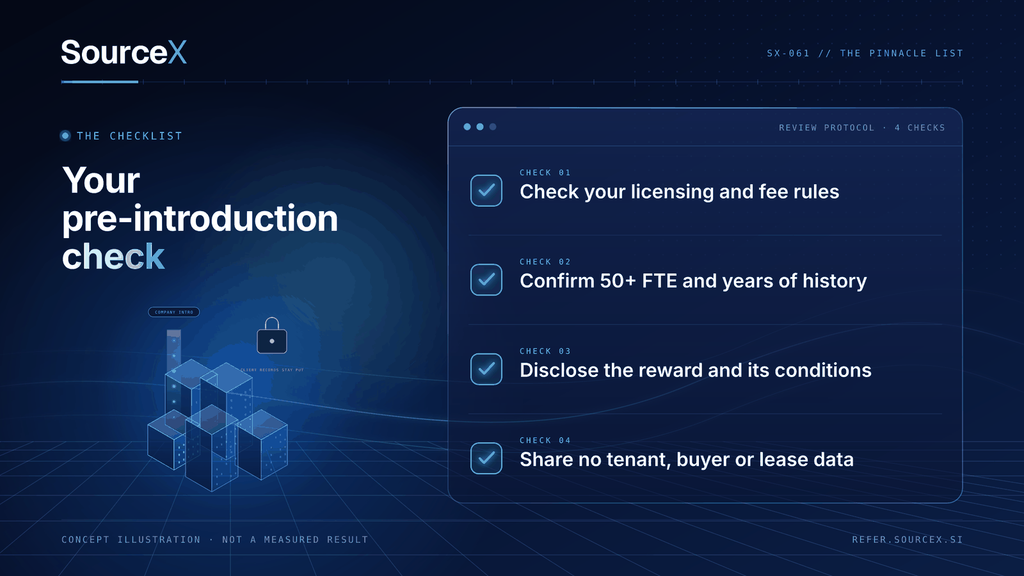
Your pre-introduction check: the four checks this article walks through.
What determines company fit and referral credit?
SourceX’s stated core company fit includes at least 50 full-time employees at peak and several years of operating history. Supported location, language, licensing rights and dataset suitability matter too.
Credit goes to the first valid introduction of a new company when it submits a verified application within the 90-day attribution window. SourceX checks dated introduction evidence, existing applications and prior relationships; an earlier click alone does not secure credit. Earlier leads, accounts or email correspondence can make a company a duplicate. Only one partner is credited per company.
Make the introduction to an owner, a senior executive or someone formally authorized to decide. A property manager holding records does not, by that fact alone, have the right to license them.
What should the introduction contain?
Three things, in this order, and nothing more:
- Why this company may fit, in a sentence or two: “You have run that service desk for twelve years, and that history may be worth an assessment.”
- Your potential reward, said plainly: “If a qualifying deal completes and the program’s conditions are met, SourceX could pay me a referral fee, separately from your payout.”
- A direct ask: “Would you like me to connect you, or shall we leave it there?”
Leave out tenant names, lease documents and customer records entirely. The company controls any later review and decides which scope and terms, if any, it will accept.
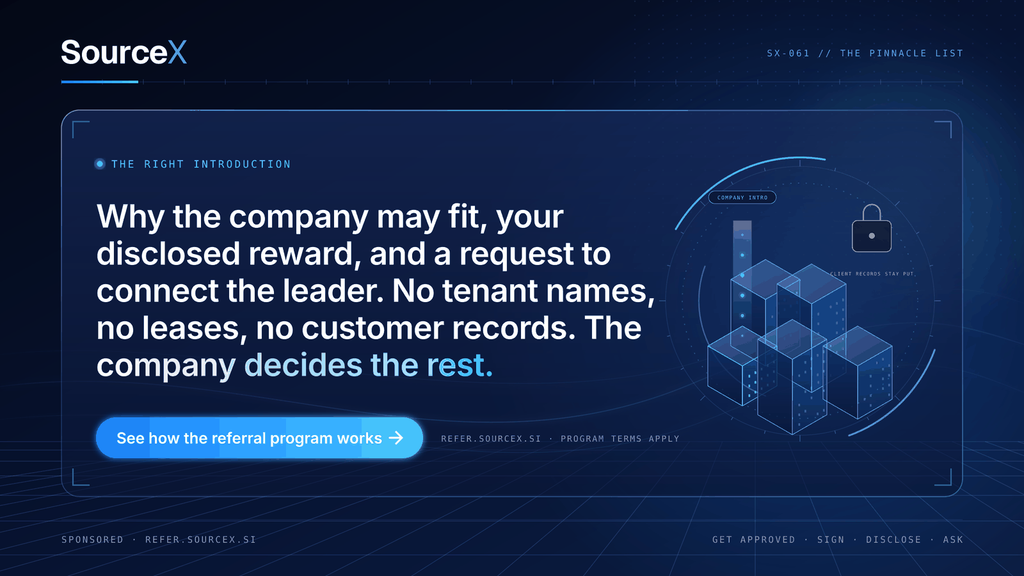
The right introduction: Why the company may fit, your disclosed reward, and a request to connect the leader. No tenant names, no leases, no customer records. The company decides the rest.
What makes a property network valuable here?
Access to the right person through a relationship they already trust. Done well, real estate business referrals give an owner a real opportunity to assess while the records stay exactly where they belong.
In a business built on discretion, that is the only kind of referral worth your name.
Review the SourceX referral program if you know an established operator that may fit. Obtain approval and sign first, check your professional obligations, disclose the incentive and ask permission to connect its authorized leader.
About the founder
Noah Loul is a four-time founder and the founder and CEO of SourceX, which licenses business data directly from companies for AI training and evaluation. He previously founded B2B Rocket, acquired by Blackpearl Group. His work focuses on building permission-based data infrastructure for AI.