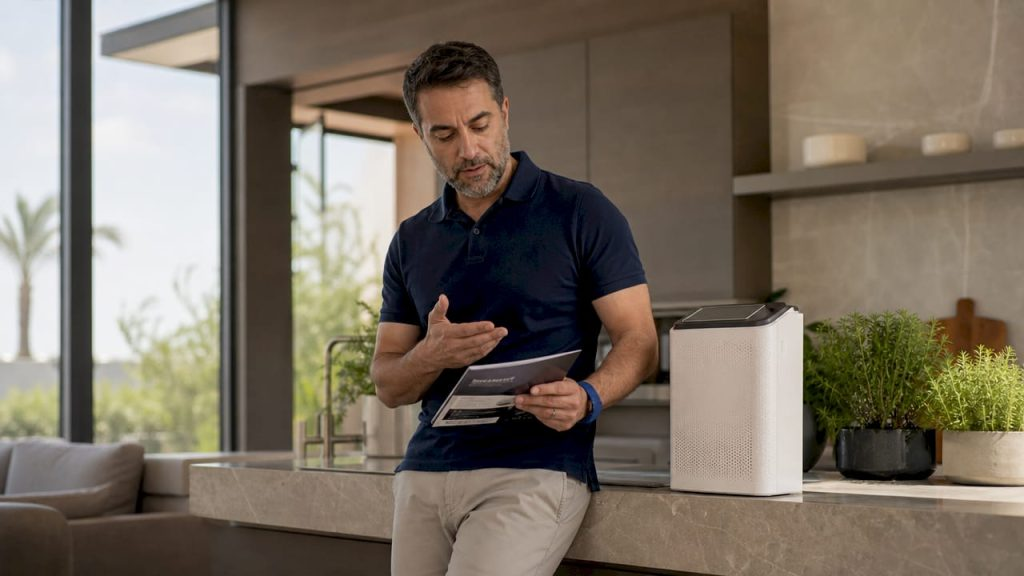
Every home has different air quality needs. A family living with dogs, a couple in a city flat and someone who spends most of the day working from a home office may all benefit from an air purifier, but the features they need will not necessarily be the same.
The challenge is knowing which specifications genuinely matter and which features are unlikely to make much difference to your daily life. Room size, the types of pollutants you want to reduce, noise levels and ongoing maintenance costs should all influence your decision.
Rather than choosing a model based on price or appearance alone, it helps to start with how you use your home. This guide explains how to select an air purifier that suits your living space, lifestyle and budget, with practical advice for households across the UK.
1. Start with Your Household, Not the Product Specifications
Before comparing air purifiers, think about the people, activities and potential pollution sources in your home. This will help you identify which features deserve priority.
If you have pets
Living with cats and dogs can mean dealing with loose fur, airborne skin flakes, persistent odours and particles carried around the house. These are related but different problems, so the most suitable purifier should address your main concerns.
A pre-filter can capture larger debris, including loose hair, before it reaches the main filtration system. A high-efficiency particle filter can help capture smaller airborne particles, including some pet dander. An activated carbon filter may help reduce certain pet-related odours.
If you are comparing air purifiers for pet hair, consider how easily the pre-filter can be cleaned and whether replacement filters are readily available. An air purifier for dog hair or an air purifier for cat hair should also provide sufficient airflow for the room in which your pet spends the most time.
Explore air purifiers for pet hair to compare options for pet-owning households.
Remember that air purification is not a substitute for regular vacuuming, washing pet bedding and grooming. Larger clumps of fur and hair that have already settled on floors or furniture will still need to be removed manually.
If pollen and allergens are a concern
Pollen can enter a home through open windows, doors, clothing and pets. Other indoor allergens may originate from dust mites or animals.
For these households, particle filtration is an important consideration. Look for clear information about the filter standard, the device’s overall performance and the room size it is designed to serve.
An air purifier for allergies may help reduce airborne allergens, but effectiveness depends on the pollutant, the filtration system, airflow and how consistently the device operates. It will not remove every allergen from carpets, mattresses or upholstery.
If you are considering an air purifier for allergy management, review the available options in Coway’s range for allergies. Continue to follow appropriate cleaning practices and any medical advice relevant to your circumstances.
If you live in a busy urban area
Homes near busy roads or other sources of outdoor pollution may experience the effects of fine particulate matter entering from outside. Cooking, candles and some household products can also contribute to indoor pollutants.
A purifier with effective particle filtration may help reduce airborne particles, while activated carbon can address certain gases and odours, depending on its design and capacity.
However, no single filter removes every type of pollutant. If outdoor air quality is a concern, check local conditions when deciding when to ventilate. A purifier should complement sensible ventilation and measures to reduce pollution at its source.
If you work from home
A home office may be a relatively small space, but you could spend several hours there every day. In this situation, noise, room coverage and ease of operation may matter more than having a large number of additional features.
Choose a unit that can deliver sufficient clean air without creating a distracting level of noise. Consider whether you can leave it running comfortably during meetings and whether its controls are simple enough for everyday use.
2. Match the Purifier to the Room Where You Need It Most
One of the most common purchasing mistakes is choosing a purifier based on its advertised coverage without considering how the room is actually used.
Start by measuring the room’s length and width.
Room area = length × width
For example, a bedroom measuring 4 metres by 3 metres has an area of 12 m². A living room measuring 6 metres by 5 metres has an area of 30 m².
Although both rooms could benefit from air purification, they may require different levels of airflow to achieve the same number of air changes per hour.
Understand room volume and air changes
Ceiling height also matters because the purifier needs to process the air within the room, not simply cover its floor area.
Room volume can be calculated as follows:
Room volume = floor area × ceiling height
A 20 m² room with a ceiling height of 2.4 metres has a volume of 48 m³.
Clean Air Delivery Rate (CADR), commonly expressed in cubic metres per hour (m³/h), indicates the volume of filtered air delivered by a purifier under specified test conditions. It can help you compare models and estimate whether a device has sufficient capacity for your space.
For example, a CADR of 240 m³/h divided by a room volume of 48 m³ gives a theoretical equivalent of five air changes per hour under the relevant assumptions.
This is a simplified calculation. Actual performance can vary with room layout, obstructions, operating speed and the conditions used for testing. Manufacturer coverage figures should therefore be compared carefully rather than treated as directly interchangeable.
What about open-plan homes?
An open-plan kitchen and living area presents a different challenge from an enclosed bedroom. Air can move between zones, and cooking may introduce pollutants that spread throughout the space.
A purifier sized for a small room may not be sufficient for a large open-plan area. Consider the total space you want to treat, where the main pollution sources are located and whether the device can operate at an effective fan speed without excessive noise.
If your home has several separate rooms, one portable purifier will not necessarily clean them all equally well. It may be more practical to prioritise the room where you spend the most time or where your main air quality concern occurs.
3. Know Which Filtration Technology You Actually Need
Once you have identified your main concern and room size, the next step is to understand how different filters work.
Particle filters for dust, pollen and dander
HEPA filters are designed to capture airborne particles, with performance depending on the applicable standard and filter grade. They are commonly used to remove fine particles, including many particles associated with dust, pollen and pet allergens.
When evaluating a product, look for specific information about its filter classification and test results. A description such as ‘HEPA-type’ should not automatically be interpreted as equivalent to a certified HEPA filter.
It is also important to assess the complete purifier rather than the filter material alone. Air leakage, airflow design and how the filter fits inside the unit can influence overall performance.
Activated carbon for certain gases and odours
Particle filters and activated carbon filters serve different purposes. While particle filters capture airborne particles, activated carbon adsorbs certain gases and odour-causing compounds.
This distinction matters if you want to address cooking smells, pet odours or some volatile organic compounds (VOCs).
The effectiveness of activated carbon depends on factors such as the quantity and type of carbon, the pollutant and the operating conditions. A thin carbon-coated layer should not automatically be assumed to provide the same capacity as a substantial carbon filter.
Pre-filters for larger debris
Pre-filters are particularly useful in homes where larger particles, hair and lint are common. They help prevent some of this material from reaching the main filter.
Check whether the pre-filter is washable, reusable or replaceable. A design that is easy to maintain can make a noticeable difference to the convenience of owning a purifier, especially in a busy household.
Avoid paying for unnecessary claims
A purifier with several filter stages is not automatically more effective than every simpler alternative. Focus on evidence of performance, suitability for your intended room and the pollutants you want to target.
Be cautious of products that promise to eliminate every pollutant or guarantee improvements in health. Good specifications should explain what has been tested and under which conditions.
4. Decide How Quiet Your Air Purifier Needs to Be
Noise is easy to overlook when shopping online, but it can determine whether you use your purifier consistently.
A unit operating in a kitchen or living room during the day may be acceptable at a higher fan speed. The same noise level could be disruptive in a bedroom at night.
Manufacturers typically express sound levels in decibels (dB). Compare these figures at the operating speeds you are likely to use, rather than relying exclusively on the quietest advertised setting.
Features worth considering include:
- A dedicated sleep mode or low-noise setting.
- Adjustable fan speeds to balance noise and airflow.
- Switchable indicator lights for dark bedrooms.
- Automatic mode for adjusting airflow when the built-in sensor detects changes in the pollutants it measures.
Keep in mind that a quieter setting may deliver less clean air. If you need a higher airflow rate to treat the room effectively, check whether the corresponding noise level will be comfortable for your household.
5. Calculate the Real Cost of Owning an Air Purifier
The initial purchase price does not tell the whole story. Electricity consumption, replacement filters and routine maintenance can all contribute to the long-term cost.
Estimate electricity consumption
Check the unit’s power rating in watts (W). The actual electricity consumed will depend on the fan speed, operating hours and automatic settings.
For example, a 40 W purifier operating for eight hours a day uses approximately 0.32 kWh per day:
0.04 kW × 8 hours = 0.32 kWh.
Multiply this figure by your electricity tariff to estimate the cost. The result is an illustration rather than a prediction, as a purifier may use different amounts of electricity at different fan speeds.
If you intend to operate the device throughout the day and night, energy efficiency becomes more important.
Include replacement filters in your budget
Filters gradually accumulate particles and may need replacing according to the manufacturer’s instructions. The replacement interval depends on the filter design, the level of pollution and how often the purifier is used.
Before purchasing, check:
- The price of genuine replacement filters.
- The recommended replacement interval.
- Whether filter replacement reminders are available.
- Whether the pre-filter can be cleaned and reused.
- Whether replacement filters are readily available in the UK.
A low-priced purifier may not offer the best value if its replacement filters are expensive or difficult to obtain.
Consider the warranty and after-sales support
Clear warranty terms, accessible customer support and reliable access to genuine replacement filters can make ownership easier over time.
Check what the warranty covers, how long it lasts and whether any maintenance requirements apply. Confirm that the terms relate to the specific model sold in the UK.
6. Choose Features That Fit Your Daily Routine
Smart features can be helpful, but the most useful ones are those that make it easier to operate and maintain the device correctly.
Air quality indicators
Some purifiers display an air quality reading or use coloured indicators to show changes in the pollutants their sensors detect.
These readings can provide useful feedback, but they do not represent every aspect of indoor air quality. A sensor that measures airborne particles may not detect all gases or odours.
Check which pollutants the sensor is designed to measure and avoid assuming that a single indicator provides a complete picture of the air in your home.
Automatic operation
Automatic mode adjusts fan speed in response to the device’s sensor readings. This can be convenient if you prefer not to change settings manually throughout the day.
However, automatic operation is only as useful as the sensor and control system behind it. Consider whether the unit allows you to override the automatic settings when you want a specific fan speed.
App controls and filter alerts
App connectivity may be worthwhile if you want remote control or access to operating information. For some households, physical controls and a straightforward filter reminder are more than sufficient.
Prioritise practical usability over the number of features listed on the product page.
7. Place Your Purifier Where It Can Work Effectively
After choosing a suitable model, think about where it will operate. Positioning can affect how well air circulates through the unit.
Place the purifier in the room you want to treat and follow the manufacturer’s instructions for clearance around the air intake and outlet. Avoid blocking these areas with furniture, curtains or other objects.
If you are concerned about pet-related particles, choose a location where the purifier can circulate room air freely and where its intake is less likely to become obstructed by accumulated hair.
For a bedroom, consider whether the unit can run comfortably while you sleep. For a home office, ensure that airflow is not blocked by a desk or shelving.
Keep the purifier away from conditions that are outside its specified operating limits, including excessive moisture where the manufacturer advises against it.
Most importantly, operate the device consistently in the room where it is needed. Moving one unit between several rooms may be less effective than maintaining suitable operation in your priority space.
8. Understand the Role of Air Purification in a Healthy Home
An air purifier can help reduce certain airborne pollutants, but it should not be treated as a complete solution to indoor air quality problems.
The UK Health Security Agency has reviewed evidence concerning portable air cleaners and their ability to reduce airborne particles. Particle reduction under specified conditions does not, by itself, prove that a device prevents illness or guarantees relief from respiratory symptoms.
A practical approach combines filtration with measures that address pollution at its source.
For example, use an extractor fan when cooking, maintain appropriate ventilation, clean floors and upholstery regularly, and address damp or mould at its source. Avoid indoor smoking and minimise unnecessary sources of airborne pollutants.
If someone in your household has asthma or another respiratory condition, an air purifier should complement rather than replace medical advice and prescribed treatment.
These precautions are important because different pollutants require different approaches. Filtration may help with some airborne particles, while ventilation, source control or specialist remediation may be more appropriate for other problems.
9. A Simple Checklist for Choosing the Right Model
Before making your final decision, compare your shortlisted models against the following criteria.
| What to compare | What to look for |
| Room suitability | Coverage appropriate for the room’s dimensions and layout |
| Clean-air delivery | CADR suitable for the intended space |
| Filtration | Clear specifications relevant to your main air quality concern |
| Noise | Acceptable sound levels at the fan speeds you will use |
| Energy use | Reasonable estimated electricity consumption |
| Filter maintenance | Accessible replacement filters and clear maintenance instructions |
| Convenience | Useful controls, sensors and reminders |
| Long-term value | Purchase price, running costs and warranty terms |
For UK buyers, also check that the model, electrical specifications, warranty and replacement filters are intended for the UK market.
Final Thoughts: Choose for Your Home, Not Just the Features
The best air purifier for your home is not necessarily the most expensive or the one with the longest list of features. It is the model that addresses your main air quality concerns, provides sufficient clean air for your room and fits comfortably into your daily routine.
Start by identifying your priorities, whether that means managing pet-related particles, reducing airborne pollen or improving air quality in a frequently used living space. Then compare room suitability, filtration performance, noise, energy consumption and replacement filter costs.
Finally, remember that air purification works best alongside sensible ventilation, cleaning and measures to reduce pollution at its source. A considered purchase, supported by transparent specifications and realistic expectations, can help you make a more informed decision for your household.