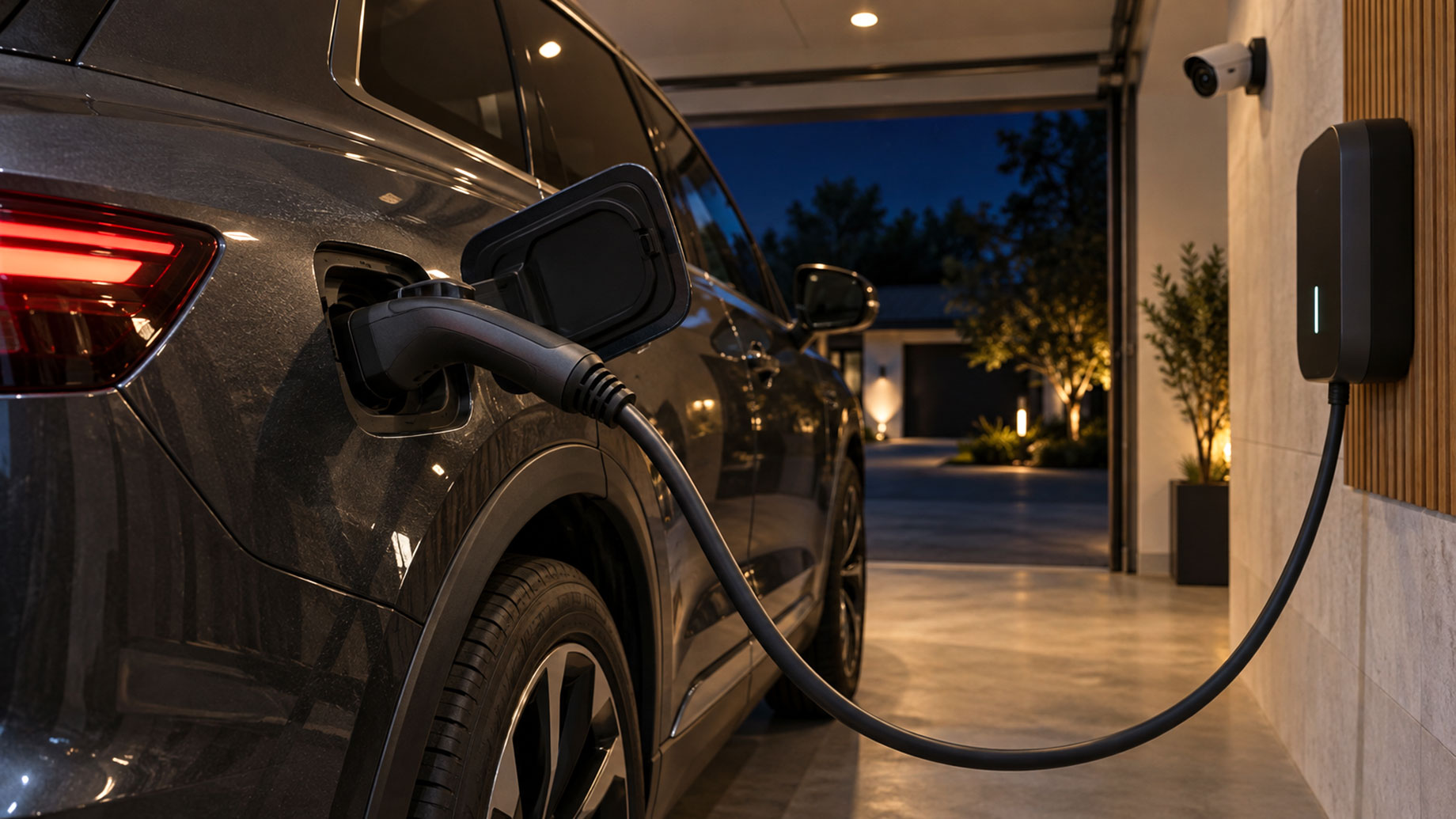
One bad hour in a luxury garage can cost six figures before anyone calls a lawyer. A delivery driver clipped by a backing SUV, a contractor who fell near the charger, a teenager who grabbed the keys without asking — any of them can turn a quiet residence into the center of an insurance fight, a police report, or a civil claim. The strange part is that the garage has already written down most of what happened.
The EV charger logged the session, the cameras caught the approach, and the car recorded its own last moves before everyone went inside for the night. Owners tend to assume this data will either save them or sink them in obvious ways. It rarely does either one.
Here are the assumptions that go wrong first, and what the record actually says.
“The Car’s Black Box Captures Everything Interesting”
The event data recorder in a modern vehicle is narrower than most owners picture. Under the federal rule that governs these devices, Part 563, EDRs are an “if equipped” standard, not a mandate, and the required data elements are crash-dynamics measurements: delta-V, indicated speed, throttle percentage, brake status, belt use, airbag timing. GPS tracks and cabin audio are not on the required list.
The richer story usually lives somewhere else in the vehicle. Infotainment systems log paired phones, navigation destinations, and door events. Telematics modules push trip summaries to the manufacturer’s cloud. If you want the full picture of the night, the EDR is one chapter in a book you need a forensic workflow to assemble. Reading the airbag snapshot as the whole record is how good cases get built on bad facts.
“The EV Charger Is Just an Appliance”
A home charger looks like a wall-mounted brick with a cord. Inside, it’s a networked device that keeps a surprisingly detailed ledger. When someone claims an injury near the equipment — a shock, a trip, a fire — the charger’s own log is often the first witness.
Investigators who handle EV incidents routinely pull these records alongside the vehicle’s state-of-charge and battery-temperature history. If the homeowner’s defense is “the equipment failed,” and the equipment’s own log shows a clean session with no faults, that defense is already in trouble before anyone opens a courtroom door.
A truck-accident attorney like the team at Anderson, Cummings & Drawhorn will typically tell you the same pattern shows up with commercial fleets: the device that was supposed to be dumb hardware turns out to be the most honest witness in the room.
“The Doorbell Camera Will Clear This Up in Thirty Seconds”
Video feels like certainty, but rarely delivers such. A doorbell or driveway camera captures a narrow cone, often at a bad angle, with motion-triggered recording that stays dark between events and often misses the exact seconds the interesting movement occurred. Night footage compresses hard.
Timestamps drift when the device loses Wi-Fi. The clip the owner is sure exonerates them frequently shows something else to a stranger watching it cold.
There’s also a preservation problem. Most consumer camera platforms rotate footage out of cloud storage on a rolling window — days, not months. If a lawyer’s letter arrives six weeks after the incident asking for the clip, there may be nothing left to produce. Download the raw file, note the device’s clock offset, and store it somewhere other than the camera’s own app.
“Smart-Home Logs Only Matter if the Police Show Up”
Criminal cases get the headlines, but civil claims are where this data actually turns up most often. Thermostats record occupancy inferences. Smart locks log every code entry. Speakers hold command history. Any of those can anchor — or demolish — a timeline in a slip-and-fall, a wrongful death, or a liability dispute with a contractor.
The owner who understands what their devices retain, and for how long, is the owner who doesn’t accidentally delete the one record that would have helped them.
“You Should Hand Everything Over, Fast, to Look Cooperative”
The instinct after a bad night is to overshare. Give the adjuster the video, send the charger log, forward the car’s trip summary. It feels like good faith; it’s often a mistake.
These records don’t speak for themselves. A charger log without a technician’s interpretation can be read three different ways. A fifteen-second clip without the ninety seconds before it can look damning.
Preserve everything in its original form, keep copies off the device, and get advice before you start forwarding files to anyone whose interests aren’t aligned with yours. Cooperation is a posture. Volunteering unfiltered evidence is a decision, and you only get to make it once.
What the Garage Is Really Telling You
A luxury home’s garage now holds more admissible data than most small businesses did a decade ago. That’s not a reason to fear the technology, and it’s not a reason to trust it blindly either. The record is partial, the timestamps drift, the clips expire, and the interpretation is almost always contested.
Learn what each device actually keeps, pull the files before they rotate out, and resist the urge to narrate what happened before you’ve read what the hardware already wrote down.
