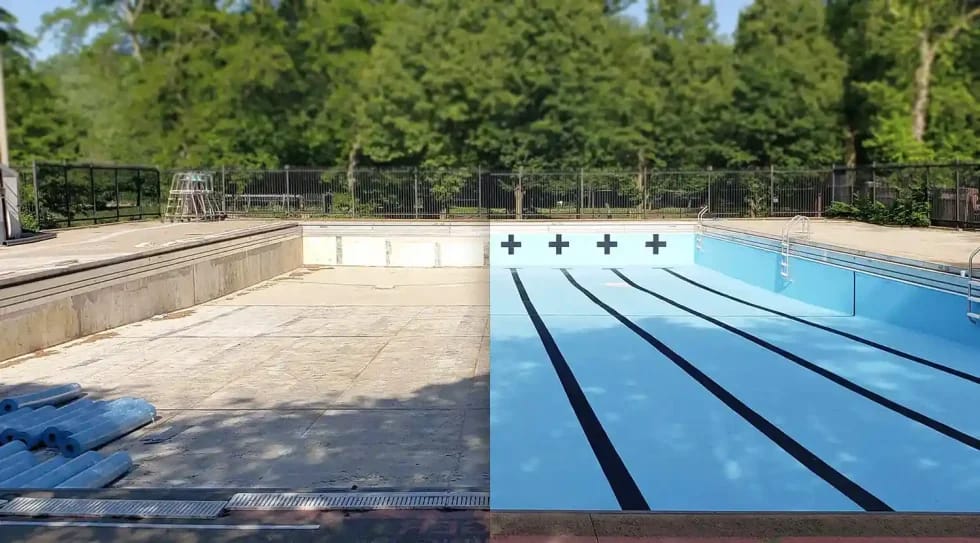
Public pool operators face a recurring decision every time a pool’s interior finish starts to fail: repaint again, or switch to a different system entirely. For decades, paint was the default answer because it was cheap and familiar. But as commercial PVC pool liners have matured as a technology, more municipal, hotel, and recreation facility operators are finding that liners solve problems paint simply cannot, particularly when it comes to longevity, labor costs, and downtime.
This article breaks down the commercial pool liner vs. paint decision in detail, covering durability, cost over time, maintenance demands, and the situations where each option genuinely makes sense.
The Basic Difference Between the Two Systems
Before comparing performance, it helps to understand what each system actually is.
Pool Paint
Pool paint is a coating, typically epoxy, chlorinated rubber, or acrylic-based, applied directly to the pool’s interior surface. It bonds to the substrate and forms a thin protective layer, but it is fundamentally a surface treatment rather than a standalone structural barrier.
Commercial PVC Pool Liners
A commercial PVC liner is a heavy-duty vinyl membrane custom-fabricated to fit the exact dimensions of the pool and mechanically installed as its own waterproof layer. Unlike paint, the liner is not just bonded to the surface; it functions as an independent barrier system between the water and the pool structure.
That structural difference is the root of nearly every performance gap between the two options.
Durability and Lifespan
This is where the gap between the two systems is most dramatic.
How Long Paint Lasts
Pool paint has a notoriously short functional life in commercial settings.
- Epoxy paint typically lasts three to five years before recoating is needed
- Chlorinated rubber paint often needs reapplication every one to three years
- Heavy commercial usage, high bather loads, and aggressive chemical treatment all accelerate wear
- UV exposure on outdoor pools further shortens paint lifespan compared to indoor facilities
How Long PVC Liners Last
Commercial PVC pool liners are built for a fundamentally longer service life.
- Quality commercial liners typically last fifteen to twenty years, and sometimes longer with proper maintenance
- Liners are engineered with UV inhibitors and reinforced construction specifically for heavy commercial and public use
- The membrane does not degrade in the same flaking or chalking pattern that paint does over time
Over a fifteen-year period, a facility relying on paint may go through four to six recoating cycles, while a liner installed at the start of that period may still be performing well without replacement.
Cost Comparison Over Time
Upfront cost tells only part of the story in the commercial pool liner vs. paint comparison. The real financial picture emerges when comparing total cost of ownership.
Upfront Installation Cost
Paint is less expensive to apply initially, which is part of why it remains common in budget-constrained facilities. A commercial PVC liner requires a larger upfront investment due to custom fabrication and installation labor.
Long-Term Cost of Ownership
When facilities model costs over a ten- to fifteen-year window, the comparison often flips.
- Repeated paint cycles mean repeated labor costs, materials, and pool closures, all of which add up
- Surface preparation for repainting, including acid washing, sanding, and removing old coating layers, is labor-intensive and adds cost each cycle
- A liner installed once can outlast three to five paint cycles, meaning the facility pays for labor and material disruption far less often
- Liners reduce water loss through the pool shell in many cases, since the membrane acts as a continuous waterproofing layer, which can lower water and chemical replacement costs over time
Facilities that evaluate cost purely on a per-project basis often underestimate how much recurring paint cycles cost in cumulative labor and downtime.
Downtime and Closure Considerations
For public and commercial pools, closure time directly affects revenue, member satisfaction, and community access.
Paint Requires Frequent Closures
- Surface preparation, application, and curing time typically require pools to be closed for a week or more per cycle
- Because paint needs reapplication every one to five years, facilities are repeatedly taken offline over the life of the pool
- Weather and temperature conditions can extend curing time for outdoor pools, adding further unpredictability to closure schedules
Liners Offer Longer Stretches of Uninterrupted Use
- Once installed, a commercial PVC liner does not require the recurring closures that repainting demands
- Installation itself does require a closure period, but because it happens far less frequently, the cumulative downtime over fifteen years is typically much lower than repeated paint cycles
- Facilities with tight operating seasons, such as outdoor public pools with a short summer window, benefit significantly from avoiding repeat paint closures during peak months
Appearance and Guest Experience
Visual condition affects how guests perceive a facility, and the two systems age very differently.
- Paint tends to chalk, fade, and peel as it approaches the end of its lifespan, which can make even a well-maintained pool look worn
- Peeling paint can flake into the water, creating both an aesthetic problem and a potential debris or filtration issue
- Commercial PVC liners maintain consistent color and finish over a much longer period, since the material is engineered for UV and chemical resistance throughout its lifespan
- Liners are available in a wide range of colors and patterns, giving facilities more design flexibility than standard pool paint options
For hotels, resorts, and public facilities where guest perception directly affects reviews and repeat visits, the visual consistency of a liner over its lifespan is a meaningful advantage.
Maintenance and Chemical Resistance
Ongoing maintenance demands differ significantly between the two systems.
Paint Maintenance Demands
- Paint is more vulnerable to chemical etching from improperly balanced water, which can accelerate breakdown
- Small chips or damaged areas often require touch-up work between full recoating cycles
- Algae and staining can penetrate porous or aging paint surfaces more easily than a sealed liner membrane
Liner Maintenance Demands
- Commercial PVC liners are non-porous, which makes them more resistant to algae growth and staining
- Liners are generally easier to clean and maintain a smoother surface texture over time
- Repairs to a liner, when needed, are typically localized patches rather than full resurfacing
Structural Considerations and Substrate Compatibility
Not every pool is an equally good candidate for a liner, and this is an important part of the decision.
- Liners work well on both new construction and many existing pool shells, provided the underlying structure is sound
- Pools with significant structural cracking or ongoing settlement issues need those problems addressed before a liner is installed, since the liner is not a structural repair
- Paint can sometimes be applied more easily to irregular or heavily repaired surfaces where a custom liner fit would be more complex
- Facilities considering a liner retrofit should have the pool shell inspected to confirm it is a suitable candidate before committing to fabrication
When Paint Still Makes Sense
Despite the advantages of liners, paint is not obsolete for every situation.
- Facilities with very limited capital budgets and a need for a quick, low-cost interim fix may still choose paint
- Pools nearing the end of their functional life, where a full renovation or replacement is planned within a few years, may not justify the investment in a long-term liner system
- Irregularly shaped or heavily patched pool shells may be more cost-effective to paint than to custom-fabricate a liner for
The right choice ultimately depends on the facility’s time horizon, budget structure, and how the pool fits into longer-term capital planning.
Common Mistakes Facilities Make
- Choosing paint repeatedly without calculating the cumulative long-term cost of recurring recoating cycles
- Failing to address underlying structural issues before liner installation, which can shorten the liner’s effective lifespan
- Underestimating how much cumulative downtime repeated paint cycles create over a facility’s operating history
- Selecting a low-grade residential liner product for a high-traffic commercial pool, rather than a liner specifically engineered for commercial use
- Not budgeting for eventual liner replacement, since even a long-lasting liner will eventually need to be replaced after fifteen to twenty years of service
FAQ
How much longer does a commercial PVC liner last compared to pool paint?
Commercial PVC liners typically last fifteen to twenty years, compared to one to five years for most pool paint systems depending on the type of paint and usage levels. That difference is the primary driver behind the long-term cost advantage of liners.
Is a commercial PVC liner more expensive than paint?
Upfront, yes. Liners cost more to fabricate and install than a single paint application. Over a ten- to fifteen-year period, however, the cumulative cost of repeated paint cycles often exceeds the cost of a single liner installation.
Can a liner be installed over an existing painted pool surface?
In many cases, yes, provided the underlying shell is structurally sound and properly prepared. A professional assessment is needed to confirm the existing surface is a suitable base for liner installation.
Do PVC liners require special chemical treatment compared to painted pools?
No significant special treatment is required, though liners generally hold up better to chemical exposure over time due to their non-porous, chemical-resistant construction.
How long does liner installation typically take compared to repainting?
Liner installation and repainting both require a closure period, often a week or more, but because liners need this only once every fifteen to twenty years compared to painting’s much more frequent cycle, cumulative downtime is significantly lower with liners.
Are commercial PVC liners suitable for all pool shapes and sizes?
Most standard commercial pool shapes are compatible with custom liner fabrication. Highly irregular shapes or pools with significant structural damage may require additional assessment or repair before a liner installation is feasible.
Final Thoughts for Facility Operators
The commercial pool liner vs. paint decision ultimately comes down to time horizon and total cost of ownership. Paint remains a viable short-term or budget-driven option, particularly for facilities nearing renovation or replacement. But for operators planning to keep a pool in service for a decade or more, commercial PVC pool liners consistently outperform paint on durability, downtime, appearance, and long-term cost. Facilities that model the full lifecycle cost of each option, rather than comparing only upfront pricing, tend to find that liners deliver significantly better value over the life of the pool.