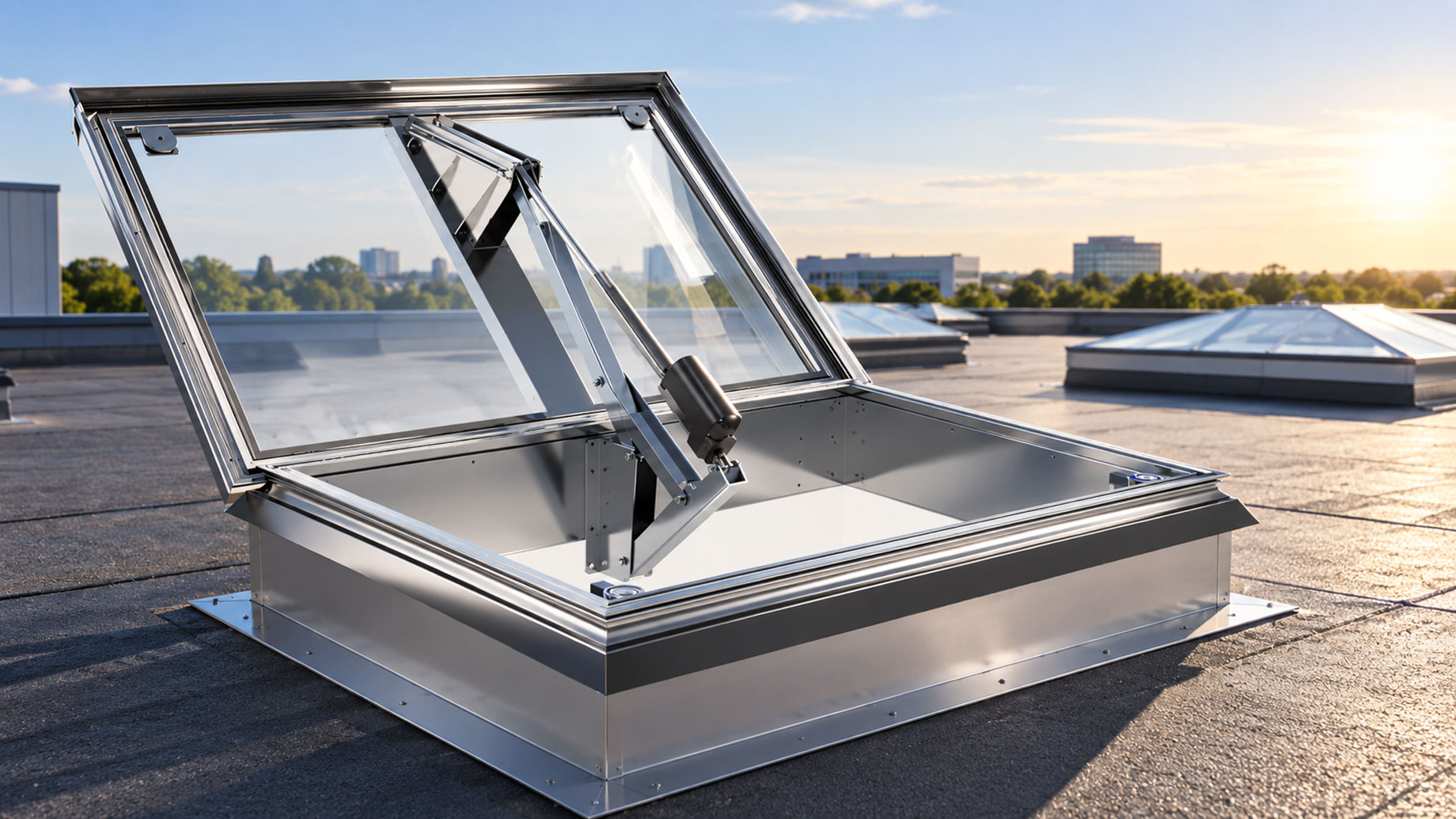
A rooflight above a stairwell, atrium or deep-plan office has to do two jobs that pull in different directions. On a normal day it needs to let daylight into the space and, ideally, provide comfort ventilation. In a fire, that same opening becomes part of the life-safety strategy. It has to release smoke and heat fast enough to help keep escape routes clear, in line with Approved Document B and the performance demands of BS EN 12101-2. Specifiers who try to meet these two requirements with separate products often end up with more roof penetrations, more junctions to detail and a greater risk of something failing to meet either brief properly. A glazed smoke vent combines daylighting glass with an automatic opening vent (AOV) function in one assembly, making it an increasingly efficient answer and the product category this guide is built around.
Our top pick is Surespan for large-format, bespoke rooflight projects where a specifier needs thermally broken double glazing, dimensional flexibility beyond standard catalogue sizes and direct manufacturer input into the specification. Available product details include 24V actuation and electromagnetic locking, which can simplify controls integration on projects where the AOV also has to answer to a fire alarm interface. The applicable performance evidence should still be confirmed for the specified size and configuration. For specifiers who need a broader European portfolio spanning modular smoke-vent rooflights and louvred ventilators with a turnkey delivery option, LAMILUX is a strong alternative. For commercial offices, atria and public buildings where day-to-day comfort ventilation is as important as the fire-safety function, VELUX Commercial is also worth shortlisting.
This guide assesses six glazed smoke vent providers against a consistent ten-point technical scorecard covering certification, glazing performance, thermal detailing, aerodynamic free area, controls, locking and UK specification support. The scope is deliberately UK-focused: BS EN 12101-2:2003+A1:2012 for natural smoke and heat exhaust ventilators (NSHEVs), Approved Document B for smoke-control strategy and ACR[M]001 for non-fragility classification of roof glazing. Where a manufacturer’s published information does not confirm a specific figure, we say so rather than guessing. Getting these numbers wrong at the specification stage can have real consequences for fire strategy sign-off.
Our Selection Criteria
Every product in this guide was assessed against the same ten criteria, which reflect what a fire engineer or M&E consultant needs to verify before a glazed smoke vent goes on a drawing. We looked for evidence of each point in manufacturer literature rather than inferring capability from company size or reputation alone. According to a recent overview of automated smoke vent rooflight systems, the sector is moving towards tighter integration of certified smoke exhaust with everyday daylighting and ventilation controls, which is the balance this scorecard is designed to test.
EN 12101-2 System Certification
Does the manufacturer publish a Declaration of Performance for the complete glazed assembly, rather than only the actuator or the glass in isolation?
Maximum Tested Unit Size
What is the largest single unit that has actually been tested and certified, as opposed to theoretically manufacturable?
Glazing and Non-Fragility
Is the glazing specified against ACR[M]001 non-fragility classification, relevant on accessible and maintenance-walked roofs?
U-Value and Upstand Insulation
How well does the assembly, including the upstand, control heat loss at the roof penetration?
Aerodynamic Free Area
What effective smoke-clearing area (Cv) does the vent achieve relative to its physical opening, a figure central to Approved Document B calculations?
Actuator Voltage and Controls
Is the vent driven by a 24V system compatible with standard fire alarm interfaces, and how does it integrate with building management systems?
Locking and Safety
Does the assembly include electromagnetic or mechanical locking suitable for accessible roof areas?
Wind and Snow Load Ratings
Has the unit been rated for UK wind and snow exposure categories?
Bespoke Sizing Availability
Can the manufacturer accommodate non-standard structural bays, or only catalogue dimensions?
UK Technical Support
Is there a UK-based specification and aftercare resource, and how much of the documentation is self-serve rather than project-specific?
The 6 Best Glazed Smoke Vents for Daylight and Fire Safety in 2026
With those criteria established, here are the six glazed smoke vent providers that best meet the combined demands of certified smoke exhaust, daylighting performance and UK project specification support. Each entry below is assessed on the same basis, so you can weigh the trade-offs against your building type, structural grid and controls strategy. Surespan leads the list for bespoke, large-format applications, with the remaining five positioned against the specific segments where they are strongest.
| Provider | Best for |
|---|---|
| Surespan | Large-format bespoke thermally broken glazed smoke vents |
| LAMILUX | Broad EN 12101-2 portfolio with turnkey delivery |
| VELUX Commercial | NSHEV comfort-venting in offices, atria and public spaces |
| Bilco | Combined roof-access, daylighting and smoke-vent unit |
| Mercor UK | UK-based support for fire-protection-led projects |
| Daylight & Ventilation Solutions | Wholesale supply of certified dome and glass SHEV rooflights |
1. Surespan: Best for Large-Format Bespoke Thermally Broken Glazed Smoke Vents
Surespan’s smoke-vent rooflight is built around a thermally broken, double-glazed assembly designed to deliver smoke exhaust alongside genuine daylighting, rather than treating the glazing as an afterthought to the vent mechanism. Its main advantage on large or unusual structural bays is the available sizing. Surespan will manufacture bespoke units up to 3,000 × 1,400 mm, giving specifiers an option for wide openings that do not suit standard catalogue dimensions. Specifiers researching this product typically start from the manufacturer’s own glazed smoke vent product page, which sets out available performance information alongside technical details for specification. The applicable evidence should be checked against the exact size, glazing and configuration proposed for the project.
The assembly is available with 24V actuation and electromagnetic locking within the same system, which matters on accessible roofs where a maintenance route crosses the vent and both fire-safety release and everyday security have to be managed through one controls interface. Surespan’s wider background is in the access and rooflight industry, and this is reflected in the attention given to structural and safety detailing around the upstand and glazing junctions. Because the product is specified project by project, buyers can discuss technical requirements directly with the manufacturer rather than relying on a purely self-serve catalogue. This suits complex or non-standard applications, although it calls for more coordination during the early specification stages.
Key Specifications
- Bespoke sizes up to 3,000 × 1,400 mm per unit
- Thermally broken double-glazed construction
- 24V actuation with integrated electromagnetic locking
- Performance information available for specified configurations
- Project-specific specification support from the manufacturer
Pros
- Accommodates large bespoke dimensions for non-standard roof openings
- Thermally broken construction addresses a common weak point at roof penetrations
- 24V actuation and locking can be combined in one system, simplifying controls integration
- Access-industry experience informs the structural and safety detailing
- Direct manufacturer involvement in project-specific specification
Cons
- Bespoke manufacturing requires more project-specific coordination than a standard catalogue purchase
- 3,000 × 1,400 mm is the quoted maximum per unit; larger required exhaust areas need multiple units and additional layout coordination
- Primarily a roof-mounted solution, so it is not a fit for wall-mounted or louvre-based smoke-exhaust strategies
- Specification is handled project by project, with less reliance on pre-published self-serve documentation
Who it’s best for: Architects and fire engineers working with large or non-standard roof openings who need one manufacturer to address both daylighting glazing and smoke-exhaust requirements, and who value direct technical support over a purely catalogue-driven process.
2. LAMILUX: Best for a Broad EN 12101-2 Portfolio With Turnkey Delivery
LAMILUX is one of the larger European names in premium rooflights, flat-roof skylights and glass roof systems. Its range extends across modular smoke-vent rooflights, louvred ventilators marketed under the roda brand within the same group and full glazed roof systems. That breadth is useful on projects where daylighting, comfort ventilation and smoke exhaust need to be resolved within a coordinated product family rather than assembled from several unrelated suppliers. LAMILUX publishes EN 12101-2 information for relevant products, giving fire engineers a documented starting point, but the applicable declaration and certified configuration should be confirmed for each specification.
The turnkey delivery option, through which LAMILUX can manage supply through to installation, reduces the coordination burden on contractors who might otherwise be handling separate glazing, mechanical and controls packages. Its extensive catalogue does require careful navigation, and specifiers may need to spend more time confirming which product line and configuration fit a given application. UK-specific pricing and lead-time data is not published in a form that can be treated as a fixed reference point, so both should be confirmed directly for the individual project.
Pros
- Broad product range spanning rooflights, louvres and glass systems under one group
- EN 12101-2 information is available for relevant smoke-vent products
- Turnkey delivery option available, reducing multi-contractor coordination
- Established European experience in daylighting and smoke ventilation
Cons
- The extensive portfolio requires careful navigation to identify the appropriate certified product and configuration
- Certification scope should be checked against the proposed unit rather than assumed across the complete catalogue
- UK-specific pricing and lead-time figures are not fixed and should be verified directly
Best for: Specifiers who want one European manufacturer group to cover daylighting, louvred ventilation and smoke exhaust across a large or multi-building scheme, subject to configuration-specific performance checks.
3. VELUX Commercial: Best for NSHEV Comfort-Venting in Offices, Atria and Public Spaces
VELUX Commercial’s glass systems range is aimed at offices, atria and public-space applications in both new build and refurbishment. Its NSHEV rooflights are designed to open automatically to release smoke and heat in a fire event. The same units can also be configured to open and close automatically in response to everyday conditions such as temperature or air quality, giving building operators comfort-ventilation value outside an emergency. That dual-mode behaviour is the product’s main selling point, as the unit can perform an everyday building function as well as forming part of the fire-safety strategy.
VELUX Commercial’s published material confirms the NSHEV auto-open function and environmental-response configurability. At product level, however, specifiers should check the full EN 12101-2 certification scope, aerodynamic free area figures, U-values and maximum unit dimensions for the configuration under consideration. Bespoke sizing capability is also not confirmed in the same way as Surespan’s quoted dimensional range. This does not make the product unsuitable, but it means project teams should request the relevant technical documentation rather than assuming that general catalogue figures apply to every scheme.
Pros
- Strong fit for commercial offices, atria and public-space projects
- Dual-mode operation supports automatic fire response and everyday comfort ventilation
- Configurable to respond automatically to changing building conditions
- Backed by established commercial glazing experience
Cons
- Published material confirms NSHEV auto-open capability, but specifiers should verify the full EN 12101-2 certification scope for their specific project
- No publicly confirmed aerodynamic free area, U-value or maximum size figures are cited here
- Bespoke sizing capability is not confirmed, and the range appears primarily catalogue-based
Best for: Commercial and public-building projects where comfort ventilation is used daily and the fire-safety function needs to sit within the same automated system without a separate dedicated smoke-vent product.
4. Bilco: Best for a Combined Roof-Access, Daylighting and Smoke-Vent Unit
Bilco’s SKY-Flatglass-1MF takes a different approach to the category. Instead of using a top-hung or pivoting vent, it has a sliding cover that provides natural smoke ventilation and daylighting while also functioning as a roof access hatch compatible with a fixed ladder. One unit can therefore replace what might otherwise be several separate roof penetrations: a rooflight, a smoke vent and a roof-access point. On projects where reducing the number of roof breaches is a priority for waterproofing or structural reasons, this combined proposition is difficult to achieve with a conventional vent.
The confirmed standard size is 1,000 × 1,500 mm, and Bilco is UK-based with a published contact line for technical queries. The manufacturer’s published material reviewed here does not confirm bespoke sizing capability beyond that standard dimension, the unit’s EN 12101-2 certification status or its U-value and thermal performance figures. Specifiers should request the relevant Declaration of Performance directly rather than assuming certification. They should also check how the sliding mechanism’s aerodynamic free area compares with top-hung alternatives, since the geometry of a sliding cover behaves differently from a hinged vent.
Pros
- Combines a smoke vent, rooflight and roof-access hatch in one unit
- Sliding cover design offers a distinct mechanical alternative to top-hung or pivot vents
- UK-based manufacturer with a direct technical contact point
- Consolidates what might otherwise be several separate roof penetrations
Cons
- Bespoke sizing capability beyond the confirmed 1,000 × 1,500 mm standard is not documented
- Aerodynamic free area characteristics of the sliding mechanism should be verified against project requirements rather than assumed equivalent to hinged vents
- EN 12101-2 certification status is not confirmed in the published material reviewed here; request the Declaration of Performance directly
- No published U-value or thermal performance data was available to confirm
Best for: Buildings where consolidating roof access, daylighting and smoke exhaust into a single penetration is a specific design priority, such as plant rooms or flat roofs with limited access points.
5. Mercor UK: Best for Fire-Protection-Led Projects Requiring UK-Based Support
Mercor UK operates as part of the wider Mercor fire-protection group, with its UK office based in Heywood, Greater Manchester. For specifiers whose priority is having a UK point of contact within a fire-protection business, that local presence is the main reason to consider the company. It provides a direct route for project teams to discuss current product availability and obtain the documentation needed for a life-safety specification.
This entry is deliberately concise because the published material available for this review confirmed the company’s location and contact details but did not set out product-specific technical data such as glazing type, EN 12101-2 certification status, aerodynamic free area, U-values or available sizes in a form that could be responsibly summarised here. Specifiers considering Mercor UK for a glazed smoke vent should contact the team directly to obtain current product specifications. The technical performance of a particular unit should not be assumed from the company’s wider fire-protection focus.
Pros
- UK-based office and team, relevant for projects wanting domestic support
- Fire protection is the company’s core area of operation
- Direct UK contact point for project queries
Cons
- No product-specific technical data covering certification, free area, U-value or sizing was available to confirm for this review
- Buyers need to request full specifications directly before including any product on a fire-strategy drawing
Best for: Projects where a UK-based fire-protection contact is valued and the specifier is prepared to obtain full technical documentation directly before finalising a product choice.
6. Daylight & Ventilation Solutions: Best for Wholesale Supply of Certified Dome and Glass SHEV Rooflights
Daylight & Ventilation Solutions is a smaller UK-based wholesale building materials company, founded in 2010 and headquartered in Bury St Edmunds, Suffolk. Its range covers individual rooflight domes, continuous rooflights, individual glass and aluminium rooflights and glazed roofing systems. The company states that these product lines can incorporate SHEV systems certified to EN 12101-2. This choice of rooflight types within a smoke-vent offering may suit contractors sourcing through a wholesale channel rather than directly from a large manufacturer, although the certification scope should be checked for the specified product and configuration.
Because it operates a wholesale supply model, the scope of installation and specification support is not confirmed in detail in the company’s published material. Buyers should clarify the level of technical assistance included before relying on it for a complex fire-strategy submission. No aerodynamic free area, U-value, maximum size or actuator voltage figures were available to verify for this review, so these details need to be requested directly for the proposed unit. Its smaller scale is also worth considering on large or technically complex projects, where the required supply and support arrangements should be discussed in advance.
Pros
- The company states that EN 12101-2-certified SHEV options can be incorporated across its rooflight types
- Broad typology covering domes, continuous rooflights, glass and aluminium units and glazed roofing systems
- Over a decade of UK trading history
- Wholesale model may suit trade buyers sourcing multiple units for a project
Cons
- Supply and support arrangements for very large or complex projects should be confirmed directly
- Installation and specification support scope is not clearly defined in published material
- No aerodynamic free area, U-value, maximum size or actuator detail was available to verify
Best for: Contractors and specifiers sourcing dome or glass SHEV rooflights through a wholesale supply channel rather than a direct manufacturer relationship, subject to product-specific certification checks.
Frequently Asked Questions
Is it worth insisting on full EN 12101-2 certification rather than a component-level claim?
Yes. EN 12101-2 certification should apply to the complete assembly, including the glazing, frame, actuator and seals together, rather than only the actuator or glass. A Declaration of Performance covering the specified unit is what a fire engineer needs to reference in a smoke-control strategy submitted under Approved Document B. As reported by Glass & Glazing Products Magazine, complete systems can combine safety and ventilation functions under EN 12101-2 certification, underlining why component-level claims alone are insufficient.
Should I choose a bespoke glazed smoke vent over a catalogue-standard unit?
The choice depends on the roof geometry. If the structural bay matches a manufacturer’s standard tested dimensions, a catalogue unit is usually more straightforward to procure and document. If the opening is larger, irregular or needs to combine functions such as roof access, a bespoke or purpose-built assembly, such as Surespan’s large-format range or Bilco’s combined access unit, may justify the additional specification work.
Is an NSHEV the same thing as a SHEV for compliance purposes?
Not quite. A SHEV, or smoke and heat exhaust ventilator, is the general category of vent used for smoke control. An NSHEV is a naturally driven SHEV, operating through buoyancy and wind effect rather than mechanical extraction. Most glazed rooflight smoke vents, including the products reviewed here, fall into the natural NSHEV category, and Approved Document B treats natural and mechanical smoke ventilation strategies differently in its design calculations.
Should I rely on aerodynamic free area figures from a spec sheet without checking test conditions?
No. Aerodynamic free area (Cv) describes the effective smoke-clearing capacity of a vent relative to its physical opening, and it depends on test conditions and geometry rather than only the stated dimensions of the unit. Always request the specific Cv figure tied to the tested configuration you intend to specify instead of assuming that a headline number applies universally across a manufacturer’s range.
Is it reasonable to use a glazed smoke vent as an everyday rooflight rather than a dedicated fire-only vent?
Yes, and this is one of the main reasons the category exists. Products such as VELUX Commercial’s comfort-configurable range and Surespan’s daylighting-focused glazing are intended to function as rooflights or ventilators in normal use while also forming part of a fire-safety system. The relevant EN 12101-2 evidence must still match the specified unit and configuration. This dual role can reduce the total number of roof penetrations and provide day-to-day value from a life-safety component.
Should I check non-fragility classification even if the roof is not regularly accessed?
Yes, it is still worth checking. ACR[M]001 non-fragility classification matters most on roofs that receive maintenance access, but treating it as a baseline check is good practice even on roofs with limited planned access, since repairs or inspection may be needed during a building’s life. U-value performance at the upstand is worth checking at the same time, as poor detailing around a rooflight upstand can contribute to condensation and heat loss.
Final Word
Across these six providers, the right glazed smoke vent depends less on brand reputation than on how closely a product’s documented performance matches the building, fire strategy and roof geometry in front of you. Surespan stands out for large or non-standard bespoke openings where thermally broken glazing, dimensional flexibility and integrated 24V actuation with electromagnetic locking need to be addressed through one manufacturer. The evidence must still be checked for the proposed size and configuration. LAMILUX and VELUX Commercial answer different needs, one through portfolio breadth and turnkey delivery and the other through comfort-ventilation-led commercial applications, while Bilco, Mercor UK and Daylight & Ventilation Solutions serve more specific requirements. Whichever direction a project takes, engage the manufacturer’s specification team while the fire strategy and roof geometry are still being finalised, rather than waiting until the structural grid is fixed.
