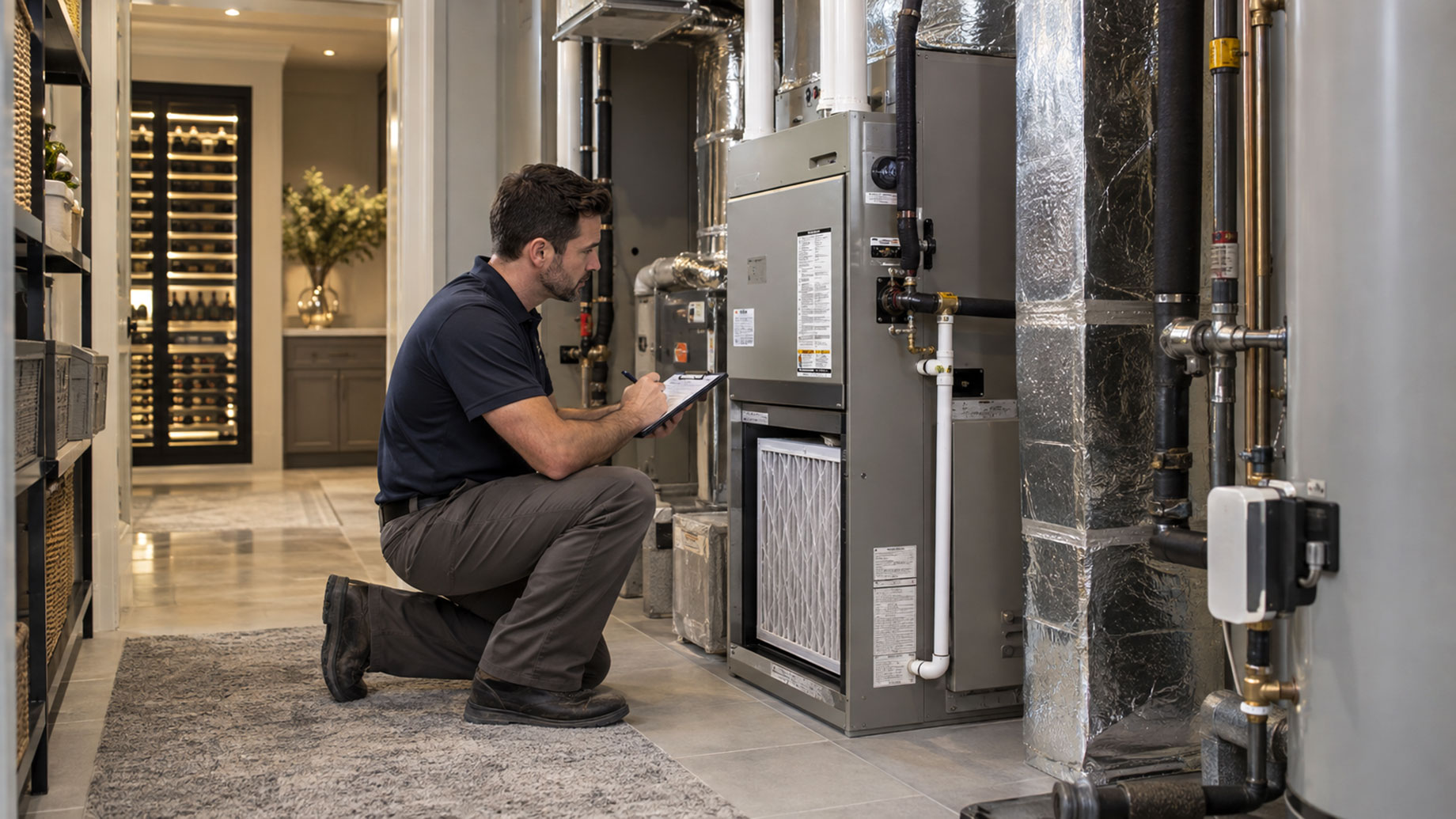
A luxury home makes a lot of promises the moment you walk in. What it rarely tells you is whether the systems keeping it comfortable are worth what you are about to pay for the house.
HVAC is the easiest thing to overlook and one of the most expensive to get wrong. In a large, high-end home, replacing or correcting a bad system is not a few thousand dollars. It can run well into five figures, and a standard home inspection often gives it only a passing glance.
That is why the systems in a high-end home deserve a harder look before closing than a general inspection provides. An inspector confirms the system turns on. A dedicated HVAC assessment tells you what it will actually cost you to own.
Here are the six HVAC checks worth making before you buy a luxury home.
1. Check the True Age of Every System
Start with how old the equipment actually is, not how old it looks. A well-kept unit can look newer than it is, and a luxury home often has multiple systems of different ages serving different wings.
Most central air conditioners last around 15 to 20 years, and furnaces are similar. A system near the top of that range is not a deal breaker, but it is a cost you should be pricing into your offer, because it is closer to replacement than the seller may admit.
Find the manufacture date on each unit’s data plate and count the systems. When the date is not printed plainly, a Fayetteville HVAC technician can decode it from the serial number, since the format differs by manufacturer. In a big home, one aging unit among four is a very different conversation than four units all installed the same year, all due at once.
2. Confirm the Home Is Properly Zoned and Sized
A luxury home is only comfortable if the HVAC can actually handle its size and layout. Big footprints, high ceilings, and lots of glass are exactly the conditions that expose an undersized or poorly zoned system.
Walk the house and feel the temperature room to room. If the primary suite is warm while the main floor is cold, or an upstairs wing never quite catches up, the system is not matched to the home.
Proper zoning lets different areas hold different temperatures independently, which is close to essential in a large home. A system that fights to keep one temperature everywhere will run hard, wear fast, and still leave rooms uncomfortable.
3. Ask for the Maintenance and Service History
Documentation tells you how the equipment was treated, and in a luxury home that history is worth real money. A system with regular records has usually been serviced by professionals who caught small problems early.
Ask for annual service records, filter change habits, and any major repairs. A well-documented system that has been maintained on schedule is far more likely to reach the high end of its lifespan.
A total absence of records is itself a finding. It usually means the equipment ran until something broke, which is exactly how expensive failures get built into a system you are about to inherit.
4. Inspect the Ductwork, Not Just the Units
The equipment gets all the attention, but the ductwork determines whether any of it works. In a sprawling home with long duct runs, leaks and bad design quietly waste a large share of what you pay to heat and cool.
According to the U.S. Department of Energy, a typical home loses 20 to 30 percent of the air moving through its ducts to leaks and poor connections. In a large luxury home, that percentage is a lot of conditioned air and a lot of money going nowhere.
Have the duct system checked for leaks, proper sizing, and insulation, especially in runs through attics and crawl spaces. Beautiful equipment attached to leaky ductwork still gives you an uncomfortable, expensive home.
5. Identify the Refrigerant the System Uses
Refrigerant type is a check almost no buyer thinks to make, and it can carry a serious hidden cost. It tells you both how old a system really is and how expensive it will be to service.
Older systems run on R-22, which the EPA phased out of production in 2020. Servicing an R-22 system now means paying a premium for dwindling recycled refrigerant, so a home still running one is signaling an overdue replacement.
Newer systems use R-410A, but under the EPA’s AIM Act, new residential equipment sold from 2025 onward uses low-GWP refrigerants like R-454B and R-32 instead. None of that makes an R-410A system bad, but knowing the refrigerant tells you exactly where the equipment sits on the timeline and what a future repair or swap will involve.
6. Review the Efficiency Ratings and Real Operating Costs
The last check is what the system costs to run, which in a large home is not a small line item. Two homes can feel identical and cost wildly different amounts to keep comfortable, and efficiency is the reason.
Look at the SEER2 rating on the cooling equipment and the furnace’s efficiency rating. Older, low-efficiency systems in a big home can mean utility bills that quietly rival a mortgage payment during peak season.
Ask to see recent utility bills across a full year if you can. Real numbers from the actual house beat any estimate, and they tell you whether the comfort you are buying comes with a running cost you did not budget for.
What a Pre-Purchase HVAC Check Really Buys You
The theme across all six checks is that HVAC is where a luxury home hides its biggest surprises. The house can be flawless and still come with aging equipment, bad zoning, leaky ducts, obsolete refrigerant, or operating costs nobody mentioned. Every one of those is far cheaper to discover before closing than after.
A dedicated pre-purchase HVAC assessment turns those unknowns into numbers you can negotiate with. Instead of hoping the systems are fine, you get a clear picture of what you are inheriting and what it will cost, which is a stronger hand at the negotiating table and peace of mind after you move in.
FAQ
Does a standard home inspection cover HVAC properly?
Not in the detail a luxury home deserves. A general inspector usually confirms the system powers on and produces hot or cold air, but does not assess sizing, ductwork, refrigerant, or true remaining lifespan. For a high-end home with multiple systems, a dedicated HVAC evaluation is worth the extra step.
How long do HVAC systems last in a large home?
Central air conditioners typically last around 15 to 20 years and furnaces about the same, though hard use in a large home can shorten that. Age alone is not the whole story, since a well-maintained older system can outlast a neglected newer one.
Is an older R-22 air conditioner a reason to renegotiate?
It is worth factoring in. R-22 was phased out of production in 2020, so servicing one is increasingly expensive, and a system still using it is usually near the end of its life. That makes it a fair point to raise when discussing price or replacement.
How much should I budget to replace HVAC in a luxury home?
It varies widely with the size of the home and the number of systems, but replacing HVAC in a large high-end home commonly reaches well into five figures. That is exactly why pricing the equipment’s condition into your offer matters before you buy.
What is the most overlooked HVAC issue when buying a home?
Ductwork. Buyers focus on the visible equipment and ignore the duct system, even though leaks and poor design can waste 20 to 30 percent of heating and cooling. In a large home with long duct runs, that oversight shows up as both discomfort and high bills.
