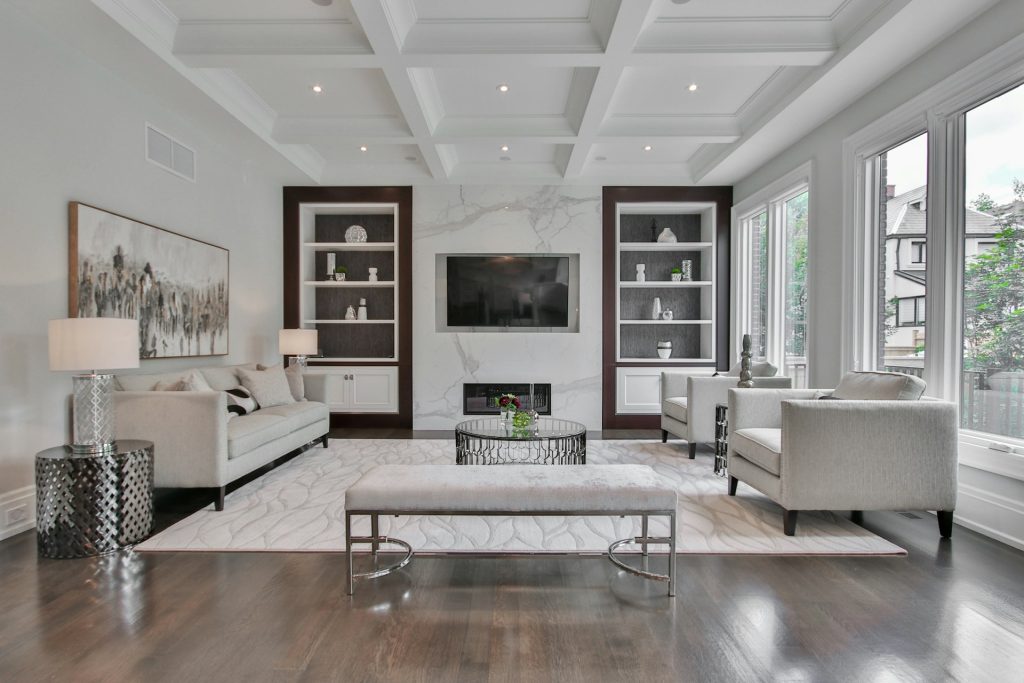
A camera can glide through a beautiful interior without making its arrangement any easier to understand. The chair receives its close-up, light crosses a wall, and a screen passes elegantly through the foreground. Yet a viewer may finish the sequence unsure whether the reading nook sits beside the main seating area or in a separate room. More movement has delivered more views, but not necessarily a clearer relationship.
For an original conceptual interior, an AI Video Generator can provide material for exploring that distinction. MakeShot offers prompt and image inputs for video generation. The useful comparison is between what a fixed view, a lateral reveal and an orbit let a viewer understand—not between how expensive their camera movement looks. The room below is hypothetical, not an existing property or a verified architectural plan.

The Fixed View Holds the Relationship Together
Imagine a pale room with a free-standing oak screen between a front sitting area and a reading bench beneath a rear window. A continuous strip of floor passes around the screen’s right edge. The design question is whether the nook still feels connected to the sitting area. That relationship, rather than the finish of the oak, gives the image a job.
A carefully chosen fixed view may answer immediately. From an oblique position, it could show the front seat, the side of the screen, the floor passing around it and the rear bench together. The viewer does not have to remember where one object was while searching for another. The arrangement is available in a single composition.
The fixed view fails when its position hides the important connection. From directly in front, the screen may overlap the bench and conceal the side passage. An attractive frontal image would then answer a question about composition while leaving the original question about connection unresolved.
Changing the viewpoint can be enough. Before commissioning movement, consider whether a different still composition explains the idea. If the open floor and bench are already legible together, a moving shot needs another reason to exist. A static image is not an incomplete version of a film; for this particular question, it may contain all the necessary information.
A Lateral Move Reveals What the Screen Hides
A lateral reveal becomes useful when the relationship cannot be shown clearly from the intended opening view. Start with the screen partly obscuring the nook, then shift sideways until the bench and connecting floor become visible. As the screen stops blocking the bench, the open floor should explain how the two areas belong together.
Keep an orientation point in view during the reveal. In this concept, the rear window could remain recognizable while the screen’s edge moves across the composition. The viewer can then relate the newly visible bench to something already seen. If the window disappears before the bench arrives, the shot may feel like a succession of decorative fragments.
In MakeShot, the desired movement can be described in a prompt, with an original concept image supplied where appropriate. Ask for a restrained sideways view that reveals the floor beside the screen while keeping the window recognizable. That wording states an intention. It does not turn the generator into a measured camera rig or guarantee that unseen parts of the room will remain consistent.
A candidate from an AI Video Generator should therefore be judged by the connection it actually depicts. If the screen shrinks to expose the bench, or the floor seems to open into a new space, the apparent reveal has changed the concept. Smooth movement would not rescue that result. The proposed room needs to remain intelligible while the view changes.
The move also needs a useful destination. Stop where the relationship can be seen, with enough time for the viewer to take it in. Continuing past that point may hide the bench again or turn the window into the only subject. The bench and passage need a moment together before either slips out of frame.
An Orbit Changes the Question Along the Way
An orbit turns around a subject instead of moving mainly across the original view. Around the oak screen, it might show how the divider presents a broad face to the front seat and a quieter backing to the reading bench. That can be useful if the design question concerns how the screen serves two areas.
For the narrower question about the connecting floor, however, the same movement may be distracting. The window changes position, the front seat leaves view and the bench may appear from an unfamiliar direction. The viewer has more surfaces to inspect but fewer stable points from which to understand the original arrangement.
That is a tradeoff, not a reason to reject every orbit. A short arc that retains the bench and a recognizable edge of the screen might explain their relationship well. A full circuit might be unnecessary. The choice should follow what the viewer needs to discover, rather than treating a complete rotation as the more impressive version of a partial one.
Nor does seeing several apparent sides establish a complete room. Generated views can introduce details that were absent from the original concept. An orbit is especially unhelpful when its appeal depends on accepting every newly revealed surface as reliable information. It remains a visual proposal, not a survey, a dimensioned model or a dependable tour of a real home.
Ask What Became Clear After the View Changed
After watching a candidate, describe the relationship without describing the camera. “The bench sits behind the screen, with open floor connecting it to the front seating” addresses the brief. “The camera moves smoothly around the divider” does not. Both observations may be true, but only the first says the room became easier to understand.
A reveal can even show the bench clearly and still fail. If the final composition crops away the side passage, the viewer sees the destination without its connection to the sitting area. Choose an ending view that holds the bench and that connecting floor together. A closer view is not necessarily a more informative one.
This review is a human judgment outside MakeShot, not a spatial-analysis feature. If a viewer cannot place the bench, return to the point where orientation was lost. The answer might be a shorter move, a different starting view or the fixed composition. Adding another shot would help only if it restores the missing relationship.

Choose the View That Makes the Room Legible
For the imagined nook, choose the fixed view if it already shows the connection. Use a lateral reveal when the screen’s concealment is worth explaining through movement. Reserve an orbit for a question that benefits from seeing the divider’s changing relationship to both areas. None is the best choice for every interior.
The final decision should leave a viewer with a clearer idea of how this conceptual room hangs together. It should not invite assumptions about actual dimensions, construction or a property’s layout. Return to the bench, screen and open floor: if the chosen view makes their intended relationship legible, the camera has done useful work. If it only adds spectacle, another viewpoint may say more with less motion.