Here is the short version, stated as a conclusion: an API gateway and an AI gateway are not the same product wearing different badges. An API gateway manages traffic coming into your system: who gets in, how much of it, and which of your services handles it. An AI gateway manages traffic going out to models: which model answers each call, what that answer costs, and what happens when a provider pushes back. They share HTTP plumbing and almost nothing else, which is why the team behind OrcaRouter built a dedicated control layer for the second problem rather than bolting features onto the first: a single point that sits between your application and every AI model API your product depends on.
This matters now because AI traffic has quietly stopped being an experiment. The calls that began as weekend prototypes are on production paths (support triage, document extraction, code generation) and they arrive with a bill, an incident channel, and a dependency on providers you do not control. The vocabulary did not keep up: both boxes are called gateways, both sit between a client and a backend, and both are drawn as a rectangle with arrows. Confuse them in a design document and the mistake survives quietly until the first outage or the first invoice surprise. The rest of this article separates the two boxes by the only test that matters: what each one is actually built to do.
What is an API gateway actually for?
An API gateway solves a problem you created for yourself. Once you have more than a handful of services, clients should not talk to each one directly, so you put a front door in front of everything: the gateway issues and checks keys, applies rate limits per client, maps paths to backends, terminates TLS, caches responses, and logs who called what. Every feature follows from one mental model: a request comes in, something behind the wall answers it, and one request is the unit of accounting.
The backends are stable by assumption. You deployed them, you version them, and they do not change behavior overnight without your involvement. A classic API gateway is excellent at this job, so excellent that when model APIs arrived, the obvious move was to treat an inference endpoint as just another backend behind the same door. That is precisely where the assumptions break.
What does an AI gateway do that an API gateway doesn’t?
Flip every assumption and you get the AI gateway’s job description. The backends are not yours; they are third-party models that rate-limit by tokens rather than requests, deprecate names on their own schedule, and can return errors that have nothing to do with your traffic. The unit of accounting is not the request but the token, which means cost varies call by call even when your request count does not. And “which backend” is no longer a static path rule: it is a per-call decision based on cost, latency, and capability.
An AI gateway is built around those facts. It routes each call to the model that should handle it, retries or fails over to another provider when one refuses, normalizes model names so your code survives a deprecation, meters tokens per team and per feature so finance can see where the money goes, and handles streaming responses without buffering them into uselessness. That last one matters more than it sounds: a proxy built for request-response will happily sit on a stream that your users experience as lag.
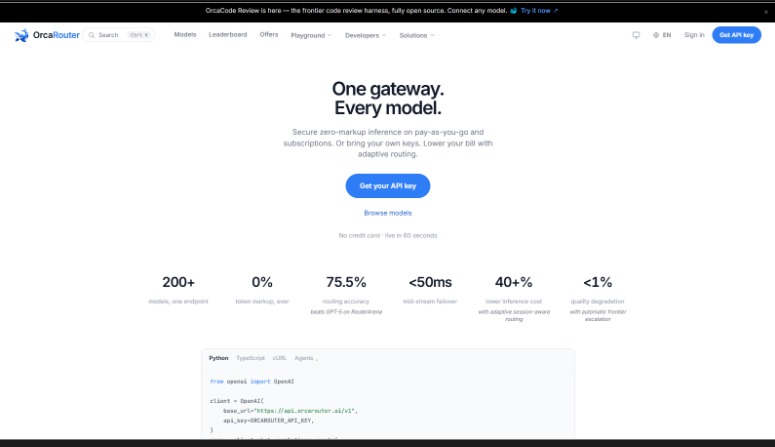
None of this is exotic. It is simply a different list of jobs than the ones an API gateway was designed around, which is exactly why retrofitting the old box rarely works.
Why can’t you just configure your existing gateway to do this?
Point a classic gateway at a model endpoint and it will forward traffic perfectly; that part is trivial and worth keeping. The problems start with everything that is not HTTP plumbing.
A retry is not a retry when the first attempt may already have consumed tokens: a naive re-send doubles spend on a failure you cannot see. A limit that counts tokens per minute cannot be expressed as requests per second per client. A routing decision that depends on the content of the call (send the easy requests to the cheaper model, keep the hard ones on the stronger one) is not a path rule, it is policy. And when a provider renames or retires a model, an aliasing layer is the difference between a config change and a code change across every service that calls it.
Teams that attempt this in gateway configuration end up, piece by piece, writing an AI gateway as a configuration application: token counters in custom middleware, fallback tables in routing rules, cost reports scraped from access logs. It works, right up until the evening a model deprecation notice lands and the on-call engineer discovers which services hard-coded the old name.
Where the two overlap, and where to draw the line
The overlap is real, and it is what makes the confusion durable. Both boxes authenticate callers, both apply limits, both log traffic, and both occupy a single rectangle in an architecture diagram. The line to draw is direction and subject: an API gateway governs ingress, an AI gateway governs egress to models.
| Question to ask | API gateway | AI gateway |
| Direction of traffic | Ingress: who may call your system, how often, and which of your services answers | Egress: which model handles each call, what it costs, and what happens when the provider says no |
| What sits behind it | Your own services, deployed and versioned by you | Third-party models that rate-limit, deprecate, and fail on their own schedule |
| Unit of accounting | The request | The token, so cost varies call by call |
| How “which backend” is decided | Static path rules | Per-call policy based on cost, latency, and capability |
| When a provider says no | Outside its scope | Retries and failover, token-aware so a retry does not double spend |
One protects your edge; the other manages your dependencies. They stack cleanly: the API gateway stays at your front door, and the AI gateway sits between your services and the model providers behind them. Replace one with the other and exactly one of those jobs goes undone.
Do you need an AI gateway, or is an API gateway enough?
An honest answer has to include the case where you do not need one. If your product calls exactly one model through one provider, treats it as a black box, and can live with its limits, then an API gateway plus a budget alert will carry you further than new infrastructure. Add an AI gateway when a second condition appears. In practice the triggers arrive in a predictable order:
• A second model enters the picture, usually as a fallback for when the first provider throttles you.
• A cheaper model starts taking the easy calls while the stronger one keeps the hard ones.
• Finance asks for per-team cost visibility and wants to know which feature is spending the money.
• You want the freedom to swap models as better ones ship, without touching application code.
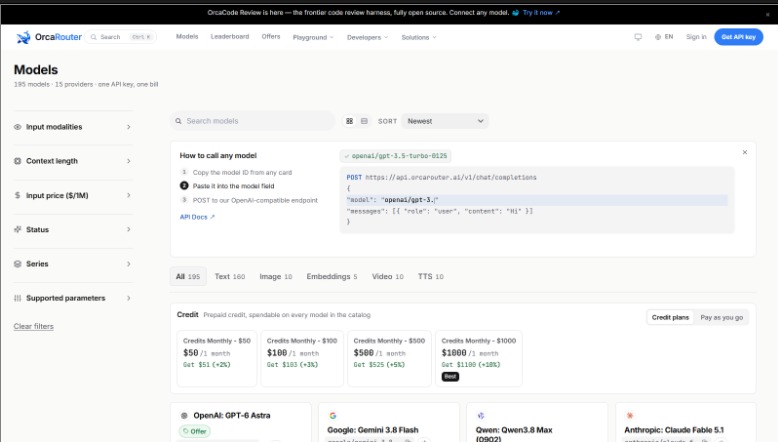
That catalog is the argument in miniature. Models are not a stable backend you version yourself; they are a moving market, and something has to absorb the movement so your product does not have to. If AI is on your cost line and in your incident channel, that something is infrastructure, not a config file.
The takeaway
Buy the box that matches the traffic. An API gateway and an AI gateway share a name and little else: one is a front door for your own system, the other is a control layer for a dependency market that changes without asking you. Keep the API gateway, which remains the right tool for your edge. But if models sit on your critical path, route them through a layer built for token accounting, provider failures, and model churn, because the first 429 you catch at peak traffic will teach the difference faster than any architecture document.
Sourcing note: This article argues from architecture rather than benchmarks and quotes no third-party performance figures. Descriptions of OrcaRouter reflect its homepage and models page (the two pages linked in the opening paragraph) as viewed on 2026-09-07.