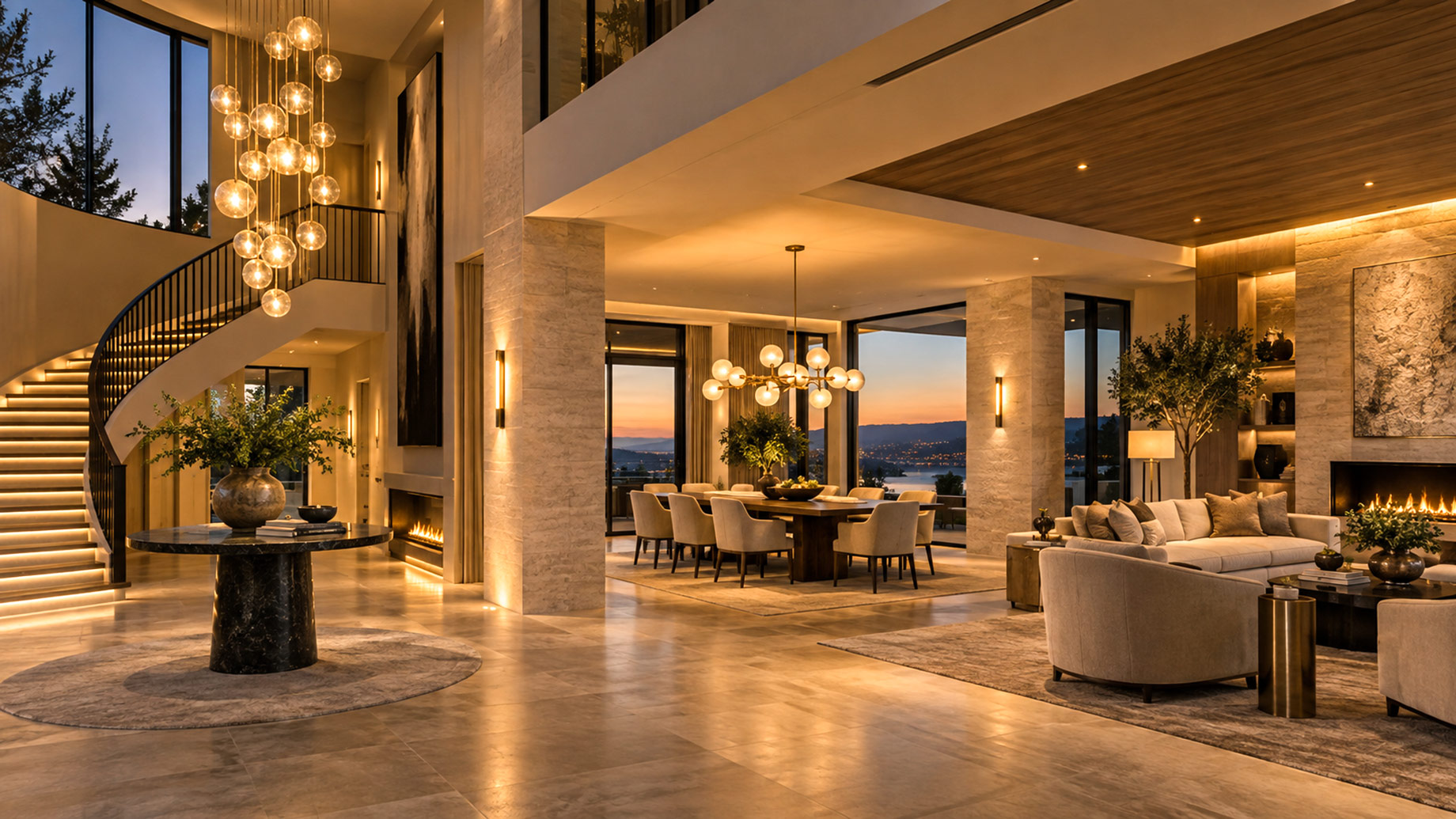
A well-composed luxury home tends to reveal itself gradually. There is the first view from the front door, the upward perspective through a stair hall, the intimacy of a dining table, and the quieter character of a living room after dark. Lighting helps shape each of those experiences.
A statement fixture may be one of the most visible objects in a room, but visibility alone is not what makes it successful. The better question is whether it makes sense within the space around it. Ceiling height, daylight, circulation, furniture placement, and even the way people move through a room can matter as much as finish or style.
Read the Room Before Measuring the Fixture
Scale is about more than whether a fixture physically fits.
A delicate pendant might look perfectly considered in a narrow entrance, then almost disappear in a large two-story foyer. At the other extreme, an elaborate multi-tier chandelier can dominate a dining room that does not have enough height or visual space to support it.
Start with the views that matter most. In an entry, that may be the line from the front door toward the staircase. In a dining room, it is usually the relationship between the table, the fixture, and the people seated around it. A living room is different again, particularly when large windows or an open-plan layout create longer sightlines.
Ceiling conditions matter too. In foyers, stairwells, and other tall spaces, the mounting surface may be flat or sloped, and a fixture designed to accommodate both can offer more flexibility without forcing the lighting plan to work around the architecture. Room-specific collections from SOOINC can also be a useful reference when comparing chandelier scale, form, and placement across different residential spaces.
The furniture below the fixture offers another clue. Long tables and kitchen islands often work naturally with linear forms, while a round table or centered seating arrangement can accommodate something more radial or clustered.
Treat the Foyer as an Interior Threshold
A foyer has a particular job: it introduces the house.
That makes lighting here less about filling an empty ceiling and more about establishing a relationship between levels. In a tall entrance, a chandelier can draw the eye upward, connect the ground floor with an upper landing, or bring attention to details such as a staircase, stone floor, or large window.
Materials behave differently here as daylight changes. Crystal and glass can pick up reflections from nearby windows, while a restrained metal frame may work better when the architecture itself already has strong lines.
Hanging height needs careful judgment. People should be able to move comfortably beneath the fixture, but placing it too high can make it feel disconnected from the room. In a two-story foyer, check the view from both levels. Something that appears perfectly proportioned from the entrance can look surprisingly small from an upper landing.
Use Height Without Filling Every Void
A high ceiling creates opportunity, but there is no rule that says every inch of vertical space needs to be occupied.
Sometimes a series of suspended elements is enough. Rings, tiers, or cascading arrangements can lead the eye upward while leaving breathing room around the fixture. That negative space matters, especially when windows, railings, artwork, or architectural details are already competing for attention.
Staircases make this more interesting because the view keeps changing. A fixture may first be seen from below, then from the side halfway up the stairs, and finally from above. Its silhouette needs to make sense from all three positions.
There is also a practical question that is easy to overlook: how will it be maintained?
Cleaning a fixture or replacing a light source is straightforward over an ordinary floor. Over a tall stairwell, it can become a much bigger job. It is worth thinking about access before installation rather than discovering the problem later.
Give the Dining Table Its Own Light
The dining room offers a clear starting point because the table already establishes the center of the composition.
A chandelier should relate to that center rather than compete with it. Linear fixtures tend to sit comfortably above longer tables, while circular and clustered forms often suit more centralized arrangements. There is no need for the shapes to match perfectly; they simply need to look comfortable together.
Hanging height changes the experience just as much as width or shape. Too high, and the fixture can feel detached from the table. Too low, and it starts to interrupt views and conversation. The aim is to create a sense of enclosure without putting the light in anyone’s way.
Then consider what happens after dinner begins.
A chandelier can establish the focal point, but it rarely needs to provide every bit of light in the room. Sconces, table lamps, and discreet architectural lighting can soften the background and make the dining area feel more relaxed.
Build a Living Room in Layers
Living rooms are harder to solve with a single source of light because they are used in so many different ways. Reading, conversation, television, entertaining, and quiet evenings all ask for something slightly different.
A central fixture can provide visual character and ambient light, but it works better when other sources handle specific tasks. A floor lamp beside a chair, a table lamp near a sofa, or subtle accent lighting around artwork can make the room far more adaptable.
It is also worth looking at the chandelier when it is switched off.
During the day, it becomes part of the architecture and furniture composition. An open design may preserve a view through large windows. A more substantial fixture can give definition to a broad seating area beneath a tall ceiling.
Neither approach is automatically better. The answer depends on how much visual weight is already present in the room.
Let Materials Respond to the Interior
Crystal, glass, metal, and fabric do more than establish style. They change what the light actually feels like.
Clear or textured glass can create reflection and movement. Frosted glass generally produces a quieter effect. Warm metals can sit comfortably beside timber, stone, and neutral upholstery, while darker finishes create stronger silhouettes against pale walls.
Matching every metal finish is rarely necessary. A chandelier might pick up a warm note from cabinet hardware, a mirror frame, or a piece of furniture without repeating it exactly.
Surrounding surfaces matter too. Polished stone and glass can amplify reflections, while plaster, wood, and textiles absorb and soften them. A fixture that seems restrained in a showroom can have a very different presence once it is installed in a reflective interior.
Design for the Evening, Not Just the Photograph
Lighting is often selected from drawings, samples, and photographs taken during the day. The room, however, still has to work after sunset.
Look at where reflections appear on screens, artwork, glass, and polished floors. Check whether a reading chair has enough task light. Notice where shadows add depth rather than creating a problem.
Dimming can help when the fixture and light source support it. A dining room may need practical illumination at one moment and a much softer atmosphere later in the evening. The same is true of a foyer or living room.
The most successful statement lighting is not necessarily the most elaborate. Often, it is the fixture that seems inevitable once it is in place: right for the scale of the room, comfortable with the materials around it, and balanced with the other sources of light.
At that point, lighting no longer feels like something added at the end. It becomes part of the architecture.
