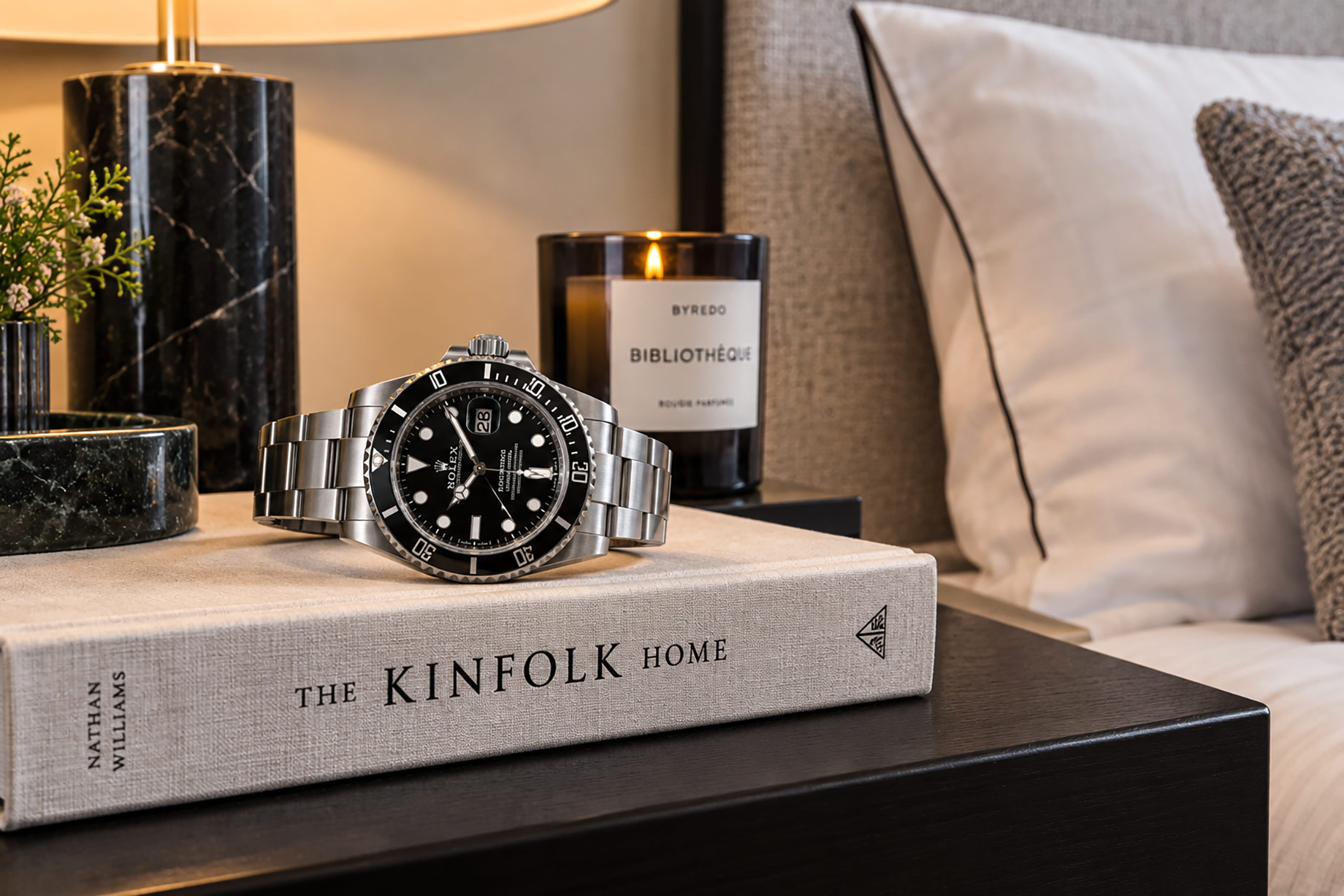
Listing photographers have a small trick for the master bedroom. A steel sports watch goes on the nightstand, crown facing the lens, next to a hardback nobody has read. It signals that the owner has arrived, that the house is a life rather than a floor plan. Buyers respond to it. Stagers know it. And almost nobody in the room asks whether the watch is real.
Increasingly, it is not. Stagers work from prop closets, and a genuine Submariner is a five-figure object that walks off a set in a jacket pocket. So the prop closet holds a copy. Ten years ago that copy looked like a copy. Today the good ones photograph identically, weigh right, and run a movement that sweeps the way the original does. Staging borrowed the word the watch world uses for that tier: super clone.
A term that arrived with the waiting lists
Super clone is not a brand and not a legal grade. It is market shorthand for the top rung of copied watches, the rung built to survive an inspection rather than a glance. Its rise tracks the genuine market. Steel Rolex sports models moved onto waiting lists that run for years. Secondary prices ran to two and three times retail. A manufacturing industry filled the gap. Most of what it makes is junk. A thin top layer is not.
What defines that layer is the movement. A super clone runs a caliber built to the layout of the genuine one. The crown winds with the same resistance. The date jumps at midnight in one snap. A chronograph starts and stops from a column wheel. Cheaper copies use a generic automatic that keeps time and does nothing else convincingly. On a nightstand the difference is invisible. On a wrist, over a week, it is not.
Materials follow the movement. The top tier uses sapphire glass and ceramic bezels with engraved rather than printed numerals. Its steel links are solid, so the weight sits where a hand expects it. Hollow links give the bottom rung away. They leave a full bracelet well over an ounce light, and a stager feels it the moment the prop turns out to be a toy.
What the honest end of the market looks like
Sellers at the top of this trade have moved toward documentation. Nothing else separates them from the social-media ads. A buyer can now expect a video of the exact watch running before it ships. Add a photograph of the movement through the caseback, a stated warranty, and a return window. A few publish their whole grading scheme, tier by tier. SwissClone lists its super clone Rolex watches with the cloned caliber named per model and the price attached. Five years ago the grey market offered nothing like that.
Prices in 2026 sit in narrow bands, which is useful because the bands act as a lie detector. A correct case with a workhorse movement inside costs four to six hundred dollars. A cloned Rolex caliber pushes the watch to roughly a thousand to fifteen hundred, with working chronographs at the top of that range. Anything sold as a super clone for two hundred dollars has redefined the words. Anything above two thousand is selling a story, since nothing at the top tier costs more to make than the tier itself.
The genuine watches, for scale, list north of ten thousand dollars and trade far above list on the secondary market. The copy runs at a few percent of that. That ratio explains the size of the market better than any influencer does.
Where the copy stops
One fact keeps the honest end honest. No clone survives an open caseback in front of a watchmaker who knows the genuine caliber. The finishing is coarser, the engraving shallower, the screws not quite right. Sellers who admit that, and spell out where the copy falls short, are describing a product. Sellers who promise perfection are describing a mood.
That is also the line every serious buyer draws for themselves. Wearing a copy is a budget decision. Passing one off as the real thing, whether in a sale or in a story left uncorrected, is the one act this whole corner of the market agrees is off limits. The people who get hurt are rarely the ones who bought openly.
There are practical edges too. Customs agencies seize copied watches, and some European countries fine the recipient. Reputable sellers ship tracked and discreet and say so in their policies. A cloned movement needs a specialist for service, since it shares almost no parts with the genuine caliber. And the depth rating on the dial belongs to the watch being copied, not to the copy, so the honest advice is to keep it out of the pool.
Back to the nightstand
None of this changes what the watch does in a listing photo. It still reads as a life, and it still sells the room. What has changed is the object doing the work. It can be an honest thousand-dollar copy rather than a five-figure heirloom borrowed from the seller’s safe. The buyer walking through on Sunday cannot tell.
The interesting shift is in the buyers themselves. A growing number of them own both. The genuine piece stays home and appreciates. The copy travels, gets worn to the beach house, and sits on the nightstand for the photographer. Once the top tier stopped looking like a copy, the sensible use for it turned out to be exactly the one stagers found first.
